- Додому

- Друк на полотні
- Герхард Ріхтер
- Star Picture
 Замовити репродукцію Купити цифрове зображення
 Надіслати
 Поділитися
 Деталі витвору
 Додати до улюблених

 Завантажити
 Схожі вироби
 Рентгенівське дослідження
 Слайд-шоу
Star Picture
 Олія на полотні
- Настінне мистецтво
- Abstract Expressionism
 1969
1969 70.0 x 70.0 cm
 Розгорнути текст
Гікле / Художній принт
Музейна якість друку جيкле або на полотні з оперативним виготовленням та різноманітними варіантами фінішної обробки.




P118B $10

P118H $10

P118W $10

P438Z $10

P508JH $12

P508YH $12

P805H $10

P805Z $10

P919BZ $10

P919G $10

P919XJ $10

P959ZH $10

P968JZ $12

W106C $8

W218G $10

W218JH $8

W218Y $10

W307PJ $10

W316G $10

W316PJ $8

W316Y $10

W398PJ $8

W4111J $10

W500HY $15

W500JH $15

W692G $12

W849H $8

W940BG $15

W953PJ $8




Обирайте з наших стандартних розмірів, що відповідають оригінальним пропорціям твору мистецтва.

Ви можете вказати власні розміри, щоб репродукція ідеально підійшла до конкретної рами або інтер'єру. Якщо обраний вами розмір не відповідає пропорціям оригіналу, ми або обріжемо полотно, або розширимо зображення за допомогою дзеркального відображення чи суцільної заливки країв. Перед початком виробництва вам буде надіслано цифровий макет для затвердження.
Будь ласка, зверніть увагу, що попередній перегляд на екрані не відображає фактичне обрізання або розширення. Тільки макет точно покаже фінальну композицію.
Хоча можливість замовлення індивідуальних розмірів доступна, ми рекомендуємо обирати формат із попередньо визначеного списку, щоб зберегти оригінальні пропорції.
Доставка по всьому світу () за 2 тижні замість стандартних 4/5 тижнів. (21 Липень)

Безкоштовна експрес-доставка по всьому світу

Високоякісне лляне полотно

Повне страхове покриття доставки

Гарантія відшкодування митних зборів

Гарантія точного відтворення кольорів

Політика повернення протягом 60 днів (лише у разі виявлення дефектів)

Гарантія повернення 100% коштів

Знижка на багатоелементні замовлення
 Скляний варіант доступний лише для розмірів до 110 см

Star Picture
Гікле / Художній принт
Розмір репродукції
-


Підсумкова ціна
-
Опис експоната
A Universe Contained: Exploring Gerhard Richter’s ‘Star Picture’
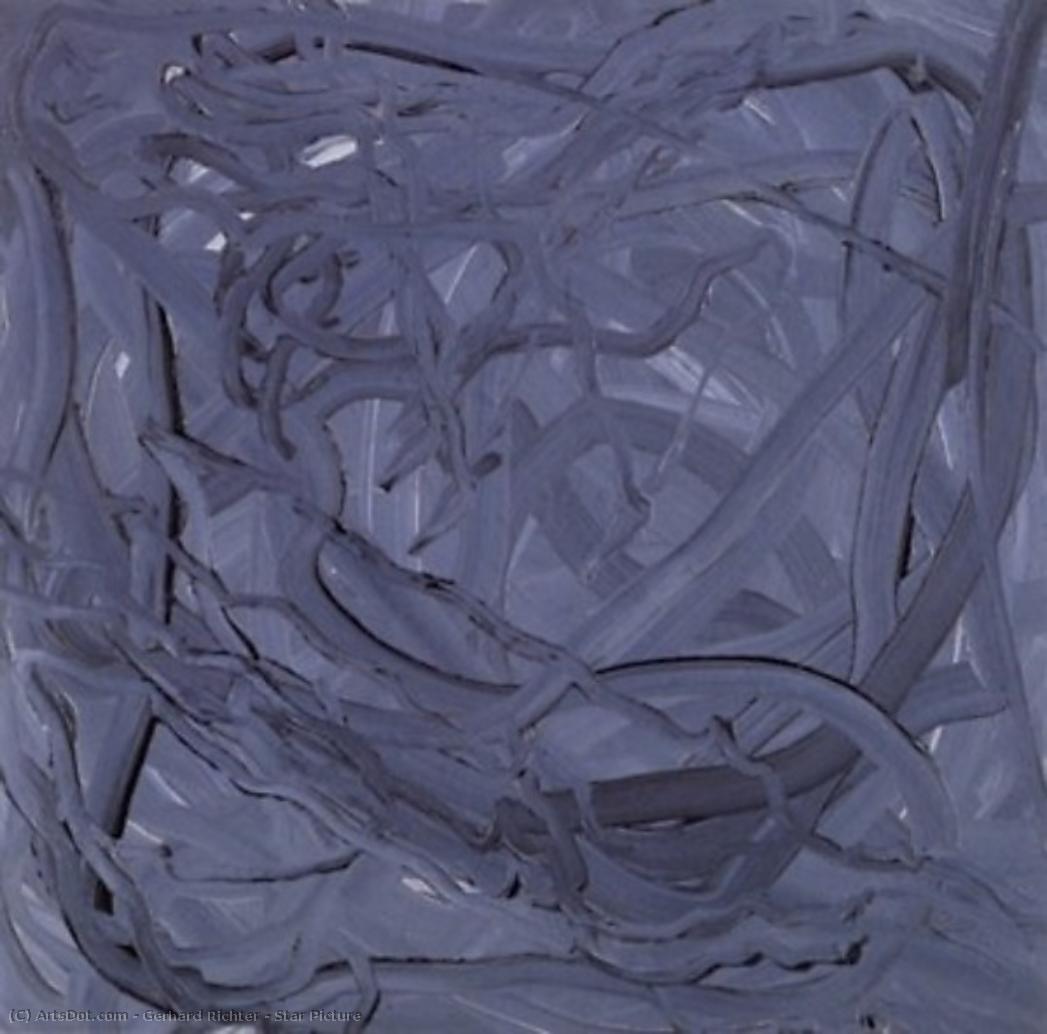
Gerhard Richter's ‘Star Picture,’ created in 1969, is not an invitation to gaze upon the cosmos with romantic wonder, but rather a compelling confrontation with its unknowable vastness. This abstract oil on canvas, measuring 70 x 70 cm, exists as a dense field of blues and greys, a chaotic interplay of lines and forms that resists easy interpretation. It’s a work born from a pivotal moment in history – the year humanity first set foot on the moon – yet it doesn't celebrate triumph or discovery. Instead, ‘Star Picture’ feels like an attempt to grapple with the unsettling implications of expanding our horizons, a visual echo of the anxieties and uncertainties that accompanied such monumental leaps forward.
The Technique of Uncertainty
Richter’s approach in ‘Star Picture’ is deeply rooted in his exploration of perception and representation. He wasn't striving for photorealistic depiction; rather, he employed a technique that deliberately obscures clarity. The painting appears to be built up through layers of paint, mimicking the texture of brushstrokes yet lacking their inherent expressiveness. This creates a tactile quality, an invitation to run your eyes across the surface, but simultaneously denies any comfortable sense of resolution. Diagonal lines dominate the composition, generating a feeling of movement and instability, as if the very fabric of space is in flux. The even lighting further contributes to this ambiguity; there are no dramatic highlights or shadows to guide the eye, only a pervasive, atmospheric haze. It’s a masterful demonstration of how abstraction can convey not emptiness, but an overwhelming sense of information – too much data for the mind to process.
Historical Echoes and Artistic Lineage
To understand ‘Star Picture,’ it's crucial to consider Richter’s biography and the artistic climate of post-war Germany. Born in 1932, he experienced firsthand the trauma of displacement and political upheaval. This history profoundly shaped his artistic vision, leading him to question established norms and explore the limitations of representation. While early influences like Picasso and Arp are discernible in his abstract compositions, Richter quickly forged his own path. The late 1960s saw him experimenting with ‘photo-paintings,’ works based on photographs that he then blurred and distorted. ‘Star Picture’ can be seen as an extension of this exploration – a photograph of the cosmos rendered not as a clear image, but as a fragmented memory or a half-forgotten dream. The ZERO group, with their focus on light and space, also provided a crucial context for Richter's work, though he maintained a critical distance from their utopian ideals.
An Emotional Landscape
‘Star Picture’ is not a comforting artwork. It evokes a sense of unease, even disorientation. The density of the composition, the lack of clear focal points, and the muted color palette all contribute to this feeling. Yet, within this chaos lies a strange beauty – a testament to Richter's ability to transform abstract forms into emotionally resonant experiences. The painting doesn’t offer answers; it poses questions about our place in the universe, the nature of perception, and the limits of human understanding. It is a work that demands contemplation, inviting viewers to project their own anxieties and aspirations onto its enigmatic surface. For those seeking an artwork that transcends mere decoration and instead sparks dialogue and introspection, ‘Star Picture’ offers a profound and enduring resonance.
Біографія митця
A Life Shaped by Division: The Early Years and Artistic Formation of Gerhard Richter
Gerhard Richter’s story is inextricably linked to the fractured history of 20th-century Germany. Born in Dresden in 1932, his childhood unfolded under the shadow of a rising National Socialist regime. This formative period, marked by displacement – his family moved several times during the war years – instilled within him a profound sense of uncertainty and a questioning spirit that would permeate his artistic practice for decades to come. The idyllic landscapes of his early upbringing in Reichenau and Waltersdorf were soon disrupted by conflict, leaving an indelible mark on his psyche. His father, though not a fervent supporter of the Nazi party, navigated the complexities of life under authoritarian rule as a schoolteacher, while his mother fostered a love for literature and music within the family. This duality – a pragmatic acceptance of circumstance alongside a yearning for cultural expression – became a defining characteristic of Richter’s own artistic approach. He began formal training at the Dresden Academy of Fine Arts in 1951, initially immersed in the tradition of socialist realism demanded by the East German state. However, even within this constrained environment, a desire for artistic freedom simmered beneath the surface, fueled by a growing dissatisfaction with ideological constraints and a longing to explore more expansive creative possibilities.Escaping Constraints: Düsseldorf and the Exploration of Style
The year 1961 proved pivotal. Richter, along with his wife Marianne Eufinger, made the daring decision to flee East Germany, seeking refuge in the burgeoning art scene of Düsseldorf. This move marked a radical shift in his artistic trajectory. The West German landscape offered a liberating environment where experimentation and innovation were not only permitted but actively encouraged. In Düsseldorf, he encountered a vibrant community of artists grappling with questions of identity, representation, and the legacy of history. He quickly began to dismantle the rigid stylistic conventions of socialist realism, embarking on a period of intense exploration that would define his early mature work. This era saw him oscillate between seemingly disparate approaches – from photorealism, meticulously recreating photographic images with astonishing precision, to abstract compositions characterized by bold colors and dynamic brushstrokes. His collaboration with Sigmar Polke led to the coining of the term ‘Capitalist Realism,’ a deliberately ambiguous label that reflected their shared skepticism towards established artistic norms and their appropriation of imagery from advertising and mass media. This period wasn’t about finding *a* style, but rather questioning the very notion of stylistic coherence, embracing contradiction as a fundamental principle.Blurring Boundaries: Photorealism, Abstraction, and the Power of Chance
Richter's artistic vocabulary expanded throughout the 1960s and beyond, encompassing a remarkable range of techniques and themes. His photorealistic paintings, often based on family photographs or newspaper images, are not merely copies of reality but rather investigations into the nature of perception and representation. By meticulously rendering these images with an almost clinical detachment, he forces viewers to confront the inherent ambiguity of photographic truth. Simultaneously, Richter delved deeper into abstraction, creating canvases layered with vibrant colors and gestural marks. These abstract works are often created using a unique technique involving squeegees – tools typically used for cleaning windows – which he drags across the surface of the canvas, manipulating the paint in unpredictable ways. This embrace of chance and spontaneity is central to his artistic philosophy, allowing him to relinquish control and invite unexpected outcomes. His ‘Color Charts,’ systematic arrangements of colored squares, further challenge traditional notions of artistic expression, questioning the very definition of painting itself. These works are not about individual aesthetic preferences but rather about exploring the inherent properties of color and its organizational possibilities.The Weight of History: From Dresden to Berlin
Richter’s early life was profoundly shaped by the tumultuous events of mid-20th century Germany. Growing up in Dresden, a city repeatedly devastated during World War II, instilled within him a deep awareness of loss and destruction. The constant rebuilding efforts, the displacement of families, and the pervasive atmosphere of uncertainty left an enduring mark on his psyche. His father’s experience as a teacher under the Nazi regime – navigating a complex and often oppressive system – further contributed to Richter's critical perspective on authority and ideology. This historical context is subtly woven into many of his works, particularly those exploring themes of memory, identity, and the relationship between art and history. The destruction of Dresden in 1945 served as a powerful catalyst for artistic exploration, prompting Richter to grapple with questions about representation, truth, and the impossibility of fully capturing reality on canvas. Later, after moving to West Germany, he continued to confront these themes through his engagement with photographic imagery, often juxtaposing images of destruction with scenes of everyday life.A Legacy of Innovation: Influence and Recognition
Gerhard Richter’s impact on contemporary art is undeniable. His willingness to challenge conventions, his relentless experimentation with technique, and his profound engagement with historical and political themes have established him as one of the most important artists of our time. He has consistently resisted easy categorization, defying attempts to pigeonhole his work into a single stylistic framework. This refusal to be defined, coupled with his technical virtuosity and intellectual rigor, has earned him widespread critical acclaim and commercial success – his paintings regularly fetch record prices at auction. Beyond the market value, however, lies a deeper significance. Richter’s art speaks to the complexities of modern existence, grappling with issues of memory, identity, and the search for meaning in a fragmented world. He doesn't offer answers but rather poses questions, prompting viewers to confront their own preconceptions and engage in critical dialogue. His influence can be seen in the work of countless artists who have followed in his footsteps, drawn to his innovative techniques and his unwavering commitment to artistic exploration. Richter’s legacy is not simply about creating beautiful objects; it's about expanding the possibilities of painting itself. He remains a vital force in contemporary art, continuing to inspire and provoke audiences with his challenging and deeply resonant work.
Герхард Ріхтер
1932 - , Німеччина
Короткі факти
- Artistic Movement Or Style:
- Фотореалізм
- Абстракція
- Капіталіст реалізм
- Artists Or Movements Influenced By This Artist: ['Сучасні художники']
- Artists Who Influenced This Artist:
- Пабло Пікассо
- Сіґмар Полке
- Date Of Birth: 9 лютого 1932
- Full Name: Gerhard Richter
- Nationality: Німецький
- Notable Artworks:
- Абстрактне зображення 610-1
- Gilbert
- S. з дитиною
- Жовтень 18, 1977
- Place Of Birth: Дрезден, Німеччина
Пов'язані статті

Ефемерні виміри світла: Трансформація сучасної абстрактної живопису під впливом освітлення
Дослідіть трансформацію сучасної абстрактної живопису під впливом освітлення. Експертний аналіз, інноваційні техніки та поради для колекціонерів і поціновувачів мистецтва. Відкрийте нові виміри сприйняття!
Топ-10 шедеврів експресіонізму: мистецтво емоцій та самовираження від OriginalUniqueArt
Пориньте у світ експресіонізму! Відкрийте 10 шедеврів Мунка, Ван Гога та інших геніїв. Історія мистецтва, емоції та кольори – все це на OriginalUniqueArt.com. Репродукції картин преміум-якості для вашого дому.

10 шедеврів німецького експресіонізму, що змінили мистецтво | OriginalUniqueArt
Пориньте у світ німецького експресіонізму! 10 шедеврів від Кандинського, Кірхнера та інших – історія творчості, емоцій та кольорів. Купуйте репродукції картин на OriginalUniqueArt.com та створіть неповторний інтер'єр.

Gerhard Richter: A Retrospective on Abstraction, Memory & the Photographic Source
Explore the profound world of Gerhard Richter's abstract paintings. Discover his techniques, influences, and lasting impact on contemporary art – a guide for discerning collectors.

Топ-10 знаменитих картин у відтінках сіро-блакитного: мистецтво для вашого дому
Пориньте у світ сіро-блакитного кольору! Від Моне до Ренуара – топ-10 знаменитих картин, що зачаровують глибиною відтінків. Історія мистецтва, техніки та натхнення для вашого дому. Знайдіть репродукцію мрії на OriginalUniqueArt.com!