
 Переглянути в інтер'єрі
 Надіслати
 Поділитися
 Деталі

 Завантажити
 Схожі експонати
 Рентгенівське дослідження
 Слайд-шоу
Joseph the Carpenter


 Читати далі
Гікле / Художній принт
Музейна якість друку جيкле або на полотні з оперативним виготовленням та різноманітними варіантами фінішної обробки. ( Перейти до замовлення ручного розпису Перейти до зображення)




P118B $10

P118H $10

P118W $10

P438Z $10

P508JH $12

P508YH $12

P805H $10

P805Z $10

P919BZ $10

P919G $10

P919XJ $10

P959ZH $10

P968JZ $12

W106C $8

W218G $10

W218JH $8

W218Y $10

W307PJ $10

W316G $10

W316PJ $8

W316Y $10

W398PJ $8

W4111J $10

W500HY $15

W500JH $15

W692G $12

W849H $8

W940BG $15

W953PJ $8




Обирайте з наших стандартних розмірів, що відповідають оригінальним пропорціям твору мистецтва.

Ви можете вказати власні розміри, щоб репродукція ідеально підійшла до конкретної рами або інтер'єру. Якщо обраний вами розмір не відповідає пропорціям оригіналу, ми або обріжемо полотно, або розширимо зображення за допомогою дзеркального відображення чи суцільної заливки країв. Перед початком виробництва вам буде надіслано цифровий макет для затвердження.
Будь ласка, зверніть увагу, що попередній перегляд на екрані не відображає фактичне обрізання або розширення. Тільки макет точно покаже фінальну композицію.
Хоча можливість замовлення індивідуальних розмірів доступна, ми рекомендуємо обирати формат із попередньо визначеного списку, щоб зберегти оригінальні пропорції.
Доставка по всьому світу () за 2 тижні замість стандартних 4/5 тижнів. (7 Серпень)

Безкоштовна експрес-доставка по всьому світу

Високоякісне лляне полотно

Повне страхове покриття доставки

Гарантія відшкодування митних зборів

Гарантія точного відтворення кольорів

Політика повернення протягом 60 днів (лише у разі виявлення дефектів)

Гарантія повернення 100% коштів

Знижка на оптові замовлення
 Скляний варіант доступний лише для розмірів до 110 см

Joseph the Carpenter
Гікле / Художній принт
Розмір репродукції
-


Загальна вартість
$ 80
Опис колекційного експоната
A Quiet Moment of Divine Foreshadowing
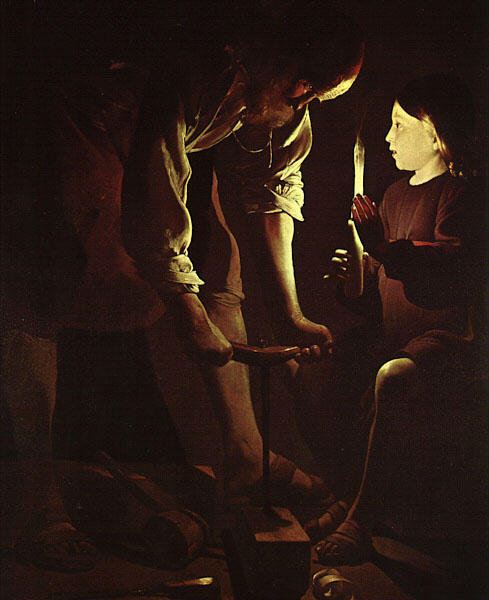
Joseph the Carpenter by Georges de La Tour is a profoundly moving depiction of domestic tranquility imbued with subtle religious symbolism. Created around 1642, this oil painting offers a glimpse into the humble workshop of Saint Joseph, presenting a tender scene of mentorship and foreshadowing. The composition centers on Joseph diligently working as a carpenter, while the young Jesus attentively holds a candle, illuminating his earthly father’s task.Masterful Tenebrism & Baroque Style
De La Tour was a leading figure in French Baroque painting, deeply influenced by Caravaggio's dramatic use of light and shadow – a technique known as *tenebrism*. This is powerfully evident here. The scene unfolds within a darkened space, with a single candle providing the primary source of illumination. This stark contrast isn’t merely stylistic; it directs our gaze to the key elements: Joseph’s focused labor, Jesus's gentle offering, and the tools of the trade.- Style: Baroque, Tenebrism
- Technique: Oil on canvas with meticulous layering (glazes) to achieve luminous effects despite the darkness.
- Composition: Intimate and focused, drawing the viewer into a quiet, personal moment.
Symbolism Woven in Wood & Light
Beyond its surface beauty, the painting is rich with symbolic meaning. The auger Joseph uses to drill wood subtly echoes the shape of the cross – a poignant prefiguration of Christ’s crucifixion. The arrangement of the wood itself, laid across the floor, further reinforces this foreshadowing. Jesus holding the candle isn't simply an act of assistance; it represents him as the “Light of the World,” a central tenet of Christian belief. His raised hand can be interpreted as a gesture of blessing or benediction.- The Auger: Symbolizes Christ’s future sacrifice on the cross.
- Candlelight: Represents Jesus as the “Light of the World.”
- Jesus' Gesture: Signifies blessing, acceptance of his destiny, and divine grace.
Historical Context & Artistic Legacy
Georges de La Tour (1593-1652) lived during a period of religious revival in Lorraine. His work reflects this piety, moving increasingly towards purely religious subjects throughout his career. He was appointed “Painter to the King” in 1638, demonstrating his rising status and influence. Interestingly, La Tour’s work fell into relative obscurity after his death, only being rediscovered in the early 20th century. His masterful use of light and shadow continues to inspire artists today.Emotional Resonance & Interior Appeal
Joseph the Carpenter evokes a sense of quiet contemplation, humility, and familial love. The painting’s subdued palette and intimate scale create an atmosphere of serenity and reverence. Its dramatic lighting and compelling narrative make it a captivating focal point for any space. This artwork would be particularly well-suited to interiors seeking a touch of Old World elegance, spiritual depth, or a sophisticated artistic statement. A high-quality reproduction captures the nuances of La Tour’s technique, bringing this timeless masterpiece into your home.Біографія митця
A Life Bathed in Shadow: The Enigmatic World of Georges de La Tour
Georges de La Tour, a name that resonates with the hushed reverence reserved for masters of light and shadow, remains one of the most compelling figures of the French Baroque. Born in 1593 in Vic-sur-Seille, a small town nestled within the Duchy of Lorraine, his life unfolded against a backdrop of religious fervor and political upheaval. While details surrounding his early training remain somewhat elusive—scholars speculate about potential journeys to Italy or apprenticeships with local artists like Jacques Bellange—the seeds of his artistic vision were undoubtedly sown in this environment. He wasn’t born into an artistically established family; his father was a baker, yet the circumstances of his mother's lineage hint at a possible connection to nobility, a subtle influence perhaps reflected in the dignity and quiet grace that permeate his work. In 1617 he married Diane Le Nerf, establishing a stable home life in Lunéville, where he would spend much of his career serving both the French court and the Dukes of Lorraine. This dual patronage allowed him to flourish, yet it was within the intimate confines of domestic scenes and religious contemplation that his true genius found expression.The Dance of Light and Darkness: Artistic Influences and Development
De La Tour’s artistic journey wasn't one of radical innovation but rather a masterful synthesis of existing influences, transformed through the lens of his unique sensibility. The dramatic chiaroscuro—the stark contrast between light and dark—that defines his paintings owes an undeniable debt to Caravaggio, the Italian master who revolutionized painting with his intensely realistic and emotionally charged scenes. However, De La Tour didn’t simply imitate; he filtered Caravaggism through the prism of Dutch Caravaggisti, particularly those from the Utrecht School like Hendrick Terbrugghen. This fusion resulted in a style that was both powerful and restrained, characterized by a muted palette dominated by earth tones and subtle gradations of light. His early works, predating 1630, exhibit a greater vibrancy and dynamism, reflecting the influence of the Utrecht school. But as his career progressed, he moved towards an increasingly introspective and minimalist aesthetic. He began to pare down compositions, focusing on essential forms and reducing extraneous details, creating scenes that felt both timeless and deeply personal. This evolution wasn’t merely technical; it was a reflection of his growing spiritual depth and his desire to convey profound emotional truths through the simplest of means.Candlelight and Contemplation: Major Works and Recurring Themes
The hallmark of De La Tour's oeuvre is undoubtedly his masterful use of candlelight, which he employed not merely as a source of illumination but as a metaphor for divine grace and spiritual awakening. His paintings are often set at night, with figures bathed in the warm, flickering glow of a single candle or lamp. This creates an atmosphere of intimacy and quiet contemplation, drawing the viewer into the scene and inviting them to share in the emotional experience of the subjects. The Fortune-Teller, painted around 1630, exemplifies this early style—a lively genre scene rendered with sharp observation and dramatic lighting. But it is his later religious works that truly showcase his genius. Adoration of the Shepherds, created around 1640, demonstrates his ability to imbue a traditional subject with profound emotional resonance. The figures are not idealized or heroic; they are ordinary people, humbled by the presence of the divine. The Tears of Saint Peter, painted in the 1650s, is a particularly poignant example of his psychological insight—the apostle’s grief rendered with heartbreaking subtlety and realism. Saint Joseph the Carpenter, another iconic work, depicts a serene domestic scene, highlighting De La Tour's mastery of capturing the quiet dignity of everyday life. These paintings aren’t simply depictions of religious events; they are meditations on faith, doubt, and the human condition.A Rediscovered Legacy: Historical Significance and Enduring Appeal
Despite achieving recognition during his lifetime—he was appointed “Painter to the King” by Louis XIII in 1638—De La Tour’s work fell into relative obscurity after his death in 1652. For centuries, many of his paintings were misattributed to other artists, and his name faded from art historical memory. It wasn't until the early 20th century that a concerted effort was made to rediscover and re-evaluate his oeuvre, led by scholars like Hermann Voss. This rediscovery revealed an artist of extraordinary originality and depth, whose work bridged the gap between Caravaggism and French Classicism. De La Tour’s innovative use of light and shadow, combined with his psychological insight into his subjects, continues to captivate audiences today. His paintings offer a glimpse into 17th-century life and spirituality, reflecting both the religious fervor and the social realities of his time. *He remains celebrated for his ability to imbue everyday scenes with profound meaning and emotional depth*, reminding us that even in the darkest of times, there is always hope to be found in the flickering light of faith and human connection. His influence can be seen in later artists who explored similar themes of introspection and spiritual longing, solidifying his place as a pivotal figure in the history of European art.
Жорж де Латур
1593 - 1652 , Франція
Досьє митця
- Artistic Movement Or Style: Бароко, Тенебризм
- Artists Or Movements Influenced By This Artist: ['Французький класицизм']
- Artists Who Influenced This Artist:
- Караваджо
- Гендрик Тербрюгген
- Date Of Birth: 13 березня 1593
- Date Of Death: 30 січня 1652
- Full Name: Georges de La Tour
- Nationality: Француз
- Notable Artworks:
- Пророка Захарія
- Святий Іоанн Хреститель
- Покрова Богоматері
- Place Of Birth: Вік-ле-Комте, Франція
Схожі статті

Shadows of Drama: Exploring the Artistic Power & Historical Context of Tenebrism
Explore the captivating world of tenebrism! Discover Caravaggio's revolutionary techniques, its spread across Europe, & lasting influence on Baroque art. A comprehensive guide for art enthusiasts.
Baroque Realism: Illusion, Emotion & the Dramatic Transformation of 17th-Century Art
Explore the dramatic world of Baroque Realism! Discover iconic artists like Caravaggio & Rubens, their techniques, and the movement's lasting impact on art history. Expert insights for collectors & enthusiasts.
Chiaroscuro & Emotional Resonance: Exploring Dramatic Light in Western Painting
Explore the captivating world of chiaroscuro & tenebrism! Discover Caravaggio's influence, Baroque masters, and the enduring power of dramatic lighting in art history. Learn about these techniques with OriginalUniqueArt.
Baroque Classicism: Reconciling Drama & Order in 17th-Century Art
Explore the captivating world of Baroque Classicism! Discover its history, key artists like Caravaggio & Rubens, and defining characteristics. Expert insights & high-quality reproductions at OriginalUniqueArt.

Maurice Quentin de La Tour: Light, Shadow & the Rococo Portrait
Explore the captivating world of Maurice Quentin de La Tour, a master of Rococo portraiture. Discover his innovative pastel techniques, intimate depictions of French aristocracy, and lasting artistic legacy. Learn more at OriginalUniqueArt.



