
 Переглянути в інтер'єрі
 Надіслати як листівку
 Поділитися
 Деталі витвору
 Посібник

 Завантажити
 Схожі екземпляри
 Рентгенівське дослідження
 Слайд-шоу
 Питання та відповіді
 Статистика
Landscape

- 15.0 x 33.0 cm

 Розгорнути текст
Гікле / Художній принт
Друк جيкле або на полотні музейної якості з оперативним виготовленням та різноманітними варіантами фінішної обробки. ( Замовити картину ручної роботи Перейти до цифрових зображень)




































Обирайте з наших стандартних розмірів, що відповідають оригінальним пропорціям твору мистецтва.

Введіть необхідну ширину та висоту, щоб принт ідеально підійшов до вашої рами або стіни. Принт можна лише обрізати, але не можна зробити більшим за оригінал, тому при зміні пропорцій частина зображення буде втрачена. Перед друком ми надсилаємо вам цифровий макет для затвердження. Зображення на цій сторінці не відображає реальну обрізку — її можна побачити лише на макеті.
Доставка по всьому світу () за 2 тижні замість стандартних 4/5 тижнів. (10 Листопад)

Безкоштовна експрес-доставка по всьому світу

Високоякісне лляне полотно

Повне страхове покриття доставки

Гарантія повернення митних зборів

Гарантія точного відтворення кольорів

Політика повернення протягом 100 днів (лише у разі виявлення дефектів)

Гарантія повернення 100% коштів

Пропозиція на оптові замовлення
 Скляний варіант доступний лише для розмірів до 110 см

Landscape
Гікле / Художній принт
Розмір репродукції
-


Підсумкова вартість
₴ 3642
Біографія митця
The Poetic Vision of George Arnald
In the grand tapestry of British Romanticism, where the dramatic skies of Turner and the pastoral sincerity of Constable often command the spotlight, the name George Arnald (1763–1841) whispers of a more intimate, yet equally profound, connection to the landscape. A painter of remarkable sensitivity, Arnald possessed the rare ability to transform topographical accuracy into emotive storytelling. His journey from the humble beginnings of a domestic servant to an established figure within the Royal Academy is a testament to a raw, burgeoning talent that sought to capture not just the physical contours of the earth, but the very spirit of the places he depicted.
Though the precise details of his early years remain shrouded in the mists of history—with accounts placing his birth anywhere from Northamptonshire to Berkshire—his artistic evolution was shaped by the rigorous guidance of William Pether. Under Pether’s tutelage, Arnald mastered the art of the landscape and engraving, learning to balance meticulous observation with a poetic sensibility. This training allowed him to contribute significantly to the illustrated county histories of his era, providing topographical views that were as much about atmosphere as they were about geography.
A Legacy of Light and History
Arnald’s oeuvre is characterized by a remarkable versatility, ranging from the quiet, sun-drenched ruins of Scotland to the thunderous, salt-sprayed chaos of naval warfare. His work often reflects a deep engagement with the Romantic ideal—the belief that art should stir the soul through the sublime and the beautiful. One might find himself lost in the serene sunset of Ruins of Rosslyn Castle, where the decay of stone meets the eternal glow of twilight, or transported to the rugged Yorkshire countryside in his depiction of Loading a Timber Wagon in the Park of Cave Castle, where dramatic skies hint at the untamed power of nature.
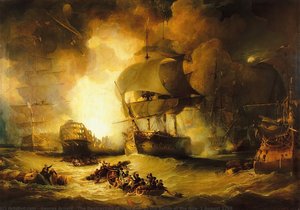
However, it was perhaps his departure from the purely pastoral that secured his place in the annals of maritime history. His most celebrated and monumental achievement, The Destruction of L'Orient at the Battle of the Nile, stands as a breathtaking masterwork of historical drama. Commissioned as part of a prestigious competition for the Greenwich Hospital, this painting captures the catastrophic moment of a naval titan’s demise. In this work, Arnald transcends mere documentation, utilizing light and shadow to evoke the terror and heroism inherent in Britain's maritime triumphs.
The Critic's Eye and Artistic Standing
Despite his prolific output—exhibiting an astounding 176 works at the Royal Academy throughout his career—Arnald’s ascent was marked by a certain bittersweet complexity. While he achieved the status of an Associate Member of the Royal Academy in 1810, he never reached the pinnacle of full fellowship. This lack of ultimate institutional acclaim famously drew the poignant commentary of the poet William Wordsworth. Wordsworth, reflecting on the Romantic necessity of intellectual depth, lamented that Arnald’s genius might have been even more profound had it been paired with a stronger literary foundation, suggesting that a true mastery of landscape requires a "tincture of the Poetic Spirit."
Yet, to judge Arnald solely through the lens of institutional rank is to miss the enduring magic of his brushwork. His significance lies in his ability to bridge the gap between the precise topographical record and the emotive power of the Romantic movement. Through his eyes, we see a Britain defined by both its historical struggles and its quiet, pastoral grace, ensuring that his contribution to the British artistic canon remains as vital and evocative as the landscapes he so lovingly rendered.
George Arnald
1763 - 1841
Короткі факти
- Artistic Movement Or Style: Romantic Landscape
- Artists Or Movements Influenced By This Artist: ['Thomas Davidson']
- Artists Who Influenced This Artist: ['William Pether']
- Date Of Birth: 1763
- Date Of Death: 1841
- Full Name: George Arnald
- Nationality: British
- Notable Artworks: ['Battle of the Nile']
- Place Of Birth: Northamptonshire (Bedfordshire)
Пов'язані статті

Mastering the English Landscape: The Top 25 John Constable Artworks
Immerse yourself in the soulful landscapes of John Constable. Explore our curated list of 25 iconic masterpieces, from atmospheric skies to the beauty of Dedham Vale. Find inspiration for museum-quality art reproductions and decor. Discover all masterpieces on OriginalUniqueArt.com.

Топ-25 шедеврів Джона Констебла: пейзажі Англії для вашого дому | OriginalUniqueArt
Відкрийте для себе 25 найкращих шедеврів Джона Констебла! Англійські пейзажі, романтизм та емоційне світло в живописі. Репродукції картин високої якості для вашого дому від OriginalUniqueArt.com. Дослідіть повну колекцію онлайн!

Mastering the English Landscape: The Top 25 Artworks by John Constable
Immerse yourself in the soul of the English countryside with our curated guide to John Constable's top 25 masterpieces. Explore the emotive landscapes and Romanticism techniques that define his legacy. Find museum-quality art reproductions at OriginalUniqueArt.com. Discover all masterpieces online.

Mastering the English Landscape: The 25 Best Artworks by John Constable
Immerse yourself in the soul of the English countryside with our curated guide to John Constable's top 25 masterpieces. Explore the emotive landscapes and romantic techniques that defined an era. Find museum-quality art reproductions for your home. Discover all masterpieces on OriginalUniqueArt.com.

Mastering the English Landscape: The Top 25 John Constable Artworks
Immerse yourself in the soul of the English countryside with our curated guide to the top 25 John Constable artworks. Explore the emotive landscapes and Romanticism mastery behind these timeless classics. Find museum-quality reproductions for your decor at OriginalUniqueArt.com.