

 Переглянути в інтер'єрі
 Надіслати як листівку
 Поділитися
 Деталі витвору
 Посібник

 Завантажити
 Схожі екземпляри
 Рентгенівське дослідження
 Слайд-шоу
 Q&A
Q&A Статистика
Feeding The Rabbits

 Розгорнути текст
Гікле / Художній принт
Друк جيкле або на полотні музейної якості з оперативним виготовленням та різноманітними варіантами фінішної обробки. ( Замовити картину ручної роботи Перейти до цифрових зображень)




P118B ₴10

P118H ₴10

P118W ₴10

P438Z ₴10

P508JH ₴12

P508YH ₴12

P805H ₴10

P805Z ₴10

P919BZ ₴10

P919G ₴10

P919XJ ₴10

P959ZH ₴10

P968JZ ₴12

W106C ₴8

W218G ₴10

W218JH ₴8

W218Y ₴10

W307PJ ₴10

W316G ₴10

W316PJ ₴8

W316Y ₴10

W398PJ ₴8

W4111J ₴10

W500HY ₴15

W500JH ₴15

W692G ₴12

W849H ₴8

W940BG ₴15

W953PJ ₴8




Обирайте з наших стандартних розмірів, що відповідають оригінальним пропорціям твору мистецтва.

Введіть необхідну ширину та висоту, щоб принт ідеально підійшов до вашої рами або стіни. Принт можна лише обрізати, але не можна зробити більшим за оригінал, тому при зміні пропорцій частина зображення буде втрачена. Перед друком ми надсилаємо вам цифровий макет для затвердження. Зображення на цій сторінці не відображає реальну обрізку — її можна побачити лише на макеті.
Доставка по всьому світу () за 2 тижні замість стандартних 4/5 тижнів. (29 Жовтень)

Безкоштовна експрес-доставка по всьому світу

Високоякісне лляне полотно

Повне страхове покриття доставки

Гарантія повернення митних зборів

Гарантія точного відтворення кольорів

Політика повернення протягом 100 днів (лише у разі виявлення дефектів)

Гарантія повернення 100% коштів

Пропозиція на оптові замовлення
 Скляний варіант доступний лише для розмірів до 110 см

Feeding The Rabbits
Гікле / Художній принт
Розмір репродукції
-


Підсумкова вартість
₴ 3579
Біографія митця
Early Life and Artistic Foundations
Felix Schlesinger, born in the bustling port city of Hamburg, Germany, on October 9, 1833, emerged from a family steeped in artistic tradition. This familial inclination proved pivotal to his development as a painter, setting him on a path that would ultimately capture the tender essence of childhood and domestic life with remarkable sensitivity. His formal training commenced in 1848 under the guidance of Friedrich Heimerdinger at Hamburg’s newly established Preparatory School for Artists. Heimerdinger, himself a product of the prestigious Kunstakademie Düsseldorf, instilled in Schlesinger a foundational understanding of artistic principles rooted in historical genre painting. This early exposure would shape his initial approach to composition and narrative. Schlesinger's pursuit of knowledge didn’t end there; he continued his education at the Düsseldorf Art Academy itself, further refining his skills under Rudolf Jordan, an artist known for depicting moral and comic scenes. A subsequent period in Antwerp with Ferdinandus de Braekeler, a specialist in humorous genre painting, broadened his artistic palette and introduced him to a lighter, more playful sensibility. However, it was his time in Paris during the mid-1850s that proved particularly transformative.A Parisian Interlude and Evolving Style
Paris in the 1850s was a crucible of artistic innovation, witnessing the rise of Realism and a renewed appreciation for Dutch masters. The controversial works exhibited at the Salon – Gustave Courbet’s *The Stonebreakers* and *Burial at Ornans*, for example – challenged conventional norms and sparked intense debate. This environment undoubtedly influenced Schlesinger, prompting him to move away from purely narrative approaches towards a more grounded, realistic depiction of everyday life. He studied with Eugène Isabey, an artist successful in historical genre painting and marine subjects, further solidifying his aesthetic direction. While in Paris, Schlesinger began to focus on genre scenes, but it was after relocating to Munich in 1861 that he truly found his voice. Initially settling briefly in Frankfurt, the move to Munich proved decisive. He established himself as a respected genre painter, regularly exhibiting his work in major artistic centers like Dresden and Vienna alongside Berlin.The Mature Style: Childhood, Family, and Domesticity
Schlesinger’s mature style is characterized by charming scenes of family life and children engaged in idyllic pursuits. His paintings evoke a sense of warmth, nostalgia, and quiet contentment. He became particularly adept at capturing the innocence and joy of childhood, often depicting children playing, interacting with animals, or simply enjoying the simple pleasures of rural existence. Realistic brushwork, muted tones, and intimate compositions are hallmarks of his technique. While early works retained a narrative quality reminiscent of his teachers, his style gradually evolved towards greater naturalism and expressiveness. It is believed that Schlesinger married in the 1860s and used his own children as models for many of his paintings; the same faces appear at different ages throughout his oeuvre, offering a poignant glimpse into his personal life.Recognition and Lasting Legacy
Schlesinger’s work resonated with collectors across Europe and particularly in the United States, where his paintings found their way into numerous private collections. His ability to capture universal themes of family love, childhood innocence, and domestic harmony appealed to a broad audience.- His humorous and sensitive depictions of everyday life were highly sought after.
- Paintings like *Children Playing with a Guitar* and *Feeding the Rabbits* exemplify his ability to evoke nostalgia and warmth.
- *Besuch beim* (Visit) offers a more poignant glimpse into familial hardship, demonstrating his range as an artist.

Felix Schlesinger
1833 - 1910 , Germany
Короткі факти
- Full Name: Felix Schlesinger
- Nationality: German
- Date Of Birth: 1833
- Date Of Death: 1910
- Place Of Birth: Hamburg, Germany
- Notable Artworks:
- Children Playing with a Guitar
- Besuch beim (Visit)
- Feeding The Rabbits
- Artistic Movement Or Style: Romanticism, Realism
- Artists Who Influenced This Artist:
- Friedrich Heimerdinger
- Rudolf Jordan
- Eugène Isabey
Пов'язані статті
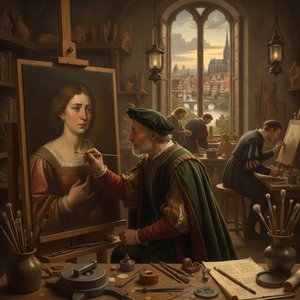
The Northern Awakening: Artistic Innovation & Cultural Transformation in the German Renaissance
Explore the artistic innovation of the German Renaissance! Discover Dürer, the Danube School & Reformation art. Learn about techniques, materials & lasting influence. Find museum-quality reproductions at OriginalUniqueArt.

Unmasking Emotion: A Journey Through the Raw Power and Visceral Beauty of German Expressionism
Explore the raw emotional power of German Expressionism. From Kirchner to Die Brücke, discover how artists used distortion and vibrant color to unmask the human psyche. A deep dive into art history for the discerning collector and enthusiast.
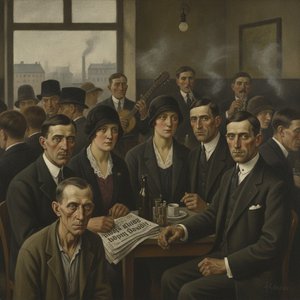
Neue Sachlichkeit: The Unflinching Realism and Social Critique of German New Objectivity
Explore the raw realism of Neue Sachlichkeit. Discover how German New Objectivity artists like Otto Dix and George Grosz captured the turbulent Weimar Republic through unflinching social critique and precise detail. A definitive guide for art historians and collectors.

10 шедеврів німецького експресіонізму, що змінили мистецтво | OriginalUniqueArt
Пориньте у світ німецького експресіонізму! 10 шедеврів від Кандинського, Кірхнера та інших – історія творчості, емоцій та кольорів. Купуйте репродукції картин на OriginalUniqueArt.com та створіть неповторний інтер'єр.

Anton von Werner: Imperial Painter, Historical Witness & Shifting German Identity
Explore the life & work of Anton von Werner, Imperial Germany's leading painter. Discover his dramatic depictions of war, unification, and court life – a fascinating insight into 19th-century German history & art.