Перейти до друку
 Розгорнути текст







































 Для творів мистецтва або репродукцій, розмір яких перевищує 105 см (приблизно 41 дюйм) з будь-якого боку, рама доставляється у вигляді розібраного комплекту. Такий метод гарантує безпечну доставку та запобігає пошкодженням під час транспортування.


Identification of Frosty Sunrise by Elioth Gruner
We are looking at Frosty Sunrise, a work created by Elioth Gruner in 1917. This piece is an oil on canvas on wood, a medium that allows for a certain weight and presence in the way the light is captured. Gruner, who lived from 1882 to 1939, possessed a specific way of observing the landscape that is quite evident here.
The painting captures a quiet moment in the rural landscape. It is a significant example of his ability to translate the atmosphere of a specific time of day into a tangible scene. Through his careful application of oil, Gruner manages to fix a fleeting morning light onto the surface of the wood.
Composition and Visual Elements of the Scene
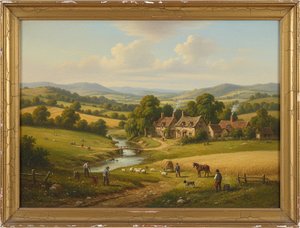
The composition centers on a quiet moment of movement within a vast, open field. A man, wearing a hat, rides a horse through the landscape as the sun begins its ascent. In the distance, another horse remains stationary, adding a sense of stillness to the unfolding morning. This arrangement creates a natural rhythm across the canvas, guiding the eye from the immediate activity in the foreground toward the quietude of the background.
Texture and depth are achieved through the careful placement of natural elements. Trees and bushes are scattered throughout the field, breaking up the expanse of the terrain and providing a sense of scale. These details, combined with the interplay of light from the rising sun, lend a tangible quality to the environment. The light casts a soft glow over the scene, settling upon the landscape to establish a peaceful atmosphere.
Physical Dimensions and Artistic Details
This work is an oil on canvas on wood, a choice of medium that lends a certain substance to the depiction of the landscape. The sight size of the painting measures 44.8 x 48.2 cm. When considering the piece in its entirety, the frame extends the dimensions to 60.0 x 63.5 cm, with a depth of 5.5 cm.
The artist’s hand is evident in the way the light is handled across the rural scene. Through the application of oil, the textures of the field and the atmosphere of the morning are rendered with a quiet precision. It is a study of the harmony between the natural surroundings and the life within them, capturing a specific moment of stillness in the countryside.
Related Works by Elioth Gruner
To understand the breadth of Gruner's landscape studies, one might look toward his earlier successes in capturing the Australian light. In 1916, he produced Morning Light, a work that depicts a small herd of dairy cows in a grassy field during the early morning hours. This piece, which features a farmer in the foreground, remains a significant part of his body of work. His ability to render the atmosphere of the Emu Plains was further explored in his 1919 painting, Spring Frost. This work also focuses on a herd of cattle and was recognized with the Wynne Prize.
The artist's exploration of the countryside continued with The Valley of the Tweed, a large-scale composition commissioned by the Art Gallery of New South Wales. His later years also produced works that have found permanent places in significant collections. For instance, the Canberra Museum and Gallery holds Untitled (The Dry Road), an acquisition that reflects his enduring presence in the study of the Australian bush. Each of these paintings offers a different perspective on the quiet rhythms of rural life and the shifting qualities of light across the landscape.
Питання та відповіді
Чи можу я детальніше розглянути "Frosty Sunrise"?
«Frosty Sunrise» можна досліджувати шар за шаром на сторінці Рентгенівське дослідження твору — це інтерактивний візуалізатор, натхненний освітлювальним столом реставратора, що пропонує одинадцять оптичних пластів зображення.
Як я можу переглянути «Frosty Sunrise» роботи Еліот Грюнер у форматі слайд-шоу?
Доступне слайд-шоу: сторінка Слайд-шоу твору «Frosty Sunrise» роботи Еліот Грюнер.
Як мені знайти твори мистецтва, схожі на «Frosty Sunrise» роботи Еліот Грюнер?
Схожі роботи до «Frosty Sunrise» можна знайти на сторінці Схожі твори цього твору.
 Переглянути в інтер'єрі

 Надіслати як листівку
 Поділитися
 Деталі витвору
 Посібник


 Завантажити
 Схожі екземпляри
 Рентгенівське дослідження
 Слайд-шоу
 Питання та відповіді
 Статистика