Переглянути в інтер'єрі
 Надіслати як листівку
 Поділитися
 Деталі витвору
 Посібник

 Завантажити
 Схожі екземпляри
 Рентгенівське дослідження
 Слайд-шоу
 Питання та відповіді
 Статистика
Springtime


 Розгорнути текст
Гікле / Художній принт
Друк جيкле або на полотні музейної якості з оперативним виготовленням та різноманітними варіантами фінішної обробки. ( Замовити картину ручної роботи Перейти до цифрових зображень)




P118B ₴10

P118H ₴10

P118W ₴10

P438Z ₴10

P508JH ₴12

P508YH ₴12

P805H ₴10

P805Z ₴10

P919BZ ₴10

P919G ₴10

P919XJ ₴10

P959ZH ₴10

P968JZ ₴12

W106C ₴8

W218G ₴10

W218JH ₴8

W218Y ₴10

W307PJ ₴10

W316G ₴10

W316PJ ₴8

W316Y ₴10

W398PJ ₴8

W4111J ₴10

W500HY ₴15

W500JH ₴15

W692G ₴12

W849H ₴8

W940BG ₴15

W953PJ ₴8




Обирайте з наших стандартних розмірів, що відповідають оригінальним пропорціям твору мистецтва.

Введіть необхідну ширину та висоту, щоб принт ідеально підійшов до вашої рами або стіни. Принт можна лише обрізати, але не можна зробити більшим за оригінал, тому при зміні пропорцій частина зображення буде втрачена. Перед друком ми надсилаємо вам цифровий макет для затвердження. Зображення на цій сторінці не відображає реальну обрізку — її можна побачити лише на макеті.
Доставка по всьому світу () за 2 тижні замість стандартних 4/5 тижнів. (10 Листопад)

Безкоштовна експрес-доставка по всьому світу

Високоякісне лляне полотно

Повне страхове покриття доставки

Гарантія повернення митних зборів

Гарантія точного відтворення кольорів

Політика повернення протягом 100 днів (лише у разі виявлення дефектів)

Гарантія повернення 100% коштів

Пропозиція на оптові замовлення
 Скляний варіант доступний лише для розмірів до 110 см

Springtime
Гікле / Художній принт
Розмір репродукції
-


Підсумкова вартість
₴ 3642
Charles Edward Conder’s “Springtime,” A Window into Heidelberg’s Soul
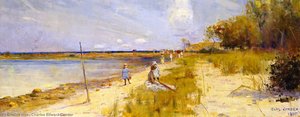
Charles Edward Conder's "Springtime," painted in 1888, isn’t merely a depiction of a rural scene; it’s a vibrant distillation of the Heidelberg School’s artistic philosophy – a celebration of light, color, and the fleeting beauty of the Australian landscape. This oil on canvas captures a moment of idyllic tranquility nestled within the rolling hills of New South Wales, yet it resonates with a deeper sense of observation and emotional resonance that distinguishes Conder's work from purely topographical representations.
The painting immediately draws the eye to the luminous quality of the light, characteristic of the Heidelberg School’s approach. Conder masterfully employs broken brushstrokes and a palette dominated by greens, blues, and yellows – not in a photographic realism, but rather as an expression of how these colors *feel* under the intense Australian sun. The composition is deceptively simple: a meandering dirt track cuts through a field dotted with grazing sheep and cows, leading towards distant trees that are rendered with a hazy, atmospheric quality. A small group of figures – likely children – are visible in the foreground, adding a touch of human presence to this otherwise serene vista.
The Heidelberg School and its Artistic Roots
To fully appreciate “Springtime,” it’s crucial to understand the context within which Conder was working. The Heidelberg School, emerging in Melbourne during the 1880s, represented a significant shift away from the academic traditions of European art that had previously dominated Australian painting. Artists like Conder, Tom Roberts, and Frederick McCubbin sought inspiration directly from the Australian landscape, rejecting idealized representations in favor of capturing its raw beauty and inherent drama. They embraced *plein air* painting – working outdoors directly from nature – a technique championed by Impressionist painters in Europe.
Conder’s early life, marked by his mother's death in India and subsequent relocation to England before returning to Australia, undoubtedly shaped his artistic sensibility. His experiences as a surveyor instilled a keen eye for detail and an appreciation for the natural world, while his time spent studying art in London exposed him to the burgeoning Impressionist movement. However, Conder ultimately forged his own unique style, blending European influences with a distinctly Australian perspective.
Symbolism and Emotional Resonance
Beyond its picturesque subject matter, “Springtime” is rich in symbolic meaning. The dirt track suggests a journey – perhaps a metaphorical one – while the grazing animals represent the bounty of the land. The figures in the foreground invite us to contemplate our relationship with nature and the simple pleasures of rural life. There’s an underlying sense of nostalgia for a bygone era, a yearning for connection with the earth and its rhythms.
The hazy atmosphere and diffused light contribute significantly to the painting's emotional impact. It evokes a feeling of warmth, tranquility, and perhaps even melancholy – a recognition that such moments of beauty are fleeting and precious. Conder’s use of color is particularly effective in conveying this mood, creating a sense of depth and luminosity that draws the viewer into the scene.
A Legacy of Australian Impressionism
“Springtime” stands as a pivotal work in the development of Australian Impressionism. It exemplifies the Heidelberg School’s commitment to capturing the essence of the Australian landscape with vibrant color, loose brushwork, and an emphasis on light and atmosphere. Conder's ability to imbue his paintings with both visual beauty and emotional depth cemented his place as one of Australia’s most important artists. Reproductions of this captivating work continue to resonate with audiences today, offering a glimpse into the soul of Heidelberg and the enduring appeal of the Australian landscape.
Питання та відповіді
Який емоційний тон має «Springtime» роботи Чарльз Едвард Кондер?
«Springtime» асоціюється з Tranquil настроєм. Емоційний тон передає враження, яке справляє цей твір.
Наскільки відомим є твір "Springtime" автора Чарльз Едвард Кондер?
Рівень популярності, зафіксований для «Springtime» роботи Чарльз Едвард Кондер, становить Recognized.
Коли було створено та до якого стилю належить твір «Springtime» роботи Чарльз Едвард Кондер?
«Springtime» роботи Чарльз Едвард Кондер датований 1888 роком і належить до Heidelberg School.
Біографія митця
Early Life and Artistic Journey
Charles Edward Conder (1868 – 1909) was an English-born painter, lithographer and designer who left an indelible mark on the art world. Born in Tottenham, Middlesex, the second son of six children, of James Conder, civil engineer and Mary Ann Ayres, he spent several years as a young child in India before the death of his mother on 14 May 1873 in Bombay, aged 31 years; he was then sent back to England and attended a number of schools including a boarding school at Eastbourne, which he attended from 1877. He left school at 15, and his very religious, non-artistic father, against Charles’s natural artistic inclinations, decided that he should follow in his footsteps as a civil engineer. He was a direct descendant, on his father's side, of the well-known sculptor Louis-François Roubiliac. He had a profound appreciation for classical art and sculpture from an early age, which would later inform his stylistic choices. Despite his father’s reservations about artistic pursuits, Conder possessed an innate talent for drawing and painting—a passion that defied conventional expectations.Artistic Career in Australia
In 1884, at the age of 16, he emigrated to Sydney, Australia, where he worked for his uncle, a land surveyor for the New South Wales government. However he disliked the work, much preferring to draw the landscape rather than surveying it. This formative experience ignited his lifelong fascination with capturing the beauty and grandeur of the Australian wilderness—a passion that would define his artistic output for decades to come. By 1886, he had become an artist for the Illustrated Sydney News alongside notable artists such as Albert Henry Fullwood and Frank Mahony. He attended the painting classes of Alfred James Daplyn and joined the Art Society of New South Wales.The Heidelberg School and Notable Works
Conder’s masterpiece, Departure of the Orient – Circular Quay (1888), showcased his newfound mastery of form and brushwork. This dockside scene, depicting the bustling harbour at Sydney Cove at the moment when the *has cast off for her voyage to England*, was quickly purchased by the Art Gallery of New South Wales, making it Conder’s first work to enter a public collection. It exemplifies the Heidelberg School's distinctive style—characterized by loose brushstrokes, vibrant colours, and an emphasis on capturing fleeting moments of light and atmosphere. The painting is considered one of Australia’s most iconic artworks. Alongside Tom Roberts and Arthur Streeton, Conder embraced the plein air technique—painting outdoors directly from nature—a cornerstone of Heidelberg School aesthetics. He produced numerous landscapes that celebrate the Australian bush, infused with a sense of romantic idealism and emotional intensity. His work also included genre paintings depicting everyday life in Melbourne and Sydney, reflecting the social realities of the era.Legacy and Later Life
Conder’s later years were plagued by poor health, including paralysis and a bout of delirium tremens. Despite these debilitating afflictions, he continued to paint—a testament to his unwavering dedication to art—producing several significant works during his final decade. His art was better received in England than in Paris, where critics often dismissed it as overly sentimental or lacking in technical sophistication. Henri de Toulouse-Lautrec painted his portrait in 1892, capturing Conder’s melancholic gaze and conveying a sense of inner turmoil—a reflection of the artist's personal struggles. He remained an active member of the art world until his death in London in 1909, leaving behind a legacy as one of Australia’s foremost Impressionist painters and a pivotal figure in establishing a uniquely Australian artistic tradition.
Чарльз Едвард Кондер
1868 - 1909 , Великобританія
Короткі факти
- Artistic Movement Or Style: Гейдельбергская школа
- Artists Who Influenced This Artist:
- Альберт Генрі Фулвуд
- Том Робертс
- Франк Махони
- Date Of Birth: 24 жовтня 1868 р.
- Date Of Death: 9 лютого 1909 р.
- Full Name: Charles Edward Conder
- Nationality: Британський
- Notable Artworks:
- Відхід Оріента – Круговий док (1888)
- Канікули в Ментоне (1888)
- Під югами
- Place Of Birth: Тоттенхем, Великобританія
Пов'язані статті

The Sublime Landscape: Exploring the Hudson River School Movement
Explore the captivating world of the Hudson River School! Discover the history, artists, and defining characteristics of this iconic American art movement. Learn about Romanticism's influence & find inspiration for your collection.

Топ-10 шедеврів романтичного пейзажу: мистецтво, що захоплює дух | OriginalUniqueArt
Відкрийте для себе 10 шедеврів романтичного пейзажу! Каспар Давид Фрідріх, Тернер та інші майстри. Історія мистецтва, емоційні кольори природи та ідеї декору з OriginalUniqueArt.com. Дослідіть колекцію онлайн!

Evoking Nature's Sublime: A Comprehensive Exploration of 19th-Century Landscape Painting
Explore the captivating world of 19th-century landscape painting! Discover renowned artists like Friedrich & Monet, key movements, and find the perfect artwork to bring nature's serenity into your home. Expert insights at OriginalUniqueArt.

Evocations of Place: A Historical Journey Through Landscape Art
Explore the rich history of landscape art with OriginalUniqueArt. Discover renowned artists, movements like Impressionism & Romanticism, and expert guidance for collecting timeless pieces. Find your perfect serene escape today!

Evocations of Place: A Historical Journey Through Landscape Art
Explore the rich history of landscape art with OriginalUniqueArt. Discover renowned artists, movements like Impressionism & tonalism, and expert guidance for collecting timeless pieces. Find your perfect serene escape today!