
 Переглянути в інтер'єрі
 Надіслати як листівку
 Поділитися
 Деталі витвору
 Посібник

 Завантажити
 Схожі екземпляри
 Рентгенівське дослідження
 Слайд-шоу
 Питання та відповіді
 Статистика
Marathon

- 157.0 x 200.0 cm


 Розгорнути текст
Гікле / Художній принт
Друк جيкле або на полотні музейної якості з оперативним виготовленням та різноманітними варіантами фінішної обробки. ( Замовити картину ручної роботи Перейти до цифрових зображень)




P118B ₴10

P118H ₴10

P118W ₴10

P438Z ₴10

P508JH ₴12

P508YH ₴12

P805H ₴10

P805Z ₴10

P919BZ ₴10

P919G ₴10

P919XJ ₴10

P959ZH ₴10

P968JZ ₴12

W106C ₴8

W218G ₴10

W218JH ₴8

W218Y ₴10

W307PJ ₴10

W316G ₴10

W316PJ ₴8

W316Y ₴10

W398PJ ₴8

W4111J ₴10

W500HY ₴15

W500JH ₴15

W692G ₴12

W849H ₴8

W940BG ₴15

W953PJ ₴8




Обирайте з наших стандартних розмірів, що відповідають оригінальним пропорціям твору мистецтва.

Введіть необхідну ширину та висоту, щоб принт ідеально підійшов до вашої рами або стіни. Принт можна лише обрізати, але не можна зробити більшим за оригінал, тому при зміні пропорцій частина зображення буде втрачена. Перед друком ми надсилаємо вам цифровий макет для затвердження. Зображення на цій сторінці не відображає реальну обрізку — її можна побачити лише на макеті.
Доставка по всьому світу () за 2 тижні замість стандартних 4/5 тижнів. (5 Листопад)

Безкоштовна експрес-доставка по всьому світу

Високоякісне лляне полотно

Повне страхове покриття доставки

Гарантія повернення митних зборів

Гарантія точного відтворення кольорів

Політика повернення протягом 100 днів (лише у разі виявлення дефектів)

Гарантія повернення 100% коштів

Пропозиція на оптові замовлення
 Скляний варіант доступний лише для розмірів до 110 см

Marathon
Гікле / Художній принт
Розмір репродукції
-


Підсумкова вартість
₴ 3644
The Drama of the Elements: Capturing Nature's Majesty in Rottmann's Marathon
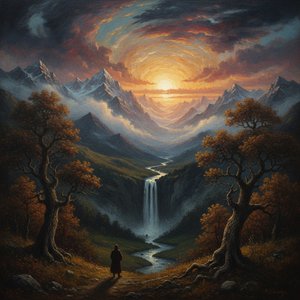
To stand before Carl Anton Joseph Rottmann’s Marathon is to be enveloped by the raw, untamed breath of nature itself. This monumental oil on canvas, painted in 1848, transcends mere landscape depiction; it is a profound meditation on power, transition, and the sublime indifference of the natural world. The scene unfolds with an almost overwhelming sense of depth, drawing the viewer's eye across rugged terrain where massive boulders litter the foreground like forgotten monuments to geological time. It is a place caught between moments—a pause before or after a monumental atmospheric event.
Mastery in Light and Shadow: Technical Brilliance
Rottmann’s technical prowess is immediately apparent, particularly in his handling of the sky. The canvas is dominated by a tumultuous, massive storm cloud that occupies the upper reaches, a brooding expanse of dark grays and deep blues. This celestial drama contrasts sharply with the muted earth tones that anchor the foreground and middle ground. Observe how the light struggles to penetrate this heavy canopy; it creates pockets of illumination on the distant rolling hills and casts dramatic shadows across the water below. The body of water acts as a perfect, somber mirror, reflecting the overcast grandeur above. This sophisticated interplay between light and shadow—a hallmark of Romantic landscape painting—gives the entire composition an electrifying, palpable atmosphere.
Historical Echoes and Emotional Resonance
Painted during the mid-19th century, Marathon speaks to the era's fascination with the sublime—that feeling of awe mixed with terror when confronted by nature’s overwhelming scale. While Rottmann draws stylistic comparisons to masters like Peter Paul Rubens in its dramatic energy, his focus here is on a more austere, almost monumental depiction of geological power. The scene evokes a sense of human insignificance against the backdrop of such vast, brooding forces. It whispers tales of endurance; the scattered life among the rocks suggests resilience, while the storm cloud hints at inevitable change.
Bringing the Sublime Home: Reproduction for the Modern Collector
For those who wish to invite this powerful emotional landscape into a contemporary setting, acquiring a high-quality reproduction allows one to experience Rottmann’s vision up close. Imagine this dramatic vista gracing your walls—a focal point that demands contemplation. The muted palette and deep sense of atmosphere make it exceptionally versatile, lending an air of cultivated drama and intellectual depth to any room. It is not merely decoration; it is a conversation piece, a window into the Romantic spirit, reminding us of nature's enduring, magnificent force.
Питання та відповіді
Який розмір та орієнтацію рекомендується для друку «Marathon» роботи Carl Anton Joseph Rottmann?
Для репродукції «Marathon» роботи Carl Anton Joseph Rottmann рекомендується розмір Large з орієнтацією Landscape.
Чи дозволено законом відтворювати «Marathon» роботи Carl Anton Joseph Rottmann, що зберігається в Нова Пінакотека?
Статус авторського права на «Marathon» роботи Carl Anton Joseph Rottmann є чітким: цей твір перебуває у є суспільним надбанням — термін дії авторського права закінчився. Його перебування в Нова Пінакотека не змінює цього статусу.
Наскільки відомим є твір "Marathon" автора Carl Anton Joseph Rottmann?
«Marathon» має рівень популярності Iconic.
Біографія митця
The Visionary Landscapes of Carl Rottmann
Born in the tranquil setting of Handschuhsheim, Germany, in 1797, Carl Anton Joseph Rottmann emerged as a profound voice within the movement of German Romanticism. His life and artistry were deeply intertwined with the shifting landscapes of 19th-century Europe, reflecting a period where the sublime beauty of nature met the burgeoning spirit of national identity. Unlike many of his contemporaries who focused on the intimate or the domestic, Rottmann possessed an expansive vision, seeking to capture the monumental scale of the world through sweeping vistas and mythic atmospheres. His journey was one of constant movement, traveling through the rugged terrains of Greece, Italy, and the Bavarian Alps, each location leaving an indelible mark on his palette and his perception of the divine within the natural world.
The development of Rottmann’s style was a masterful evolution from classical precision to a more emotive, atmospheric approach. Influenced by the grand traditions of landscape painting, he moved beyond mere topographical accuracy to embrace the sublime—that specific Romantic quality of awe and terror inspired by the vastness of nature. His technique involved a sophisticated understanding of light and shadow, using them not just to define form, and shape, but to evoke a sense of historical weight and mythic presence. In his hands, a mountain range was never just stone and ice; it was a silent witness to antiquity, a stage for the legends of old. This ability to infuse physical geography with spiritual and historical narrative became the hallmark of his mature period.
A Legacy of Light and Myth
Rottmann’s achievements are most notably seen in his ability to bridge the gap between the tangible world and the realm of imagination. His works often serve as windows into a lost era, where the ruins of ancient civilizations seem to breathe under the soft glow of a Mediterranean sun or the misty shroud of a northern forest. Through his meticulous attention to the interplay of light upon textures—the roughness of weathered stone, the translucency of water, and the softness of clouds—he achieved a level of luminosity that captivated the art world of his time.
The historical significance of his oeuvre lies in its role as a cornerstone of Romantic landscape art. His contributions can be summarized through several key artistic pillars:
- The Synthesis of History and Nature: He pioneered a method of painting where the landscape itself acts as a vessel for historical memory, blending archaeological interest with poetic expression.
- Mastery of Atmospheric Perspective: His use of color temperature and clarity to create depth allowed viewers to feel immersed in the vastness of his depicted scenes.
- Cultural Documentation: Through his travels, he provided a visual record of the European landscapes that were central to the Romantic identity, particularly the Greek and Bavarian vistas.
Ultimately, the work of Carl Rottmann remains a testament to the power of the gaze to transform the ordinary into the extraordinary. He did not merely paint what he saw; he painted what he felt in the presence of greatness. His legacy continues to resonate with those who find beauty in the monumental and meaning in the silent, enduring features of our earth, ensuring his place as a vital figure in the tapestry of 19th-century European art.

Carl Anton Joseph Rottmann
1797 - 1850 , Germany
Короткі факти
- Full Name: Joseph Wright of Derby
- Nationality: English
- Date Of Birth: 1797
- Date Of Death: 1850
- Place Of Birth: Handschuhsheim, Germany
- Notable Artworks:
- An Experiment on a Bird in the Air Pump
- The Slaughtered Horse
- A Man Defending His Cart
- Artistic Movement Or Style: Romanticism, Neoclassicism
- Artists Who Influenced This Artist:
- Janys Zedres
- Rembrandt
- Artists Or Movements Influenced By This Artist:
- Joshua Reynolds
- Romanticism
Пов'язані статті
Capturing the Soul: The Emotional Magic and Sublime Grandeur of Romantic Landscape Painting
Explore the profound emotional depth of Romantic landscape painting. Discover how masters like Friedrich and Turner captured the sublime through light, shadow, and nature's power in this expert art history retrospective for discerning collectors.

Топ-25 шедеврів Джона Констебла: пейзажі Англії для вашого дому | OriginalUniqueArt
Відкрийте для себе 25 найкращих шедеврів Джона Констебла! Англійські пейзажі, романтизм та емоційне світло в живописі. Репродукції картин високої якості для вашого дому від OriginalUniqueArt.com. Дослідіть повну колекцію онлайн!

Capturing the Sublime: A Guide to Romantic Landscape Art & Its Emotional Power
Explore the profound emotional power of Romantic landscape art. Discover how masters like Friedrich captured the sublime through breathtaking nature, and learn to curate these evocative masterpieces for your luxury interior collection.

Топ-10 шедеврів романтичного пейзажу: мистецтво, що захоплює дух | OriginalUniqueArt
Відкрийте для себе 10 шедеврів романтичного пейзажу! Каспар Давид Фрідріх, Тернер та інші майстри. Історія мистецтва, емоційні кольори природи та ідеї декору з OriginalUniqueArt.com. Дослідіть колекцію онлайн!

The Sublime and the Picturesque: Exploring Emotion & Nature in Romantic Landscape Painting
Explore the emotional power of Romantic landscape painting! Discover the sublime & picturesque traditions, key artists like Friedrich & Cole, and find your perfect artwork at OriginalUniqueArt.


