Landscape (Берталан Пор)
Берталан Пор (1880–1964) створив Landscape.

 Переглянути в інтер'єрі

 Картина олією ручної роботи
 Надіслати як листівку
 Поділитися
 Інформаційна картка


 Завантажити
 Схожі екземпляри
 Рентгенівське дослідження
 Слайд-шоу
 Питання та відповіді

 Статистика
Landscape коротко
- Назва
- Landscape
- Художник
- Берталан Пор (1880–1964)
- Рік народження митця
- Бабіна, Словаччина
- Сюжет
- landscape
Зображення високої роздільної здатності Landscape
Protected by copyright: these files are for personal reference, not a licence to republish.
Берталан Пор, Landscape.
Відповіді на запитання про Landscape
Які сюжети зображені у «Landscape» роботи Берталан Пор?
«Landscape» роботи Берталан Пор зображує: landscape.
Чи можна вільно відтворювати зображення «Landscape» роботи Берталан Пор?
«Landscape» роботи Берталан Пор перебуває у все ще перебуває під захистом авторського права. Цей статус визначає правила відтворення зображення твору.
Хто є автором "Landscape"?
Автором твору «Landscape» є Берталан Пор. Робота внесена до каталогу під іменем Берталан Пор.
Чому статус авторського права на "Landscape" саме такий?
«Landscape» за авторством Берталан Пор перебуває у все ще перебуває під захистом авторського права. Термін дії авторського права розраховується з року смерті митця; Берталан Пор помер(ла) у 1964.
Про художника Берталан Пор

1880–1964, Словаччина
Берталан Пор
A Pioneer of Hungarian Modernism: The Life and Art of Bertalan Pór Bertalan Pór, born in Budapest on November 4th, 1880, stands as a pivotal figure in the vibrant tapestry of early twentieth-century Hungarian art. His life’s journey – from his formative years immersed in the artistic currents of fin-de-siècle Hungary to his eventual embrace of Parisian modernism and his return to contribute to the cultural revival of his homeland – embodies an unwavering commitment to innovation, a profound engagement with evolving aesthetic sensibilities, and a remarkable resilience in the face of political upheaval. From a young age, Pór demonstrated a natural inclination towards drawing, a seed that blossomed into a rigorous academic training and ultimately propelled him into the heart of avant-garde artistic circles. Initially honing his skills under László Gyulay at the School of Industrial Design in Budapest, he quickly recognized the limitations of local instruction and sought further development abroad, driven by an ambition to expand his horizons and absorb diverse artistic influences.
Також за участю Берталан Пор
 Selt-portrait
 trait of Mátyás Rákosi
 Self-portrait -
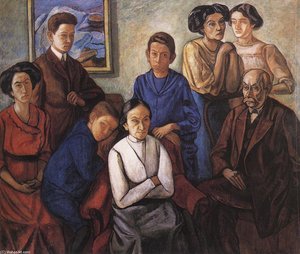 The Family
Есе до твору Landscape
 25 Masterpieces by Paul Gauguin: The Bold Colors of a Post-Impressionist LegendExplore 25 iconic Paul Gauguin masterpieces and his Post-Impressionist legacy. Discover the full collection online at OriginalUniqueArt.com.
 The Language of Light and Form: Emotional Resonance in Abstract LandscapesExplore the emotional depth of abstract landscapes through Kandinsky and Gauguin. Discover the power of color and form today.
 Atmospheric Vistas: A Study of Notable Landscape CompositionsExplore a masterclass on atmospheric landscapes from Patinir to Monet. Discover the evolution of light and texture in art history.