Forest Path (Берталан Пор)
Берталан Пор (1880–1964) створив Forest Path.

 Переглянути в інтер'єрі

 Картина олією ручної роботи
 Надіслати як листівку
 Поділитися
 Інформаційна картка


 Завантажити
 Схожі екземпляри
 Рентгенівське дослідження
 Слайд-шоу
 Питання та відповіді

 Статистика
Forest Path коротко
- Назва
- Forest Path
- Художник
- Берталан Пор (1880–1964)
- Рік народження митця
- Бабіна, Словаччина
- Сюжет
- forests, roads
Зображення високої роздільної здатності Forest Path
Захищено авторським правом: ці файли призначені лише для особистого ознайомлення і не надають права на переопублікацію.
Берталан Пор, Forest Path.
Берталан Пор (1880–1964), Forest Path. Зображення: OriginalUniqueArt.com.
Відповіді на запитання про Forest Path
Що зображено на творі "Forest Path"?
Сюжетами твору "Forest Path" є forests, roads.
Чи є «Forest Path» роботи Берталан Пор суспільним надбанням?
«Forest Path» роботи Берталан Пор перебуває у все ще перебуває під захистом авторського права. Цей статус визначає правила відтворення зображення твору.
Хто є автором "Forest Path"?
«Forest Path» було створено Берталан Пор. Інформація на цій сторінці описує оригінальний твір Берталан Пор.
Чому статус авторського права на "Forest Path" саме такий?
«Forest Path» роботи Берталан Пор перебуває у все ще перебуває під захистом авторського права. Термін дії авторського права розраховується від року смерті митця, яка відбулася у 1964.
Про художника Берталан Пор

1880–1964, Словаччина
Берталан Пор
A Pioneer of Hungarian Modernism: The Life and Art of Bertalan Pór Bertalan Pór, born in Budapest on November 4th, 1880, stands as a pivotal figure in the vibrant tapestry of early twentieth-century Hungarian art. His life’s journey – from his formative years immersed in the artistic currents of fin-de-siècle Hungary to his eventual embrace of Parisian modernism and his return to contribute to the cultural revival of his homeland – embodies an unwavering commitment to innovation, a profound engagement with evolving aesthetic sensibilities, and a remarkable resilience in the face of political upheaval. From a young age, Pór demonstrated a natural inclination towards drawing, a seed that blossomed into a rigorous academic training and ultimately propelled him into the heart of avant-garde artistic circles. Initially honing his skills under László Gyulay at the School of Industrial Design in Budapest, he quickly recognized the limitations of local instruction and sought further development abroad, driven by an ambition to expand his horizons and absorb diverse artistic influences.
Також за участю Берталан Пор
 Selt-portrait
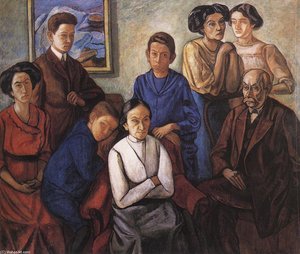 The Family
 trait of Mátyás Rákosi
 Trait Of My Mother
Есе до твору Forest Path
 Tracing the Way: A Study of Winding Paths and Scenic Roads in Landscape ArtExplore the history of winding paths in art from the Renaissance to Expressionism. Discover the soul of the landscape through every bend.
 Masterpieces of Nature: The Top 25 Artworks by Théodore RousseauIn 1830, Landscape Study (La Source) marked a pivotal shift toward the unvarnished reality of the natural world, moving away from idealized…
 Master of the Forest: The Top 25 Ivan Shishkin ArtworksBorn in 1832 in Yelabuga, Shishkin traded the polished artifice of the studio for the raw, unyielding truth of the Russian wilderness.