
() ·
A print made for you, with care
Гікле / Художній принт
Друк جيкле або на полотні музейної якості з оперативним виготовленням та різноманітними варіантами фінішної обробки. ( Замовити картину ручної роботи Перейти до цифрових зображень)
Біографія митця
Dutch painter Gerard Sanders specialized in portraits and landscapes like Archibald Hope the Elder. Discover his exquisite fine art collection.
 Розгорнути текст
від ·
Розділ 1
On which medium should it be printed?
Canvas is printed with giclée inks and can be stretched or framed like a painting; paper comes flat, or framed behind glass.
Розділ 2
Якого розміру вона має бути?
Гортайте, щоб змінити розмір; на зображенні ліворуч показано рамку її справжньої ширини. Пропорції оригіналу збережено.
Обирайте з наших стандартних розмірів, що відповідають оригінальним пропорціям твору мистецтва.

Введіть необхідну ширину та висоту, щоб принт ідеально підійшов до вашої рами або стіни. Принт можна лише обрізати, але не можна зробити більшим за оригінал, тому при зміні пропорцій частина зображення буде втрачена. Перед друком ми надсилаємо вам цифровий макет для затвердження. Зображення на цій сторінці не відображає реальну обрізку — її можна побачити лише на макеті.
Розділ 3
Яким має бути спосіб доставки?
Оберіть тип країв натяжного полотна
Оберіть свою раму

Білий край ₴1

Розмитий край ₴1

З розширенням ₴1

P118B ₴10

P118H ₴10

P118W ₴10

P438Z ₴10

P508JH ₴12

P508YH ₴12

P805H ₴10

P805Z ₴10

P919BZ ₴10

P919G ₴10

P919XJ ₴10

P959ZH ₴10

P968JZ ₴12

W106C ₴8

W218G ₴10

W218JH ₴8

W218Y ₴10

W307PJ ₴10

W316G ₴10

W316PJ ₴8

W316Y ₴10

W398PJ ₴8

W4111J ₴10

W500HY ₴15

W500JH ₴15

W692G ₴12

W849H ₴8

W940BG ₴15

W953PJ ₴8

H24-GOLD ₴30

H24-SILVER ₴30

H36-GOLD ₴45

H36-SILVER ₴45
У рамі
Багет: . Загальний розмір із рамою: .
Розділ 4
Доставка по всьому світу () за 2 тижні замість стандартних 4/5 тижнів. (21 Листопад)
Останні штрихи
Табличка, як у музеї?
Деталі гравірування на бронзовій табличці
This elegant plaque features the artist's name and the title of the artwork, finely engraved for a timeless presentation.
It is made from bronze with a refined, elegant finish. The text is precisely laser-engraved for a sharp and permanent result. Measuring 9x2 cm, the plaque is compact yet easy to read. It's built to be durable and scratch-resistant, offering a professional, museum-quality look. Mounting is simple thanks to the included adhesive backing.
Деталі прозорої акрилової таблички
The plaque includes essential engraved details such as the artist's name, the title of the artwork, the date it was created, the type of media used-like oil on canvas or watercolor-a brief description of the piece, and a QR code that links to the complete artwork information.
It is crafted from clear acrylic, offering a sleek, modern appearance. The text is UV-engraved in black to ensure strong visual contrast. With a size of 10x15 cm, it ensures optimal readability. It comes equipped with two metal hooks for secure wall mounting. The plaque is designed to be weather-resistant, making it suitable for various environments, and it includes interactive features that work seamlessly with smartphone scanning.
Деталі чорної акрилової таблички
This elegant plaque includes engraved information such as the artist's name, the title of the artwork, the date it was created, the type of media used (like oil on canvas or watercolor), a short description of the artwork, and a QR code for quick access to more information.
The plaque itself is made from refined black acrylic with a premium finish. The text is laser-engraved in white for high contrast and readability. Its size is 10x15 cm, designed to be easy to read. It comes with two metal hooks for professional mounting. The design is sleek and fits any interior style. It is also weather-resistant and durable, with built-in digital integration for mobile compatibility.
Захисний лак?
Коли вам це потрібно?
Розділ 5
Your print, as you ordered it

Amorous Couple
Матеріал репродукції
Розмір репродукції
-

Рама для репродукції
-
-
Для творів мистецтва або репродукцій, розмір яких перевищує 105 см (приблизно 41 дюйм) з будь-якого боку, рама доставляється у вигляді розібраного комплекту. Такий метод гарантує безпечну доставку та запобігає пошкодженням під час транспортування.
Потребує професійного збирання — це не продукт для самостійного виготовлення (DIY).
Комплект має бути зібраний, а полотно натягнуте досвідченим майстром багетних робіт із використанням клейового дерева (не входить у комплект), щипців для натягування полотна та затискачів, щоб підрамник залишався рівним під час висихання клею. Неправильне збирання або нерівномірне натягування полотна може призвести до незворотного пошкодження твору мистецтва, що не підпадає під дію нашої гарантії.
 Для творів мистецтва або репродукцій, розмір яких перевищує 105 см (приблизно 41 дюйм) з будь-якого боку, рама доставляється у вигляді розібраного комплекту. Такий метод гарантує безпечну доставку та запобігає пошкодженням під час транспортування.
У комплект входять усі бруски з цільного дерева, точно вирізані за розміром.
Збирається за допомогою гвинтів, що входять до комплекту, а також клейового розчину для кутових з'єднань, який не входить до комплекту і має бути підготовлений вашим майстром.
Потрібні професійні інструменти, які не входять до комплекту: щипці для натягування полотна (натягувач) та затискачі, щоб утримувати рейки рівно під час висихання клею.
Важливо:
Для з'єднання кутів потрібен клей для дерева, перекладини необхідно затиснути струбцинами до повного висихання клею, а для натягування полотна на зібрану раму знадобляться щипці для натягування полотна. Жоден із цих інструментів не входить до комплекту. Будь ласка, проконсультуйтеся з досвідченим майстром багетного оформлення перед замовленням рами такого розміру.

Етикетка експоната
-
-

Захисний лак
Глянцевий лак (підсилює яскравість кольорів, захищає від світла та вологи)
-

Прискорено
Доставка по всьому світу () за 2 тижні замість стандартних 4/5 тижнів. (21 Листопад)
-
Експрес-доставка
Доставка по всьому світу () протягом 4–5 тижнів. (28 Листопад).
Включено в ціну
Підсумкова вартість
₴ 3661
Скляний варіант доступний лише для розмірів до 110 см
До кожного замовлення додається
- Безкоштовна експрес-доставка по всьому світу
- Високоякісне лляне полотно
- Повне страхове покриття доставки
- Гарантія повернення митних зборів
- Гарантія точного відтворення кольорів
- Політика повернення протягом 100 днів (лише у разі виявлення дефектів)
- Гарантія повернення 100% коштів
- Пропозиція на оптові замовлення


 Переглянути в інтер'єрі

 Надіслати як листівку
 Поділитися
 Деталі витвору
 Посібник


 Завантажити
 Схожі екземпляри
 Рентгенівське дослідження
 Слайд-шоу
 Питання та відповіді
 Статистика
У цифрах
- 1752рік написання
- 29доступні варіанти обрамлення
- стандартні розміри, у власних пропорціях
- 5тижнів на написання та доставку
Про оригінал

- 41.0 x 36.0cm


Цей твір захищено авторським правом
Мистецький твір, представлений на цій сторінці, захищений законом про авторське право, що унеможливлює легальне створення або продаж його ідентичної репродукції. Цей захист забезпечується відповідно до міжнародних угод, таких як Бернська конвенція та національним законодавством, зокрема положеннями, що викладені в Законодавство США про авторське право — Розділ 17. Всі права захищені. Будь-яке використання без дозволу заборонено.
Як шанобливу та законну альтернативу, ми пропонуємо унікальні картини ручної роботи, створені натхненням від оригіналу. Наші досвідчені професійні художники ретельно вивчають стиль, настрій та художню сутність оригіналу, щоб створити новий, неповторний твір, який викликає ті ж почуття, — залишаючись при цьому самобутнім творінням.
Цей метод повністю відповідає нормам авторського права, оскільки він не передбачає копіювання чи дублювання захищеного твору мистецтва. Натомість це творче переосмислення — створення нового малюнка під впливом оригіналу, який не є його точним відтворенням.

Gerard Sanders
1702 - 1767
Короткі факти про Gerard Sanders
- Artists Who Influenced This Artist:
- Tobias van Nijmegen
- Elias van Nijmegen
- Full Name: Gerard Sanders
- Nationality: Dutch
- Notable Artworks:
- Archibald Hope the Elder
- Amorous Couple
- Portrait of Johannes Wilhelmus Bussingh
- Portrait of Elisabeth van der Linden
- Place Of Birth: Wesel am Rhein, Germany
- Date Of Birth: 1702
- Date Of Death: 1767
Біографія митця
Early Life, Family and Training
Born in 1702 in Wesel am Rhein, Germany, Gerard Sanders entered a world of visual craft through the intimate ties of family. His early years were shaped by a significant transition when his mother remarried Tobias van Nijmegen. This change in family structure provided the young artist with his first formal introduction to the arts, as he became a pupil of his stepfather. Under Tobias's guidance, Sanders began to develop the foundational skills of a painter and draughtsman, learning the nuances of composition and form within a domestic apprenticeship.
The trajectory of his education shifted when he reached the age of eighteen. Seeking to broaden his technical horizons, he moved to Rotterdam to study under Elias van Nijmegen. This period of study was essential in refining his ability to navigate both portraiture and landscape, preparing him for a career that would eventually see him decorating the interiors of the social elite. Throughout his life, he was occasionally known by the alias Gerhard Sanders, a variation that reflects the shifting linguistic borders of his era.
Patrons, Workshop and Commissions
Sanders’s professional life was defined by his ability to navigate the social hierarchies of the eighteenth century, moving between the private splendor of aristocratic homes and the public dignity of civic institutions. His early training under his stepfather, Tobias van Nijmegen, provided a foundation in the art of decoration, a skill that would lead him to decorate the interiors of the elite. This expertise in large-scale decorative schemes allowed him to secure significant placements, including work for the Elector Palatinate in Düsseldorf. Such commissions required a versatility that bridged the gap between fine art and the functional requirements of interior design.
His reputation for handling both private and public spaces is evident in the varied nature of his patronage. He was entrusted with the decoration of the house of Isaac Hope, a commission that placed his work within the intimate, domestic settings of the wealthy. This ability to cater to the specific tastes of prominent families ensured a steady presence in the high-society circles of the era. His work was not confined to the private sphere, however; he also engaged with the civic identity of the Netherlands. In 1764, he was commissioned to paint several scenes of civic virtues for the Town Hall of Middelburg, a task that required a shift from the personal nuances of portraiture to the formal demands of public morality.
Key Works and Artistic Subjects
Sanders focused his creative energy on the formal demands of portraiture, history subjects, and landscapes. His ability to navigate these diverse genres allowed him to move between the intimate scale of a private study and the grander requirements of civic decoration. In 1730, he produced a portrait historiée of a mother with her children, a work that suggests an interest in the allegorical or narrative potential of the human figure. This interest in character and status is further evidenced by his 1737 portrait of Archibald Hope the Elder, a piece that captures the dignity of its subject within the social hierarchies of the era.
As his career progressed, his output continued to reflect the tastes of the Dutch elite. He turned his attention to the likenesses of prominent individuals, including a portrait of Johannes Wilhelmus Bussingh (1727-1782) and a portrait of Elisabeth van der Linden (1735-1783), both dating to about 1760. These works demonstrate a steady hand in capturing the specificities of his sitters. Beyond the human form, he also engaged with the natural world, as seen in his 1763 watercolor over graphite, Fleurs et châtaignes sur un entablement.
- Portrait historiée of a mother with her children (1730)
- Portrait of Archibald Hope the Elder (1737)
- Portrait of Johannes Wilhelmus Bussingh (1727-1782) (about 1760)
- Portrait of Elisabeth van der Linden (1735-1783) (about 1760)
- Fleurs et châtaignes sur un entablement (1763)
Technique and Style
Sanders operated with the versatility required of a professional working in the Dutch tradition, moving fluidly between the roles of painter, draughtsman, and decorator. His training under his stepfather and later in Rotterdam provided him with a technical foundation that allowed him to navigate diverse commissions. Whether he was executing large-scale decorations for the interiors of the elite or working on more intimate studies, his hand remained steady and purposeful. He was as comfortable as a schilder handling canvas as he was a tekenaar capturing the essential lines of a subject.
In his more delicate works, Sanders demonstrated the precision of an aquarellist. He frequently employed watercolor over graphite on laid paper, a method that allowed for a controlled yet expressive application of color. This technique was particularly suited to his botanical studies and his ability to render the subtle textures of still life. The use of graphite provided a structural clarity to his compositions, ensuring that even his most light-handed washes of color maintained a sense of formal order.
His stylistic range was dictated by the demands of his environment. As a decorator, his work had to harmonize with the architectural spaces of the wealthy, requiring a sense of scale and decorative rhythm. In his portraiture and history subjects, he focused on the clarity of form and the character of his sitters. This adaptability—the ability to shift from the broad requirements of interior decoration to the fine, meticulous detail of a watercolor on paper—defined his professional practice.
Пов'язані статті
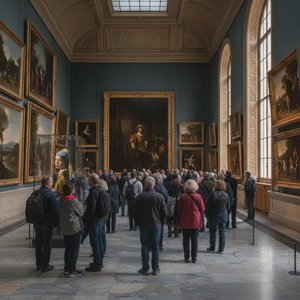
Masterpieces of the Dutch Soul: Top 25 Must-See Artworks in Amsterdam's Rijksmuseum
Embark on a journey through the Dutch Golden Age. From Rembrandt's drama to Vermeer's light, explore 25 iconic Rijksmuseum masterpieces and find museum-quality art reproductions for your decor. Discover all masterpieces on OriginalUniqueArt.com.

Masterpieces Unveiled: The Top 25 Artworks at the J. Paul Getty Museum
Explore 25 iconic masterpieces from the J. Paul Getty Museum. From Renaissance to Baroque, discover the legends on OriginalUniqueArt.com.