

 Переглянути в інтер'єрі
 Надіслати
 Поділитися
 Деталі
 Посібник

 Завантажити
 Схожі предмети колекціонування
 Рентгенівське дослідження
 Слайд-шоу
 Статистика переглядів
Lobster Trap and Fish Tail


 Читати далі
Олійная репродукція ручної роботи
Написана вручну олією на полотні у вашому розмірі та рамі, виготовлена на замовлення нашими художниками. ( Перейти до друку Перейти до цифрових зображень)




P118B $10

P118H $10

P118W $10

P438Z $10

P508JH $12

P508YH $12

P805H $10

P805Z $10

P919BZ $10

P919G $10

P919XJ $10

P959ZH $10

P968JZ $12

W106C $8

W218G $10

W218JH $8

W218Y $10

W307PJ $10

W316G $10

W316PJ $8

W316Y $10

W398PJ $8

W4111J $10

W500HY $15

W500JH $15

W692G $12

W849H $8

W940BG $15

W953PJ $8




Обирайте з наших стандартних розмірів, що відповідають оригінальним пропорціям твору мистецтва.

Ви можете вказати власні розміри, щоб репродукція ідеально підійшла до конкретної рами або інтер'єру. Якщо вибраний вами розмір не відповідає пропорціям оригіналу, ми або обріжемо полотно, або доповнимо картину додатковими елементами, промальованими вручну. Цифровий макет буде надіслано вам на затвердження перед початком виробництва.
Зверніть увагу, що попередній перегляд на екрані не відображає фактичне обрізання або розширення зображення. Тільки макет точно покаже остаточну композицію.
Хоча ми можемо виготовити виріб у нестандартному розмірі, для збереження оригінальних пропорцій рекомендуємо обирати варіанти зі встановленого списку.
Після оформлення замовлення команда OriginalUniqueArt.com зв'яжеться з клієнтом електронною поштою для отримання інструкцій та надасть попередній макет
Доставка по всьому світу () за 3–4 тижні замість стандартних 5 тижнів. (26 Вересень). Без жодних компромісів у якості.

Безкоштовна експрес-доставка по всьому світу

Високоякісне лляне полотно

Повне страхове покриття доставки

Гарантія повернення митних зборів

Гарантія точного відтворення кольорів

Політика повернення протягом 100 днів (лише у разі виявлення дефектів)

Гарантія повернення 100% коштів

Знижка на оптові замовлення
 Скляний варіант доступний лише для розмірів до 110 см

Lobster Trap and Fish Tail
Техніка репродукції
Розмір репродукції
-


Загальна вартість
$ 300
Alexander Milne Calder’s Minimalist Dance of the Deep
Alexander Milne Calder's "Lobster Trap and Fish Tail," created in 1939, isn’t merely a depiction of marine life; it’s an embodiment of movement captured within a strikingly reductive aesthetic. This captivating abstract composition, rendered in the restrained palette of black, white, and varying shades of grey against a subtly lit expanse of pale gray, immediately draws the eye into its dynamic arrangement. The artwork speaks to a profound sense of fluidity and grace, achieved through the elongated, curving forms that dominate the canvas – stylized fish tails intertwined with what appears to be a lobster trap, creating an intriguing visual dialogue.
Calder’s approach leans heavily towards geometric abstraction, prioritizing line and form over realistic representation. The technique employed suggests a deliberate fusion of digital painting and illustration, resulting in a remarkably clean and precise execution. Notice the careful delineation of shapes – ovals morphing into elongated teardrops, culminating in simplified fins—each element contributing to the overall sense of controlled motion. Texture is subtly implied through variations in line weight and shading, rather than relying on literal surface detail, adding depth without sacrificing the artwork’s inherent minimalism.
A Reflection of Calder's Artistic Evolution
Understanding "Lobster Trap and Fish Tail" requires a brief journey into the life and work of Alexander Milne Calder. Born in Aberdeen, Scotland, in 1846, Calder initially trained as a sculptor under John Rhind, honing his skills at the Royal Academy in Edinburgh before migrating to London and working on the Albert Memorial. His subsequent move to Philadelphia in 1868 marked a pivotal moment, where he studied with Joseph A. Bailly and Thomas Eakins at the Pennsylvania Academy of Fine Arts. This period saw him gain recognition for monumental works like the Philadelphia City Hall sculpture – a complex undertaking involving over 250 individual pieces—and the colossal bronze statue of William Penn. Calder’s later career embraced kinetic art, experimenting with mobiles that responded to air currents and gravity, pushing the boundaries of sculptural form.
Interestingly, his grandson, Alexander “Sandy” Calder, continued this legacy, further developing the principles of chance and movement within sculpture. The influence of Joan Miró's biomorphic surrealism and Martha Graham’s choreography is palpable in Calder’s approach to motion – a deliberate harnessing of mechanical forces to evoke a sense of organic fluidity.
Symbolic Currents and Spatial Dynamics
Beyond its formal qualities, "Lobster Trap and Fish Tail" invites contemplation on deeper symbolic meanings. The arrangement of the fish tails, diagonally intersecting with a central mobile element, creates a powerful visual rhythm, suggesting an ongoing, almost perpetual movement. The lobster trap itself adds a layer of complexity, hinting at themes of capture, vulnerability, and perhaps even the precariousness of existence within the vastness of the ocean. The predominantly light gray background serves as a crucial anchor, emphasizing the shapes and contributing to the artwork’s serene yet dynamic mood.
Calder's masterful use of negative space—the expansive light gray field—is integral to the composition’s balance and overall impact. It allows the abstracted forms to breathe, preventing the piece from feeling cluttered or overwhelming. The flattened perspective, typical of abstract art, further enhances this sense of spaciousness, inviting viewers to lose themselves within the sculpture's graceful dance.
A Timeless Piece for Interior Spaces
"Lobster Trap and Fish Tail" is more than just a beautiful artwork; it’s a testament to Calder’s innovative spirit and his ability to capture the essence of movement. A hand-painted reproduction offers an exceptional opportunity to bring this captivating piece into your home or office, adding a touch of sophisticated serenity and visual intrigue. Its minimalist design complements a wide range of interior styles, while its subtle dynamism injects a sense of life and energy into any space. Consider it not just as decoration, but as a thoughtful meditation on form, motion, and the enduring beauty of the natural world.
Біографія митця
Introduction to Alexander Milne Calder
Alexander Milne Calder (MILL-nee) was a Scottish-American sculptor whose groundbreaking approach to art revolutionized the visual landscape of the 20th century. Born in Aberdeen, Scotland, on August 23, 1846, Calder’s artistic journey began amidst the burgeoning Arts and Crafts Movement, profoundly shaped by his father's influence as a stonemason—a craft he himself diligently honed early in life. He attended the Royal Academy in Edinburgh, immersing himself in classical sculpture traditions before embarking on a transformative relocation to London where he studied at the South Kensington School and collaborated closely with Thomas Eakins at the Pennsylvania Academy of Fine Arts. This formative period instilled within him an appreciation for both meticulous technique and expressive experimentation.- Early Life & Education: Calder’s childhood was marked by a fascination with art, nurtured by his parents' dedication to creative pursuits. Notably, he posed nude for his father’s sculpture *Man Cub*, demonstrating an early inclination towards artistic representation.
- Parisian Influences: Calder’s travels to Paris exposed him to the avant-garde currents of Surrealism and Kinetic Art—movements that would irrevocably alter his artistic vision.
- Philadelphia & Collaboration: He established himself in Philadelphia, where he partnered with John McArthur Jr., to realize monumental sculptures for City Hall—a project that demanded unparalleled precision and innovation.
Notable Works & Artistic Style
Calder’s oeuvre is characterized by two distinct yet interconnected styles: architectural sculpture and kinetic mobiles. His magnum opus, Philadelphia City Hall, stands as a testament to his mastery of marble and bronze, embodying the grandeur and ambition of Beaux-Arts architecture. The statue of William Penn atop the tower—a colossal undertaking—further cemented Calder’s reputation as a visionary sculptor capable of tackling ambitious projects. However, it was Calder's mobiles – delicately balanced assemblages of metal rods and hanging weights – that truly captivated audiences and established him as a pioneer in Kinetic Art. These sculptures harnessed the principles of chance and movement, reflecting Calder’s belief that “theories may be all very well for the artist himself, but they shouldn’t be broadcast to other people.”- Philadelphia City Hall: Calder's architectural sculpture showcased his meticulous attention to detail and technical prowess.
- William Penn Statue: This monumental sculpture demonstrated Calder’s ability to execute large-scale projects with exceptional artistry.
- Mobiles: Calder’s mobiles—characterized by their balanced movement—became iconic representations of Kinetic Art, embodying the spirit of improvisation and serendipity.
Legacy & Influence
Alexander Milne Calder's influence extended far beyond his own creations, shaping the artistic landscape of subsequent generations. His son, Alexander Stirling Calder, and grandson, Alexander ‘Sandy’ Calder—both accomplished sculptors—carried forward his legacy, perpetuating his innovative spirit and furthering the exploration of kinetic sculpture. Calder’s contributions to art history are recognized globally, with his sculptures housed in prestigious museums worldwide, including the Smithsonian American Art Museum and the Galleria Civica di Arte Moderna e Contemporanea Torino. His unwavering conviction that “art should be a surprise” continues to inspire artists today—a testament to the enduring power of his artistic vision.- Son’s Artistic Contribution: Alexander Stirling Calder, Calder's son, followed in his father's footsteps as a sculptor, furthering the family tradition of artistic excellence.
- Grandson’s Artistic Legacy: Alexander ‘Sandy’ Calder—Calder’s grandson—maintained his grandfather’s pioneering spirit and expanded upon his explorations of Kinetic Art.

Александр Мильне Кадер
1898 - 1976 , Шотландія
Довідкова інформація
- Artistic Movement Or Style: Architectural sculpture
- Artists Or Movements Influenced By This Artist:
- Kinetic art
- Surrealism
- Artists Who Influenced This Artist: ['John Rhind']
- Date Of Birth: August 23, 1846
- Date Of Death: June 14, 1923
- Full Name: Alexander Milne Calder
- Nationality: Scottish-American
- Notable Artworks:
- Philadelphia City Hall
- William Penn statue
- Place Of Birth: Aberdeen, Scotland
Схожі статті

Beyond Form & Color: Geometric Abstraction's Evolution in 20th/21st Century Art
Explore the evolution of geometric abstraction from Cubism to contemporary art. Discover key artists like Malevich & Mondrian, investment insights, and expert collecting advice at OriginalUniqueArt.
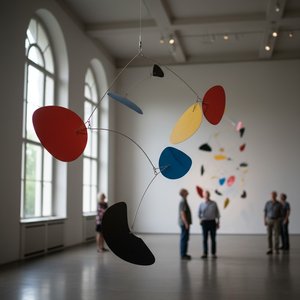
Alexander Calder: Kinetic Sculpture, Mobile Art & the Poetics of Chance
Explore the revolutionary world of Alexander Calder's kinetic sculptures & mobiles. Discover insights for collectors, acquisition advice, and the enduring legacy of this modern master. Expert analysis & art valuation.

Топ-10 шедеврів геометричної абстракції: мистецтво для вашого інтер'єру від OriginalUniqueArt.com
Відкрийте для себе 10 шедеврів геометричної абстракції від Кандинського, Малевича та Мондріана! Історія мистецтва, кольори та форми. Репродукції картин преміум-класу на OriginalUniqueArt.com – ідеальний декор для вашого дому.

10 легендарних бронзових скульптур, що змінили мистецтво | OriginalUniqueArt
Відкрийте 10 легендарних бронзових скульптур, що змінили хід мистецтва! Дізнайтесь історії Мікеланджело, Родена та інших геніїв. Репродукції картин преміум-класу для вашого дому – на OriginalUniqueArt.com

Neo-Abstract Art: The High-Impact Evolution of Modern Visual Energy and Geometric Sophistication
Discover the power of Neo-Abstract art. Explore how bold geometric forms and high-impact visual energy are redefining modern design. Learn to curate sophisticated, high-energy spaces with the latest trends in contemporary abstraction and structural color.
