

 Переглянути в інтер'єрі
 Надіслати
 Поділитися
 Деталі
 Посібник

 Завантажити
 Схожі предмети колекціонування
 Рентгенівське дослідження
 Слайд-шоу
 Статистика переглядів
Black Sun


 Читати далі
Гікле / Художній принт
Музейна якість друку جيкле або на полотні з оперативним виготовленням та різноманітними варіантами фінішної обробки. ( Купити картину ручної роботи Перейти до цифрових зображень)




P118B ₴10

P118H ₴10

P118W ₴10

P438Z ₴10

P508JH ₴12

P508YH ₴12

P805H ₴10

P805Z ₴10

P919BZ ₴10

P919G ₴10

P919XJ ₴10

P959ZH ₴10

P968JZ ₴12

W106C ₴8

W218G ₴10

W218JH ₴8

W218Y ₴10

W307PJ ₴10

W316G ₴10

W316PJ ₴8

W316Y ₴10

W398PJ ₴8

W4111J ₴10

W500HY ₴15

W500JH ₴15

W692G ₴12

W849H ₴8

W940BG ₴15

W953PJ ₴8




Обирайте з наших стандартних розмірів, що відповідають оригінальним пропорціям твору мистецтва.

Ви можете вказати власні розміри, щоб репродукція ідеально підійшла до конкретної рами або інтер'єру. Якщо обраний вами розмір не відповідає пропорціям оригіналу, ми або обріжемо полотно, або розширимо зображення за допомогою дзеркального відображення чи суцільної заливки країв. Перед початком виробництва вам буде надіслано цифровий макет для затвердження.
Будь ласка, зверніть увагу, що попередній перегляд на екрані не відображає фактичне обрізання або розширення. Тільки макет точно покаже фінальну композицію.
Хоча можливість замовлення індивідуальних розмірів доступна, ми рекомендуємо обирати формат із попередньо визначеного списку, щоб зберегти оригінальні пропорції.
Доставка по всьому світу () за 2 тижні замість стандартних 4/5 тижнів. (30 Вересень)

Безкоштовна експрес-доставка по всьому світу

Високоякісне лляне полотно

Повне страхове покриття доставки

Гарантія повернення митних зборів

Гарантія точного відтворення кольорів

Політика повернення протягом 100 днів (лише у разі виявлення дефектів)

Гарантія повернення 100% коштів

Знижка на оптові замовлення
 Скляний варіант доступний лише для розмірів до 110 см

Black Sun
Гікле / Художній принт
Розмір репродукції
-


Загальна вартість
₴ 3566
Alexander Milne Calder’s “Black Sun”: A Dance of Darkness and Light
Alexander Milne Calder's "Black Sun," painted in 1953, isn’t merely a depiction of abstract forms; it’s an invitation to contemplate the interplay between chaos and order, darkness and light. Born in Aberdeen, Scotland, and later establishing himself as a pivotal figure in American sculpture alongside his son Alexander Stirling Calder and grandson Alexander ‘Sandy’ Calder, Milne Calder possessed a singular vision – one that sought to capture dynamic movement and inherent instability within static forms. This piece exemplifies that philosophy perfectly, presenting a swirling vortex of black acrylic paint against a stark white canvas, creating an immediate sense of both tension and serenity.
The artwork's core is defined by its curvilinear shapes: elongated ribbons and sweeping curves dominate the composition, reminiscent of waves in perpetual motion or the currents of a turbulent stream. These forms are interwoven with sharp, geometric elements – triangles and circles – that introduce a counterpoint of structure to the fluidity. This juxtaposition immediately establishes a dynamic tension; the organic curves seem poised to collide with the rigid angles, suggesting an ongoing negotiation between opposing forces. The thick application of paint contributes significantly to this effect, lending a tactile quality to the forms and emphasizing their weight and presence within the space.
A Symbol Rooted in Mystery
The “Black Sun” motif itself carries a complex and layered history, extending far beyond Calder’s artistic intentions. Initially conceived as a symbol by SS officer Wilhelm Landig during the Nazi era, it was intended to replace the swastika – a potent emblem of Aryan supremacy. The Wewelsburg mosaic, where this design first appeared, became a clandestine center for occult practices and esoteric beliefs within the Nazi regime. Calder, however, remained largely unaware of this symbolic context during the creation of his painting. The symbol’s association with the occult has since been embraced by neo-Nazis and far-right groups, adding another layer of intrigue to its visual language.
Interestingly, the “Black Sun” also found resonance within esoteric traditions, particularly in alchemy and Hermeticism. It represents a solar deity associated with transformation, rebirth, and the cyclical nature of time. This connection speaks to Calder’s broader interest in exploring universal themes through his art – themes that transcend specific historical contexts. The painting, therefore, can be interpreted as a meditation on these enduring concepts, inviting viewers to consider their own relationship to cycles of destruction and renewal.
Technique and Emotional Resonance
Calder’s technique is characterized by its directness and immediacy. He employed acrylic paint applied directly onto the canvas with broad brushstrokes and, potentially, other tools like palette knives, creating a textured surface that enhances the sense of movement. The lack of traditional perspective—depth is implied through overlapping forms rather than linear recession—further contributes to the artwork’s dynamic quality. There's no attempt at realistic representation; instead, Calder focuses on capturing the *feeling* of motion and energy.
“Black Sun” evokes a powerful emotional response. The stark contrast between black and white creates a dramatic visual impact, while the swirling forms generate a sense of unease and dynamism. Yet, there’s also an underlying feeling of balance and harmony—a suggestion that even within chaos, order can be found. It's a piece that demands contemplation, inviting viewers to lose themselves in its intricate patterns and ponder the mysteries it holds. The painting’s enduring appeal lies in its ability to simultaneously fascinate and unsettle, prompting us to confront our own perceptions of beauty, darkness, and the cyclical nature of existence.
A Legacy of Motion and Form
Alexander Milne Calder's legacy extends far beyond this single masterpiece. His pioneering work with mobiles—kinetic sculptures that respond to air currents—revolutionized sculpture and continues to inspire artists today. His son, Alexander Stirling Calder, further developed these concepts, while his grandson, Alexander ‘Sandy’ Calder, created monumental public art installations around the world. “Black Sun” stands as a testament to their collective vision – a celebration of movement, form, and the enduring power of abstract expression.
Біографія митця
Introduction to Alexander Milne Calder
Alexander Milne Calder (MILL-nee) was a Scottish-American sculptor whose groundbreaking approach to art revolutionized the visual landscape of the 20th century. Born in Aberdeen, Scotland, on August 23, 1846, Calder’s artistic journey began amidst the burgeoning Arts and Crafts Movement, profoundly shaped by his father's influence as a stonemason—a craft he himself diligently honed early in life. He attended the Royal Academy in Edinburgh, immersing himself in classical sculpture traditions before embarking on a transformative relocation to London where he studied at the South Kensington School and collaborated closely with Thomas Eakins at the Pennsylvania Academy of Fine Arts. This formative period instilled within him an appreciation for both meticulous technique and expressive experimentation.- Early Life & Education: Calder’s childhood was marked by a fascination with art, nurtured by his parents' dedication to creative pursuits. Notably, he posed nude for his father’s sculpture *Man Cub*, demonstrating an early inclination towards artistic representation.
- Parisian Influences: Calder’s travels to Paris exposed him to the avant-garde currents of Surrealism and Kinetic Art—movements that would irrevocably alter his artistic vision.
- Philadelphia & Collaboration: He established himself in Philadelphia, where he partnered with John McArthur Jr., to realize monumental sculptures for City Hall—a project that demanded unparalleled precision and innovation.
Notable Works & Artistic Style
Calder’s oeuvre is characterized by two distinct yet interconnected styles: architectural sculpture and kinetic mobiles. His magnum opus, Philadelphia City Hall, stands as a testament to his mastery of marble and bronze, embodying the grandeur and ambition of Beaux-Arts architecture. The statue of William Penn atop the tower—a colossal undertaking—further cemented Calder’s reputation as a visionary sculptor capable of tackling ambitious projects. However, it was Calder's mobiles – delicately balanced assemblages of metal rods and hanging weights – that truly captivated audiences and established him as a pioneer in Kinetic Art. These sculptures harnessed the principles of chance and movement, reflecting Calder’s belief that “theories may be all very well for the artist himself, but they shouldn’t be broadcast to other people.”- Philadelphia City Hall: Calder's architectural sculpture showcased his meticulous attention to detail and technical prowess.
- William Penn Statue: This monumental sculpture demonstrated Calder’s ability to execute large-scale projects with exceptional artistry.
- Mobiles: Calder’s mobiles—characterized by their balanced movement—became iconic representations of Kinetic Art, embodying the spirit of improvisation and serendipity.
Legacy & Influence
Alexander Milne Calder's influence extended far beyond his own creations, shaping the artistic landscape of subsequent generations. His son, Alexander Stirling Calder, and grandson, Alexander ‘Sandy’ Calder—both accomplished sculptors—carried forward his legacy, perpetuating his innovative spirit and furthering the exploration of kinetic sculpture. Calder’s contributions to art history are recognized globally, with his sculptures housed in prestigious museums worldwide, including the Smithsonian American Art Museum and the Galleria Civica di Arte Moderna e Contemporanea Torino. His unwavering conviction that “art should be a surprise” continues to inspire artists today—a testament to the enduring power of his artistic vision.- Son’s Artistic Contribution: Alexander Stirling Calder, Calder's son, followed in his father's footsteps as a sculptor, furthering the family tradition of artistic excellence.
- Grandson’s Artistic Legacy: Alexander ‘Sandy’ Calder—Calder’s grandson—maintained his grandfather’s pioneering spirit and expanded upon his explorations of Kinetic Art.

Александр Мильне Кадер
1898 - 1976 , Шотландія
Довідкова інформація
- Artistic Movement Or Style: Architectural sculpture
- Artists Or Movements Influenced By This Artist:
- Kinetic art
- Surrealism
- Artists Who Influenced This Artist: ['John Rhind']
- Date Of Birth: August 23, 1846
- Date Of Death: June 14, 1923
- Full Name: Alexander Milne Calder
- Nationality: Scottish-American
- Notable Artworks:
- Philadelphia City Hall
- William Penn statue
- Place Of Birth: Aberdeen, Scotland
Схожі статті
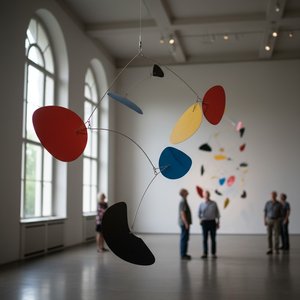
Alexander Calder: Kinetic Sculpture, Mobile Art & the Poetics of Chance
Explore the revolutionary world of Alexander Calder's kinetic sculptures & mobiles. Discover insights for collectors, acquisition advice, and the enduring legacy of this modern master. Expert analysis & art valuation.

Neo-Abstract Art: The High-Impact Evolution of Modern Visual Energy and Geometric Sophistication
Discover the power of Neo-Abstract art. Explore how bold geometric forms and high-impact visual energy are redefining modern design. Learn to curate sophisticated, high-energy spaces with the latest trends in contemporary abstraction and structural color.

Топ-25 шедеврів Василя Кандинського: подорож у світ абстрактного мистецтва | OriginalUniqueArt.com
Відкрийте для себе 25 найвідоміших шедеврів Василя Кандинського! Пориньте у світ абстрактного мистецтва, експресіонізму та кольорових композицій. Репродукції картин Кандинського преміум-якості на OriginalUniqueArt.com – для вашого інтер'єру з душею. Дослідіть повну колекцію онлайн!

Beyond Form & Color: Geometric Abstraction's Evolution in 20th/21st Century Art
Explore the evolution of geometric abstraction from Cubism to contemporary art. Discover key artists like Malevich & Mondrian, investment insights, and expert collecting advice at OriginalUniqueArt.

Топ-10 шедеврів геометричної абстракції: мистецтво для вашого інтер'єру від OriginalUniqueArt.com
Відкрийте для себе 10 шедеврів геометричної абстракції від Кандинського, Малевича та Мондріана! Історія мистецтва, кольори та форми. Репродукції картин преміум-класу на OriginalUniqueArt.com – ідеальний декор для вашого дому.
