

 Переглянути в інтер'єрі
 Надіслати
 Поділитися
 Деталі
 Посібник

 Завантажити
 Схожі предмети колекціонування
 Рентгенівське дослідження
 Слайд-шоу
 Статистика переглядів
Abstract Painting
 Oil On Canvas
- WallArt
- Abstract Expressionism
 1966
1966- Modern
 31.0 x 31.0 cm
 Музей сучасного мистецтва (MoMA)
 Читати далі
Гікле / Художній принт
Музейна якість друку جيкле або на полотні з оперативним виготовленням та різноманітними варіантами фінішної обробки. ( Купити картину ручної роботи Перейти до цифрових зображень)




P118B ₴10

P118H ₴10

P118W ₴10

P438Z ₴10

P508JH ₴12

P508YH ₴12

P805H ₴10

P805Z ₴10

P919BZ ₴10

P919G ₴10

P919XJ ₴10

P959ZH ₴10

P968JZ ₴12

W106C ₴8

W218G ₴10

W218JH ₴8

W218Y ₴10

W307PJ ₴10

W316G ₴10

W316PJ ₴8

W316Y ₴10

W398PJ ₴8

W4111J ₴10

W500HY ₴15

W500JH ₴15

W692G ₴12

W849H ₴8

W940BG ₴15

W953PJ ₴8




Обирайте з наших стандартних розмірів, що відповідають оригінальним пропорціям твору мистецтва.

Ви можете вказати власні розміри, щоб репродукція ідеально підійшла до конкретної рами або інтер'єру. Якщо обраний вами розмір не відповідає пропорціям оригіналу, ми або обріжемо полотно, або розширимо зображення за допомогою дзеркального відображення чи суцільної заливки країв. Перед початком виробництва вам буде надіслано цифровий макет для затвердження.
Будь ласка, зверніть увагу, що попередній перегляд на екрані не відображає фактичне обрізання або розширення. Тільки макет точно покаже фінальну композицію.
Хоча можливість замовлення індивідуальних розмірів доступна, ми рекомендуємо обирати формат із попередньо визначеного списку, щоб зберегти оригінальні пропорції.
Доставка по всьому світу () за 2 тижні замість стандартних 4/5 тижнів. (7 Жовтень)

Безкоштовна експрес-доставка по всьому світу

Високоякісне лляне полотно

Повне страхове покриття доставки

Гарантія повернення митних зборів

Гарантія точного відтворення кольорів

Політика повернення протягом 100 днів (лише у разі виявлення дефектів)

Гарантія повернення 100% коштів

Знижка на оптові замовлення
 Скляний варіант доступний лише для розмірів до 110 см

Abstract Painting
Гікле / Художній принт
Розмір репродукції
-


Загальна вартість
₴ 3556
The Architecture of Silence: Ad Reinhardt’s Monochromatic Vision
To stand before Ad Reinhardt’s 1966 Abstract Painting is to enter a realm where the noise of the modern world dissolves into a profound, meditative stillness. This work, a masterclass in reductive abstraction, does not seek to represent the external world but rather to exist as an end in itself. At first glance, the viewer is met with a monumental black square that dominates the canvas, a void so deep it seems to pull the gaze inward. Yet, upon closer inspection, this is not merely a flat expanse of darkness. Through a meticulous application of oil paint, Reinhardt has layered subtle gradations and textures that catch the light in unexpected ways, revealing a hidden topography of grey and charcoal tones. The thin, pale beige border acts as a quiet threshold, a delicate frame that emphasizes the weight and presence of the central dark form, creating a sense of balanced tension between the void and the edge.
The technique employed here is one of extreme discipline, reflecting Reinhardt’s radical pursuit of what he termed "Art-as-Art." Moving away from the emotive turbulence of Abstract Expressionism, Reinhardt sought to strip away all traces of subjectivity, biography, and illusion. His process involved a uniform layering of pigment that prioritizes the inherent qualities of the medium over any representational goal. There are no sweeping gestures or dramatic highlights to distract the eye; instead, the beauty lies in the subtle manipulation of surface texture and the interplay of near-invisible tonal shifts. This approach transforms the canvas into a tactile object, where the very substance of the oil paint becomes the subject, inviting a slow, rhythmic engagement from anyone fortunate enough to contemplate it.
A Legacy of Purest Essence
Historically, this painting represents the pinnacle of Reinhardt’s "ultimate" period, a time when he believed he was approaching the final, most perfected stage of painting. Influenced by the philosophical rigor of thinkers like Heidegger and Wittgenstein, Reinhardt viewed the act of painting as a monastic endeavor—a rejection of the superficial in favor of the essential. By eliminating recognizable figures, landscapes, or even vibrant colors, he challenged the viewer to confront pure visual sensation. This period of his work serves as a bridge between the expressive energy of the mid-century and the austere intellectualism of Minimalism, making it a cornerstone of post-war American art history.
For the discerning collector or interior designer, this piece offers more than just aesthetic value; it provides an emotional anchor for a space. The painting’s ability to evoke both mystery and peace makes it a versatile yet commanding presence in any sophisticated environment. Whether placed in a minimalist gallery setting or used as a focal point in a contemporary living space, the work radiates a sense of timelessness and authority. It is a piece that does not demand attention through loudness, but rather commands respect through its unwavering, quiet strength—a true masterpiece of monochromatic meditation.
Запитання та відповіді
Якому художнику приписують роботу "Abstract Painting"?
«Abstract Painting» приписують Ад Reinhardt.
У якому році було створено "Abstract Painting"?
«Abstract Painting» датована 1966 роком. Ця дата дозволяє визначити місце твору в творчому шляху Ад Reinhardt та відповідну епоху.
З яких матеріалів створено "Abstract Painting" та в якому стилі?
«Abstract Painting» виконано в техніці Oil On Canvas у стилі Abstract Expressionism.
Який формат і розмір твору "Abstract Painting"?
«Abstract Painting» Ад Reinhardt має формат Square розміром 31 x 31 cm.
Як можна використати «Abstract Painting» Ад Reinhardt в інтер'єрі дому?
«Abstract Painting» Ад Reinhardt рекомендується для Mood, ідеально — у Office. Поєднання способу використання та простору допоможе визначити, де саме пасуватиме репродукція.
Скільки років було Ад Reinhardt, коли створювався твір "Abstract Painting" у 1966 році?
Ад Reinhardt створив(ла) «Abstract Painting» у віці 53 років. Митець народився(лася) у 1913, а дата створення твору — 1966.
Наскільки насиченими є кольори у творі "Abstract Painting"?
Кольори твору «Abstract Painting» Ад Reinhardt демонструють Muted насиченість із Monochromatic інтенсивністю.
Біографія митця
A Life Dedicated to the Essence of Art
Ad Reinhardt, born Adolph Friedrich Reinhardt in Buffalo, New York, on December 24, 1913, was a figure who dedicated his life not merely to creating art, but to defining what art *could* be. His early years were marked by a familial mobility—his father’s work led the family to Queens, New York—and a close bond with his cousin Otto. Even as a child, Reinhardt displayed an exceptional talent for drawing and painting, winning accolades in school that hinted at the rigorous artistic journey ahead. He wasn't simply interested in *making* images; he was driven by a need to understand the very foundations of visual expression. This intellectual curiosity led him to Columbia University where he studied art history under the influential Meyer Schapiro, an experience that profoundly shaped his thinking about aesthetics and the role of the artist. Further training at Columbia’s Teachers College, the American Artists School with Carl Holty and Francis Criss, and portraiture studies at the National Academy of Design under Karl Anderson solidified his technical skills—skills he would later deliberately attempt to transcend. Reinhardt believed he had mastered traditional techniques early on, freeing him to pursue a more conceptual path.From Geometric Beginnings to the “Ultimate” Black
Reinhardt’s artistic evolution was far from linear. He began with works rooted in geometric abstraction, exploring form and color with a precision that demonstrated his technical mastery. These early pieces—often characterized by clean lines, precise angles, and carefully chosen palettes—reflected a deep understanding of Cubism and Constructivism, movements he studied extensively. However, this early work served as a stepping stone toward something more radical. His involvement with the WPA Federal Art Project during the 1930s provided him with crucial support and exposure, allowing him to hone his craft while contributing to public art initiatives. This experience broadened his understanding of art’s potential role in society, though he remained steadfast in his belief that its primary value lay in its aesthetic qualities. The 1940s saw Reinhardt become an active member of American Abstract Artists (AAA), a group he considered pivotal to his development. He found kinship with fellow artists who shared a commitment to non-representational art, exhibiting regularly alongside them and engaging in lively debates about the future of painting. His association with Betty Parsons Gallery further cemented his place within the burgeoning New York art scene. Throughout the 1950s, Reinhardt embarked on a series of paintings exploring subtle variations within single hues—all red, all blue, all white—a deliberate reduction that foreshadowed his most iconic works. It was in the 1960s, however, that he achieved what many consider his defining achievement: the “black” paintings. These weren’t simply black canvases; they were meticulously crafted explorations of near-black shades, subtle gradations and textures designed to challenge perception and push the boundaries of painting itself. He referred to them as his "ultimate" paintings, suggesting a culmination of artistic endeavor—a point beyond which further progress was impossible.Art-as-Art: A Philosophy of Pure Aestheticism
Central to understanding Reinhardt’s work is his philosophy of *Art-as-Art*. He vehemently believed in the autonomy of art, rejecting any notion that it should serve political, social, or narrative purposes. For Reinhardt, the value of a painting lay solely in its aesthetic qualities—its form, color, composition, and the way it engaged with the viewer on a purely visual level. This conviction led him to critique what he saw as problematic tendencies within the art world, particularly artists who prioritized messaging over aesthetics. He expressed these critiques through satirical cartoons and writings, often challenging prevailing artistic norms with wit and intellectual rigor. His friendships with Robert Lax and Thomas Merton, both of whom explored themes of simplicity in their respective fields, further informed his aesthetic principles. Reinhardt’s work resonated with a growing interest in minimalism and conceptual art, influencing artists who sought to strip away extraneous elements and focus on the essential qualities of their medium. He wasn't merely creating paintings; he was articulating a theoretical position about the nature of art itself. His famous cartoon “How to Look at Modern Art in America” perfectly encapsulated this stance – a stark critique of the perceived intrusion of social or political concerns into the realm of pure artistic expression.The "Black Paintings" and Their Significance
Reinhardt’s “black” paintings, produced between 1954 and 1967, represent the apex of his career. These works—large-scale canvases painted in a range of nearly black shades – were not intended to depict anything specific. Instead, they were explorations of texture, tone, and the very nature of perception. Reinhardt meticulously layered thin washes of paint, creating subtle shifts in color and surface that demanded close attention from the viewer. He famously stated that these paintings were “not about anything,” emphasizing their independence from external references. Yet, despite their apparent simplicity, they possessed a profound emotional resonance, evoking feelings of stillness, contemplation, and perhaps even a sense of the sublime. The paintings’ starkness challenged conventional notions of beauty and representation, forcing viewers to confront the fundamental qualities of art itself. They became iconic symbols of minimalist aesthetics and influenced generations of artists who sought to reduce their work to its essential elements.A Lasting Legacy
Ad Reinhardt died on August 30, 1967, in New York City, leaving behind a legacy that continues to inspire and provoke. His “black” paintings remain among the most studied and admired works of the 20th century, demonstrating the enduring power of abstract art. Beyond his own creations, Reinhardt’s philosophy of *Art-as-Art* has had a profound impact on contemporary art theory and practice. He is remembered not only as an artist but also as a critical thinker who challenged conventional assumptions about the role of art in society. His influence can be seen in the work of countless artists who continue to explore the boundaries of visual expression, seeking to create works that are both aesthetically compelling and intellectually stimulating. The Ad Reinhardt Estate continues to promote his legacy through exhibitions and publications, ensuring that his unique vision remains accessible to a wider audience.
Ад Reinhardt
1913 - 1967 , США
Довідкова інформація
- Artistic Movement Or Style: Абстракціонізм, Мінімалізм
- Artists Or Movements Influenced By This Artist:
- Концептуальне мистецтво
- Мінімалізм
- Artists Who Influenced This Artist:
- Майєр Шпайєр
- Роберт Лакс
- Date Of Birth: 24 груд., 1913
- Date Of Death: 30 лип., 1967
- Full Name: Adolf Friedrich Reinhardt
- Nationality: Американський
- Notable Artworks:
- Чорні картини
- Червоний і сірий
- Place Of Birth: Буффало, США
Схожі статті

Top 25 Masterpieces by Christian Noiret: A Journey Through Abstract Texture and Light
Immerse yourself in the textured world of Christian Noiret. Explore our curated list of 25 iconic abstract masterpieces, celebrating light, color, and form. Find museum-quality art reproductions for your space. Discover all masterpieces on OriginalUniqueArt.com.

Top 25 Masterpieces by Laurent Fabre: A Journey Through Neo-Abstract Geometry
Immerse yourself in the luminous world of Laurent Fabre. Explore 25 iconic Neo-Abstract masterpieces defined by geometric precision and chromatic harmony. Find inspiration for your space with museum-quality art reproductions. Discover all masterpieces on OriginalUniqueArt.com.
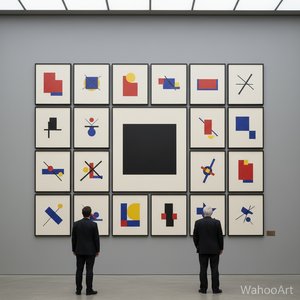
Казимир Малевич: Топ-25 шедеврів абстрактного мистецтва для вашого дому | OriginalUniqueArt
Відкрийте світ Казимира Малевича! Топ-25 шедеврів супрематизму, включаючи легендарний Чорний квадрат. Історія мистецтва, репродукції картин та ідеї декору для вашого дому на OriginalUniqueArt.com. Дослідіть повну колекцію онлайн!

Top 25 Masterpieces by Laurent Fabre: The Essence of Neo-Abstract Geometry
Immerse yourself in the luminous world of Laurent Fabre. Explore 25 iconic Neo-Abstract masterpieces, from geometric precision to vibrant color fields. Find museum-quality art reproductions and curated decor inspiration. Discover all masterpieces on OriginalUniqueArt.com.

Mastering Abstraction: The Top 25 Essential Works by Wassily Kandinsky
Journey through the soul of abstraction with our curated guide to the top 25 Wassily Kandinsky masterpieces. Explore the vibrant colors and spiritual forms that defined modern art. Find museum-quality reproductions and decor inspiration. Discover all masterpieces on OriginalUniqueArt.com.