Portrait of Honoré Daumier

The 100 Most Famous Honoré Daumier Paintings, a Gallery Selection

Updated Ekim 2026 · ranked by our popularity score (searches, visits and orders for each work) · 355 works by Honoré Daumier in our catalogue

In short

Of all the originals Honoré Daumier left, the most famous is Honoré Daumier Barabbas'ı İstiyoruz (Ecce Homo) (1852), in the collection of the Museum Folkwang, Essen. Close behind it come The Third-class Carriage (1860) and Unknown, maybe Hippolyte Lucien-Joseph Lucas (1807-1878), a Journalist, maybe P.Mendez de Vigo (1790-1860) a Spanish General, but Most Probably the Count Pelet de la Lozere (1785-1871), a Politician (1833). Our catalog holds 355 works by Honoré Daumier; the gallery has kept the 100 the world admires most, each shown with its date, its museum and its story.

1808 – 1879, Marsilya Realizm Most works: Musée d'Orsay

Honoré Daumier's top 10 paintings: the gallery's choice

1
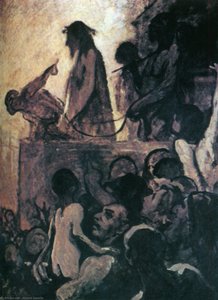
Honoré Daumier Barabbas'ı İstiyoruz (Ecce Homo) (1852) by Honoré Daumier

Honoré Daumier Barabbas'ı İstiyoruz (Ecce Homo)

1852 · Tuval Üzerine Yağlı Boya · Museum Folkwang, Essen

Powerful Depiction of Human Suffering and Social Justice This compelling artwork captures a poignant biblical scene that resonates deeply with themes of compassion, injustice, and societal critique. Rendered in a raw, expressive style, the scene invites viewers into a moment of collective emotion and moral reflection. The figures, depicted with gestural immediacy, evoke a sense of urgency and human vulnerability, making it a profound statement on social conscience and spiritual…

2
The Third-class Carriage (1860) by Honoré Daumier

The Third-class Carriage

1860 · Oil On Canvas · Metropolitan Sanat Müzesi, New York

In the crowded, dimly lit confines of a mid-19th-century railway carriage, Honoré Daumier captures more than just a moment in transit; he captures the very essence of human endurance. The Third-class Carriage serves as a profound window into the burgeoning urban reality of France during the Second Empire. As the industrial revolution reshaped the landscape of Europe, Daumier turned his gaze away from the gilded salons of the aristocracy and…

3
Unknown, maybe Hippolyte Lucien-Joseph Lucas (1807-1878), a Journalist, maybe P.Mendez de Vigo (1790-1860) a Spanish General, but Most Probably the Count Pelet de la Lozere (1785-1871), a Politician (1833) by Honoré Daumier

Unknown, maybe Hippolyte Lucien-Joseph Lucas (1807-1878), a Journalist, maybe P.Mendez de Vigo (1790-1860) a Spanish General, but Most Probably the Count Pelet de la Lozere (1785-1871), a Politician

1833 · Clay / Terracotta · Musée d'Orsay, Paris

This evocative portrait captures more than just the likeness of an elderly gentleman; it arrests a moment in time, freezing the very essence of 19th-century Parisian intellectual life. The subject, whose identity is suggested by the possibilities of a journalist or politician, possesses a gaze that seems to look past the viewer, into some distant, weighty contemplation. Rendered with the unmistakable hand of Honoré Daumier, the piece transcends mere portraiture;…

4
Ratapoil (front view) (1850) by Honoré Daumier

Ratapoil (front view)

1850 · Bronze · Musée d'Orsay, Paris

Honoré Daumier's "Ratapoil (front view)," created around 1850, is more than just a bronze sculpture; it’s a potent distillation of 19th-century French social commentary and political critique. This arresting figure, rendered with remarkable dynamism and a touch of unsettling realism, offers a captivating window into the turbulent world of post-Revolutionary France – a world grappling with nascent democracy, imperial ambitions, and the pervasive inequalities of its society. The sculpture’s enduring…

5
Intermission at the Comédie Française (1858) by Honoré Daumier

Intermission at the Comédie Française

1858 · Watercolor · Hermitaj Müzesi, Saint Petersburg

Honoré Daumier's “Intermission at the Comédie Française,” painted in 1858, isn’t merely a depiction of an elderly gathering; it’s a meticulously crafted observation of a specific moment frozen in time – and brimming with unspoken commentary. The artwork immediately draws the viewer into a densely packed scene: rows upon rows of men, their faces etched with age and lined with contemplation, are absorbed in reading newspapers or pamphlets within the…

6
Ratapoil (1850) by Honoré Daumier

Ratapoil

1850 · Bronze · Staatliche Kunsthalle Karlsruhe, Karlsruhe

The photograph captures a pivotal moment – a frozen dance of energy and emotion rendered in the enduring medium of bronze. This exquisite reproduction offers an intimate encounter with "Ratapoil," a sculpture by the visionary artist Honoré Daumier, born in Marseille in 1808 and tragically lost in 1879. More than just a depiction of a figure, it’s a window into the social anxieties and artistic fervor that defined mid-19th century…

8
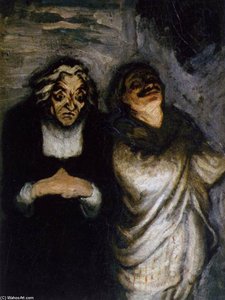
Scene from a Comedy (1858) by Honoré Daumier

Scene from a Comedy

1858 · Oil On Canvas · Musée d'Orsay, Paris

Honoré Daumier's "Scene from a Comedy," painted in 1858, isn’t merely a depiction of two figures; it’s a meticulously crafted snapshot of Parisian society and the biting social commentary that defined the artist’s career. Housed within the walls of the Musée d’Orsay, this oil on canvas offers a rare glimpse into Daumier's world – a world brimming with observation, critique, and an undeniable sense of humor laced with profound sadness.…

9
Ratapoil (1850) by Honoré Daumier

Ratapoil

1850 · Acrylic On Canvas · Artizon Museum, Tokyo

Honoré Daumier's "Ratapoil," created in 1850, isn’t merely a sculpture; it’s a distilled embodiment of the anxieties and frustrations simmering beneath the surface of mid-19th century France. This arresting figure, rendered in cast iron with a deliberate roughness that mirrors its subject matter, captures a moment of profound disillusionment – a silent indictment of societal hypocrisy and the precariousness of human existence. The sculpture’s power lies not just in its…

10
Family on the Barricades in 1848 (1854) by Honoré Daumier

Family on the Barricades in 1848

1854 · Oil · Národní Galerie, Prag

In the heart of Honoré Daumier’s 1854 masterpiece, Family on the Barricades in 1848, we find a moment suspended in the amber of history. This is not merely a painting of a political uprising; it is a profound psychological study of human resilience. As the Second French Revolution tore through the streets of Paris, Daumier captured the very essence of the era's turbulent spirit. The scene presents a family huddled…

The Honoré Daumier selection continues, 11 to 100

11The Print Collector (1865) by Honoré DaumierThe Print Collector1865 · Şikago Sanat Enstitüsü 12The Republic (1848) by Honoré DaumierThe Republic1848 · Musée d'Orsay 13Comedy scene (scene from Molière) (1862) by Honoré DaumierComedy scene (scene from Molière)1862 · Musée d'Orsay 14On a Bridge at Night (1848) by Honoré DaumierOn a Bridge at Night1848 · The Phillips Collection 15Les Gens de Justice: Vous m (1845) by Honoré DaumierLes Gens de Justice: Vous m1845 16Burden (1850) by Honoré DaumierBurden1850 · Hermitaj Müzesi 17Street Musicians (1855) by Honoré DaumierStreet Musicians1855 · Şikago Sanat Enstitüsü 18Count Antoine-Maurice-Apollinaire d'Argout (1782-1858), Minister and Peer of France (1832) by Honoré DaumierCount Antoine-Maurice-Apollinaire d'Argout (1782-1858), Minister and Peer of France1832 · Musée d'Orsay 19The Studio (1870) by Honoré DaumierThe Studio1870 · J. Paul Getty Müzesi 20Jean-Marie Fruchard (1788-1872), Deputy (1833) by Honoré DaumierJean-Marie Fruchard (1788-1872), Deputy1833 · Musée d'Orsay 21Load (Washerwoman) (1853) by Honoré DaumierLoad (Washerwoman)1853 · Národní Galerie 22Clément-François-Victor-Gabriel Prunelle (1774-1853), Doctor, Major of Lyon and Deputy (1832) by Honoré DaumierClément-François-Victor-Gabriel Prunelle (1774-1853), Doctor, Major of Lyon and Deputy1832 · Musée d'Orsay 23The Intoxication of Silène (1850) by Honoré DaumierThe Intoxication of Silène1850 24Two Lawyers (1860) by Honoré DaumierTwo Lawyers1860 · Şikago Sanat Enstitüsü 25Outside the Print–Seller's Shop (1860) by Honoré DaumierOutside the Print–Seller's Shop1860 · Dallas Sanat Müzesi 26Exit from the Theater (1863) by Honoré DaumierExit from the Theater1863 · Nelson-Atkins Sanat Müzesi 27Felix Barthe by Honoré DaumierFelix Barthe 28The Uprising (L (1848) by Honoré DaumierThe Uprising (L1848 · The Phillips Collection 29Le Peintre (The Painter) (1865) by Honoré DaumierLe Peintre (The Painter)1865 · Scottish National Gallery 30The Defender (1865) by Honoré DaumierThe Defender1865 · Musée d'Orsay 31The Good Samaritan (1855) by Honoré DaumierThe Good Samaritan1855 · Burrell Collection 32The Loge (In the Theatre Boxes) (1856) by Honoré DaumierThe Loge (In the Theatre Boxes)1856 · Walters Art Museum 33Susannah and the Elders (1853) by Honoré DaumierSusannah and the Elders1853 · Burrell Collection 34Penelopa's Dream (1842) by Honoré DaumierPenelopa's Dream1842 · Bibliothèque Nationale 35Jean-Auguste Chevandier de Valdrome, Parliamentarian (The Fool) (1832) by Honoré DaumierJean-Auguste Chevandier de Valdrome, Parliamentarian (The Fool)1832 · Musée d'Orsay 36The Washerwoman (1863) by Honoré DaumierThe Washerwoman1863 · Musée d'Orsay 37Masks of 1831 (1832) by Honoré DaumierMasks of 18311832 · Minneapolis Institute of Art 38Remembrances of St. Pelagie. (Souvenir de ste Pélagie) (1834) by Honoré DaumierRemembrances of St. Pelagie. (Souvenir de ste Pélagie)1834 39Mr. Joliv (Adolphe Joliv) (1833) by Honoré DaumierMr. Joliv (Adolphe Joliv)1833 · Musée d'art et d'histoire Paul Eluard 40Celebrités du Juste Milieu (1835) by Honoré DaumierCelebrités du Juste Milieu1835 · Zimmerli Art Museum at Rutgers University 41Grand Staircase of the Palace of Justice (1848) by Honoré DaumierGrand Staircase of the Palace of Justice1848 42The Conclusion of a Speech à la Demosthene (1848) by Honoré DaumierThe Conclusion of a Speech à la Demosthene1848 43Neighbourhood gossip (1855) by Honoré DaumierNeighbourhood gossip1855 · The Mesdag Collection 44Une salle d'attente (The Waiting Room) (1851) by Honoré DaumierUne salle d'attente (The Waiting Room)1851 · Buffalo AKG Art Museum 45Second-Class Carriage (1849) by Honoré DaumierSecond-Class Carriage1849 · Rhode Island School of Design Museum of Art 46Mme Pipelet, the Concierge (1849) by Honoré DaumierMme Pipelet, the Concierge1849 · Rhode Island School of Design Museum of Art 47Hunters by the fireside (1850) by Honoré DaumierHunters by the fireside1850 48Head of a Man (1855) by Honoré DaumierHead of a Man1855 · National Museum Cardiff 49The Miller, His Son and the Donkey (1849) by Honoré DaumierThe Miller, His Son and the Donkey1849 · Burrell Collection 50Bathers (1853) by Honoré DaumierBathers1853 51On the Shore (1853) by Honoré DaumierOn the Shore1853 52Return from the Market (1856) by Honoré DaumierReturn from the Market1856 · Museum collection Am Römerholz 53The Confidence or The Kiss of Judas (1859) by Honoré DaumierThe Confidence or The Kiss of Judas1859 · Petit Palais 54Four Heads (1857) by Honoré DaumierFour Heads1857 · Burrell Collection 55Head of an Old Woman (1858) by Honoré DaumierHead of an Old Woman1858 56Painting by Honoré Daumier (1862) by Honoré DaumierPainting by Honoré Daumier1862 57Scapin (1861) by Honoré DaumierScapin1861 · Harvard Art Museums 58Count Auguste-Hilarion de Kératry (1769-1859), Deputy, Peer of France (1832) by Honoré DaumierCount Auguste-Hilarion de Kératry (1769-1859), Deputy, Peer of France1832 · Musée d'Orsay 59The Beautiful Narcissus (1842) by Honoré DaumierThe Beautiful Narcissus1842 · Bibliothèque Nationale 60Sancho Panza, Resting Under a Tree (1865) by Honoré DaumierSancho Panza, Resting Under a Tree1865 61The Painter (1867) by Honoré DaumierThe Painter1867 · Musée des Beaux-Arts 62Au Palais de Justice (At the Law Courts) (1865) by Honoré DaumierAu Palais de Justice (At the Law Courts)1865 · Rhode Island School of Design Museum of Art 63The Two Colleagues (Lawyers) (1867) by Honoré DaumierThe Two Colleagues (Lawyers)1867 · Brooklyn Müzesi 64A Third Class Carriage (1865) by Honoré DaumierA Third Class Carriage1865 · National Museum Cardiff 65François-Pierre-Guillaume Guizot (1787-1874), Deputy, Minister and Historian (1833) by Honoré DaumierFrançois-Pierre-Guillaume Guizot (1787-1874), Deputy, Minister and Historian1833 · Musée d'Orsay 66Two Singers by Honoré DaumierTwo SingersHarvard Art Museums 67Jean-Claude Fulchiron (1774-1859), Deputy, Peer of France, and Poet (1832) by Honoré DaumierJean-Claude Fulchiron (1774-1859), Deputy, Peer of France, and Poet1832 · Musée d'Orsay 68Don Quixote and the Windmills (1850) by Honoré DaumierDon Quixote and the Windmills1850 · Şikago Sanat Enstitüsü 69The Serenade (1858) by Honoré DaumierThe Serenade1858 · Scottish National Gallery 70The Print Amateur (1855) by Honoré DaumierThe Print Amateur1855 · Harvard Art Museums 71Le Wagon de troisième classe, huile sur toile The Coach of third class, oil on fabric by Honoré DaumierLe Wagon de troisième classe, huile sur toile The Coach of third class, oil on fabric 72Jacques Lefévre (1777-1856), Banker and Deputy (1833) by Honoré DaumierJacques Lefévre (1777-1856), Banker and Deputy1833 · Musée d'Orsay 73The Print Collector (1862) by Honoré DaumierThe Print Collector1862 · Burrell Collection 74Don Quixote and the Dead Mule (1860) by Honoré DaumierDon Quixote and the Dead Mule1860 · Metropolitan Sanat Müzesi 75The Strong Man (1865) by Honoré DaumierThe Strong Man1865 · The Phillips Collection 76Head of Pasquin (1863) by Honoré DaumierHead of Pasquin1863 · Dallas Sanat Müzesi 77Baron Joseph de Podenas (1782-1851), Deputy (1833) by Honoré DaumierBaron Joseph de Podenas (1782-1851), Deputy1833 · Musée d'Orsay 78Charles Philipon (1800-1861), Journalist and Director of the Magazines Caricature and Charivari (1833) by Honoré DaumierCharles Philipon (1800-1861), Journalist and Director of the Magazines Caricature and Charivari1833 · Musée d'Orsay 79Rue Transnonain, April 15, 1834 (1834) by Honoré DaumierRue Transnonain, April 15, 18341834 · Bibliothèque Nationale 80Theater Audience (1856) by Honoré DaumierTheater Audience1856 · Ulusal Batı Sanatı Müzesi 81Don Quixote Reading (1866) by Honoré DaumierDon Quixote Reading1866 · National Museum Cardiff 82Les Avocats et Les Plaideurs: Enfin! Nous avons obtenu la séparation de biens (1851) by Honoré DaumierLes Avocats et Les Plaideurs: Enfin! Nous avons obtenu la séparation de biens1851 83Le Ventre Legislatif (1834) by Honoré DaumierLe Ventre Legislatif1834 84Avant l (1865) by Honoré DaumierAvant l1865 85Two Drinkers (Les Deux buveurs) by Honoré DaumierTwo Drinkers (Les Deux buveurs)Barnes Foundation 86Two Lawyers by Honoré DaumierTwo Lawyers 87Crispin et Scapin ou Scapin et Sylvestre, huile sur toile Crispin and Scapin or Scapin and Sylvestre, oil on fabric by Honoré DaumierCrispin et Scapin ou Scapin et Sylvestre, huile sur toile Crispin and Scapin or Scapin and Sylvestre, oil on fabric 88Une cause célèbre, crayon et aquarelle A famous cause, pencil and watercolour by Honoré DaumierUne cause célèbre, crayon et aquarelle A famous cause, pencil and watercolour 89Don Quixote and Sancho Panza (1864) by Honoré DaumierDon Quixote and Sancho Panza1864 · Burrell Collection 90Don Quixote and Sancho Panza (1870) by Honoré DaumierDon Quixote and Sancho Panza1870 · Courtauld Galerisi 91The Reader by Honoré DaumierThe Reader 92Street Scene (1864) by Honoré DaumierStreet Scene1864 · Museum Boijmans Van Beuningen 93Charles-Léonard Gallois (1774-1851), Publicist and Historian, Republican (1833) by Honoré DaumierCharles-Léonard Gallois (1774-1851), Publicist and Historian, Republican1833 · Musée d'Orsay 94André-Marie-Jean-Jacques Dupin, Also Called Dupin the Elder by Honoré DaumierAndré-Marie-Jean-Jacques Dupin, Also Called Dupin the Elder 95Le Drame, huile sur toile The Drama, oils on fabric by Honoré DaumierLe Drame, huile sur toile The Drama, oils on fabric 96The Hypochondriac (Le Malade imaginaire) by Honoré DaumierThe Hypochondriac (Le Malade imaginaire)Barnes Foundation 97To the Street (1850) by Honoré DaumierTo the Street1850 · The Phillips Collection 98Three Lawyers (1857) by Honoré DaumierThree Lawyers1857 · The Phillips Collection 99Honoré Daumier Le Martyre de saint Sébastien, esquisse, huile sur panneau The Martyrdom of Sebastien saint, draft, oil on panel (1850) by Honoré DaumierHonoré Daumier Le Martyre de saint Sébastien, esquisse, huile sur panneau The Martyrdom of Sebastien saint, draft, oil on panel1850 100Mother (1855) by Honoré DaumierMother1855 · Народний музей Сербії

Honoré Daumier's famous paintings, period by period

The subjects that held Honoré Daumier's eye

The four subjects that come back most often in these originals, each with its finest example.

The museums that keep Honoré Daumier's originals

The 8 museums that hold the most of the paintings on this page.

Museum City Works by Honoré Daumier Paintings from this list
Musée d'Orsay, ParisMusée d'Orsay Paris 33 Unknown, maybe Hippolyte Lucien-Joseph Lucas (1807-1878), a Journalist, maybe P.Mendez de Vigo (1790-1860) a Spanish General, but Most Probably the Count Pelet de la Lozere (1785-1871), a Politician, Ratapoil (front view), Ratapoil (rear view)
Burrell Collection, GlasgowBurrell Collection Glasgow 9 The Good Samaritan, Susannah and the Elders, The Miller, His Son and the Donkey
The Phillips Collection, Washington, D.C.The Phillips Collection Washington, D.C. 8 On a Bridge at Night, The Uprising (L, The Strong Man
Şikago Sanat Enstitüsü, ChicagoŞikago Sanat Enstitüsü Chicago 4 The Print Collector, Street Musicians, Two Lawyers
National Museum Cardiff, CardiffNational Museum Cardiff Cardiff 8 Head of a Man, A Third Class Carriage, Don Quixote Reading
Rhode Island School of Design Museum of Art, ProvidenceRhode Island School of Design Museum of Art Providence 4 Second-Class Carriage, Mme Pipelet, the Concierge, Au Palais de Justice (At the Law Courts)
Bibliothèque Nationale, ParisBibliothèque Nationale Paris 3 Penelopa's Dream, The Beautiful Narcissus, Rue Transnonain, April 15, 1834
Harvard Art Museums, CambridgeHarvard Art Museums Cambridge 3 Scapin, Two Singers, The Print Amateur

Honoré Daumier decade by decade: the original that defines each

Works per decade

Pick a decade to see the original that defines it.

Collectors' questions about Honoré Daumier's paintings

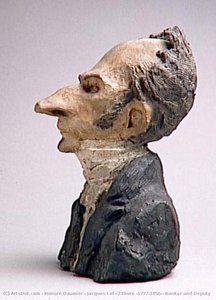
Which work is Honoré Daumier most famous for?Reveal the answer

Honoré Daumier Barabbas'ı İstiyoruz (Ecce Homo) (1852), Museum Folkwang, Essen. The Third-class Carriage (1860) and Unknown, maybe Hippolyte Lucien-Joseph Lucas (1807-1878), a Journalist, maybe P.Mendez de Vigo (1790-1860) a Spanish General, but Most Probably the Count Pelet de la Lozere (1785-1871), a Politician (1833) come next.

What age was Honoré Daumier when Honoré Daumier Barabbas'ı İstiyoruz (Ecce Homo) was made?Reveal the answer

44 years old: Honoré Daumier Barabbas'ı İstiyoruz (Ecce Homo) dates from 1852, and Honoré Daumier was born in 1808.

What are the ten most famous Honoré Daumier paintings?Reveal the answer

Honoré Daumier Barabbas'ı İstiyoruz (Ecce Homo), The Third-class Carriage, Unknown, maybe Hippolyte Lucien-Joseph Lucas (1807-1878), a Journalist, maybe P.Mendez de Vigo (1790-1860) a Spanish General, but Most Probably the Count Pelet de la Lozere (1785-1871), a Politician, Ratapoil (front view), Intermission at the Comédie Française, Ratapoil, Ratapoil (rear view), Scene from a Comedy, Ratapoil and Family on the Barricades in 1848. The ranking above gives each one's year and museum.

How many paintings did Honoré Daumier leave?Reveal the answer

Our catalog holds 355 works by Honoré Daumier, dated from 1832 to 1870.

In which museums do Honoré Daumier's masterpieces hang?Reveal the answer

Mostly in Musée d'Orsay (Paris), Burrell Collection (Glasgow) and The Phillips Collection (Washington, D.C.). The museum table above lists them all.

In which years did Honoré Daumier paint the most famous works?Reveal the answer

In 1850s: 34 of the 100 works on this page were made then, Honoré Daumier Barabbas'ı İstiyoruz (Ecce Homo) among them.

What are the first and the last famous originals of Honoré Daumier?Reveal the answer

On this page, the earliest is Count Antoine-Maurice-Apollinaire d'Argout (1782-1858), Minister and Peer of France (1832) and the latest The Studio (1870).

Which subjects did Honoré Daumier choose most often?Reveal the answer

People (18), Satire (15) and Man (13), across the 100 works on this page.

Which technique did Honoré Daumier use most?Reveal the answer

Oil On Canvas, for 15 of the 100 works on this page.

To which art movement does Honoré Daumier belong?Reveal the answer

Realizm, judging by the originals on this page.

Which Honoré Daumier works hang at the Musée d'Orsay?Reveal the answer

Unknown, maybe Hippolyte Lucien-Joseph Lucas (1807-1878), a Journalist, maybe P.Mendez de Vigo (1790-1860) a Spanish General, but Most Probably the Count Pelet de la Lozere (1785-1871), a Politician, Ratapoil (front view) and Ratapoil (rear view): the Musée d'Orsay, Paris holds 19 of the works on this page.

Can I commission a reproduction of a Honoré Daumier painting?Reveal the answer

Yes, as a reproduction: the original stays in its museum, but any painting on this page can be painted by hand for you, made to order one at a time, from the painting's own page.

Honoré Daumier: life and work

Onur Daumier’nin Hayatı ve Sanatsal Yolculuğu: Hicivle İşlenmiş Bir Yaşam

1808 yılında Marsilya'da doğan Honoré-Victorin Daumier, 19. yüzyıl Fransa'sının çalkantılı akımlarıyla derinden iç içe bir yaşam sürmüştür. Babasının şiirsel tutkuları ve ardından 1814’te Paris’e taşınmasıyla erken çocukluğu, sanatsal enerjiyle dolu bir şehirde geçmiştir. Başlangıçta hukuk kariyerine yönlendirilse de genç Daumier'nin eğilimi kaçınılmaz olarak sanata doğru kaymıştır. Alexandre Lenoir’in atölyesinde çıraklık yapmış, klasik etkilerin yanı sıra Rubens’in dramatik ışık-gölge oyunlarına olan takdirini geliştirmiş ve Académie Suisse’de becerilerini daha da keskinleştirmiştir. Bu temel eğitim, gerçekçilik ve dışavurumcu çizim yeteneğinin güçlü bir karışımını şekillendirecek belirleyici bir rol oynamıştır. Ancak Daumier'ı tanımlayan yalnızca sanatsal teknik değildi; çevresindeki sosyal adaletsizliklere ve politik absürtlüklerine karşı derin bir duyarlılıktı.

Keskin Kalem: Karikatür ve Toplumsal Eleştiri

Daumier’nin kariyeri, Fransız tarihinin seyrini değiştiren 1830 Devrimi'nden sonra gerçek anlamda ivme kazanmıştır. Bu olay, hem Fransız tarihinde bir dönüm noktası olmuş hem de onun gelişen hiciv yeteneği için verimli bir zemin hazırlamıştır. Kısa sürede usta bir litograf olarak tanınmış, başlangıçta çeşitli yayınlara anonim olarak katkıda bulunmuş, ardından Charles Philipon tarafından kurulan bağımsız çizgi roman dergisi *Le Charivari* ile ün kazanmıştır. Daumier’nin dehası tam da burada filizlenmiştir. Karikatürleri sadece eğlenceli tasvirler değildi; burjuvaziye, hukuk sistemine ve siyasi çevreye yönelik sert eleştirilerdi. Kral Louis-Philippe'i korkusuzca hicvetmiş ve özellikle keskin bir karikatürü nedeniyle 1832’de altı aylık hapis cezası almıştır. Bu deneyim onu susturmak yerine, sanatı aracılığıyla ikiyüzlülüğü açığa çıkarma ve otoriteye meydan okuma konusundaki kararlılığını daha da pekiştirmiştir. Litografileri birer görsel manifesto haline gelmiş, zamanının toplumsal sorunlarına yönelik eleştirel yorumları yansıtmıştır. Bu dönemdeki üretkenliği hayret vericidir; hem popüler eğlence hem de güçlü politik beyanlar olarak hizmet veren binlerce litografi yapmıştır.

Karikatürün Ötesinde: Resim ve Heykel Vizyonları

Daumier genellikle litografisiyle anılsa da, onu yalnızca karikatürist olarak tanımlamak büyük bir eksiklik olurdu. Hayatının ilerleyen dönemlerinde ressam ve heykeltıraş olarak da kendini adamış, ancak bu eserleri için tanınması daha sonra gelmiştir. Paris yaşamının sıradan sahnelerini tasvir eden tabloları—üçüncü sınıf vagonlar, çamaşırcılar, avukatlar—derin bir gerçekçilik ve empati duygusuyla doludur. İdealize edilmiş tasvirler değil, aksine zorlukların ve mücadelelerin acımasızca yansıtılmasıdır. Gevşek fırça darbeleri ve dramatik ışık kullanımıyla duygu ve atmosferi ustalıkla aktarmış, İzlenimcilerin daha sonra benimsediği bazı teknikleri önceden sezmiştir. Hayatının büyük bir bölümünde pişmemiş halde kalan kil heykelleri ise insan formunu dürüstlükle yakalama ve fiziksel hareket yoluyla psikolojik karmaşıklığı ifade etme konusundaki olağanüstü yeteneğini ortaya koymaktadır. Ölümünden sonra keşfedilen bu heykeller, modelleme konusunda dikkate değer bir yetenek ve duygusal derinliği yansıtma becerisini göstermektedir.

Kalıcı Miras: Etkisi ve Tarihi Önemi

Honoré Daumier’nin sanat tarihine etkisi tartışılmazdır. Romantizm ile Gerçekçilik arasındaki boşluğu kapatmış, dünyayı olduğu gibi—kusurlarıyla birlikte—tasvir etmeye çalışan gelecek nesil sanatçılar için yolu açmıştır. Acımasız toplumsal eleştirisi Gustave Courbet ve Édouard Manet gibi sanatçıları etkilemiş, yenilikçi litografi kullanımı ise baskı sanatında devrim yaratmıştır. Eserleri bugün de yankılanmaya devam ediyor; sanata otoriteye meydan okuma, adaletsizliği açığa çıkarma ve insan durumuna tanıklık etme gücünü hatırlatıyor. Paris’teki Musée d'Orsay, tablolarının ve heykellerinin önemli bir koleksiyonunu barındırarak ziyaretçilere canlı bir şekilde tasvir ettiği dünyaya bir bakış sunuyor. Litografileri ise OriginalUniqueArt gibi koleksiyonlar aracılığıyla geniş kitlelere ulaşılabilir hale getirilerek hicivsel dehasının düşünce uyandırmaya ve diyaloğu teşvik etmeye devam etmesini sağlıyor. Daumier sadece bir sanatçı değil, aynı zamanda zamanının kronikeriydi—sesi olmayanlara ses veren ve gücü hesaba çeken görsel bir şairdi. Mirası, sanatın toplumsal değişim için kalıcı gücünün bir kanıtı olarak duruyor.
All 355 works by Honoré Daumier →