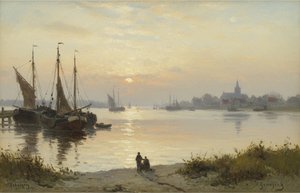
Early Life and Artistic Training
Born in Christiania, which is known today as Oslo, Ragnvald Hjerlow entered the world on February 20, 1863. His early years in Norway provided the foundation for a life dedicated to the brush and the canvas. He began his path in art through the guidance of Jacob Calmeyer, who provided the young man with his first formal lessons in the craft. This early instruction set him upon a steady course toward professional mastery.
As his ambition grew, Hjerlow sought more rigorous instruction, eventually becoming a student of Knud Bergslien. His dedication led him to the National Academy of Craft and Art Industry, where he studied with purpose until his graduation in 1880. This period of formal schooling was essential, yet he remained hungry for the nuances of light and atmosphere found in the natural world. In 1883, he sought out the "open-air academy" of Frits Thaulow at Modum, a move that allowed him to study the landscape directly under the sky.
The transition from student to recognized artist happened swiftly. In that same year, 1883, Ragnvald Hjerlow made his debut at the Autumn Exhibition. This public appearance marked his arrival in the artistic circles of his homeland, signaling the beginning of a long and respected career in both painting and teaching.
Professional Career and Teaching
His path as a painter led him far from the familiar streets of Oslo. In 1882, he sought new perspectives in Munich, a move that broadened his understanding of the craft. By 1889, his ambitions drew him toward the light of Paris and the rugged landscapes of Brittany, where he remained until 1891. It was during this period of intense study and travel that his talent began to garner formal recognition. At the 1889 World Exhibition in Paris, his work caught the eye of the international community, earning him an honorable mention. This success was bolstered by the A. C. Houen Grant, which he received in both 1890 and 1891, providing him with the means to continue his pursuit of art.
As his reputation grew, Hjerlow turned his attention toward the instruction of others. In 1895, he began a tenure as a teacher at the Christiania Burgher School, sharing his technical knowledge with a new generation of students. His dedication to the academic side of art eventually led him to a position of significant influence. From 1908 until 1933, he served as a senior teacher at the National Academy of Craft and Art Industry. Through these decades of teaching, he helped shape the artistic landscape of Norway, moving between the quiet observation of nature and the structured discipline of the classroom.
Notable Paintings and Key Works
During his time in Paris, Hjerlow captured a specific sense of light and atmosphere that would define much of his early output. In 1891, he produced View from my Window, a work painted while he was immersed in the life of the French capital. This piece, executed in oil on cardboard, was noted for its sunny disposition and a colorful execution that brought the scene to life. It remains a significant part of his legacy, finding its place within the National Gallery.
As his career progressed, his focus turned toward the quietude of the Norwegian landscape. Around 1898, he painted Autumn Evening at Finskog, a landscape that reflects a more contemplative mood. This work captures the specific essence of a fading day in the countryside, moving away from the urban observations of his youth toward the natural world of his homeland. Through these varied subjects, one can trace his movement from the bustling streets of Paris to the stillness of the Nordic evening.
Where to See His Works Today
Those who wish to encounter the traces of his hand may find them held within the halls of Norway's most significant institutions. His presence in the national collection ensures that his vision remains part of the country's visual history. One might find his work Fra mitt vindu (From My Window) within the National Gallery, where it has been preserved as a sunny and colorfully well-executed little picture. This particular piece, an oil on cardboard mounted on cardboard, offers a glimpse into the light he captured during his time in Paris.
The landscape tradition he pursued is further represented in the National Museum of Art, Architecture and Design. There, the quietude of the Norwegian countryside is preserved in Autumn Evening at Finskog. This painting remains a significant part of the museum's holdings, allowing viewers to observe the way he handled the changing light of the seasons. Through these collections, his contribution to the Norwegian art scene remains accessible to those who seek to study his technique and his observations of the natural world.
Soru ve Cevaplar
Ragnvald Hjerlow imzalı eserleri belirli bir temaya göre nasıl bulabilirim?
Ragnvald Hjerlow'in eserlerini, sanatçının Anahtar Kelimelerle sayfasında anahtar kelimelere göre keşfedebilirsiniz. Her anahtar kelime ilgili eserleri bir araya getirir.
Ragnvald Hjerlow hangi dönem sanatçısıdır?
Ragnvald Hjerlow, 19th Century döneminde eserlerini vermiştir. Bu dönem, sanatçının çalışmalarını tarihsel bir bağlama oturtur.
Ragnvald Hjerlow hangi takma adlar veya alternatif isimlerle tanınmaktadır?
Ragnvald Hjerlow aynı zamanda Ragnvald Amandus Pedersen Hjerlow olarak da bilinir.
Ragnvald Hjerlow eserlerini renk spektrumuna göre keşfedebilir miyim?
Ragnvald Hjerlow sanatçısının Renk Spektrumu sayfası, eserleri renklerine göre düzenleyen bir sayfadır.