Early Life, Family and Training
Jean de la Vallée was an architect whose professional identity was forged through lineage and movement. Born in France, he was the son of the architect Simon de la Vallée. This familial connection provided more than just a name; it offered a direct line to the structural logic of the era. In 1637, Jean de la Vallée moved to Sweden alongside his father, a transition that would eventually shift the trajectory of Swedish architectural development.
His early training was not confined to textbooks but was shaped by direct observation. He made early trips through France and Italy, absorbing the specificities of the new baroque forms of architecture. These travels allowed him to study the geometry and scale of the continental style firsthand. He did not merely observe these structures; he internalized the principles that would later define his approach to Swedish building projects.
Travels and Architectural Studies
Architecture is a discipline of observation, and Jean de la Vallée’s development was fueled by direct exposure to European forms. In 1646, he received a royal scholarship from Queen Kristina, a move that allowed him to move beyond local traditions. This funding facilitated an international study of architectural structures that would define his later career in Sweden. He did not merely observe; he absorbed the logic of the continent's most significant building sites.
His movement through Europe followed a clear, purposeful path. He traveled through the Netherlands before arriving in Paris in August 1646. From France, his focus shifted toward the classical foundations of the south. He spent several years studying the architectural language of Italy and Rome, eventually leaving the Italian peninsula in the spring of 1650. This period of study provided the technical vocabulary he would later use to implement Baroque forms in Swedish construction.
Royal and Noble Commissions
Jean de la Vallée’s influence on the Swedish landscape was cemented through his direct service to the monarchy and the high nobility. His work moved beyond mere construction into the realm of state identity. He designed apartments for Queen Hedvig Eleonora at Gripsholm Castle, demonstrating a capacity to handle the specific spatial requirements of royal life. His reach extended to the spiritual heart of the capital, where he planned two major churches in central Stockholm: Katarina kyrka in 1656 and Hedvig Eleonora Church in 1658. These projects were not mere local additions but central components of the urban fabric.
The nobility provided a steady stream of high-stakes work that required both technical precision and an understanding of prestige. He managed the remodeling of Karlberg Castle for Magnus Gabriel de la Gardie, a client who demanded architecture reflecting his immense status. This pattern of working for the elite was a constant throughout his career. His professional standing was eventually formalized by the state; in 1680, he was awarded the title of Royal and City Architect. This was not a mere honorific but a recognition of his dominance in the architectural landscape of Stockholm.
Major Architectural Works
Jean de la Vallée’s impact on the Swedish landscape is best understood through his ability to translate continental Baroque principles into local stone. He did not merely follow trends; he applied them to the structural needs of the Swedish nobility and the crown. His work on the House of Knights in Stockholm, which he completed in 1660 after his father's death, demonstrates an early ability to manage large-scale, complex urban projects. This was not a solo effort of ego but a continuation of a specific architectural lineage intended to define the capital's character.
His involvement in the design of Skokloster Castle highlights his capacity for working within a collaborative framework. While other architects like Caspar Vogel and Nicodemus Tessin the Elder contributed to the site, de la Vallée’s presence ensured the project maintained a cohesive architectural language. His influence extended to the urban fabric of Stockholm through his work on Riddarholmen. There, he handled the Palace of Bonde and the remodeling of the Wrangel Palace, projects that required a precise understanding of both residential grandeur and administrative utility.
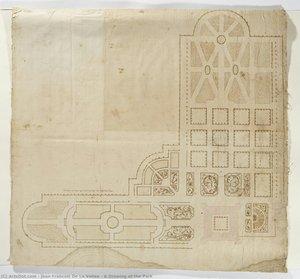
Even his unfulfilled ambitions reveal a clear technical direction. He produced detailed remodeling plans for Stockholm Palace, drawing heavily from Roman and French models to suggest a transformation of the site into a true Baroque palace. These sketches, though never realized, prove he was looking toward a specific, international standard for Swedish royal architecture. His career was defined by this tension between the practicalities of Swedish construction and the sophisticated geometry of the European continent.
Later Years and Death
The final decade of Jean de la Vallée's career was defined by official state authority. In 1680, he was awarded the title of "Royal and City Architect," a position he held until 1688. During this period, he functioned as a state architect in Stockholm, cementing his influence over the capital's structural development. His professional standing reached a peak in 1692 when he was knighted.
His life ended in Stockholm. He died on 12 March 1696. This conclusion marked the end of a career that had transitioned from the study of foreign Baroque forms to the practical administration of Swedish architectural standards.
Soru ve Cevaplar
Jean de la Vallée adlı sanatçının tüm eserlerini nerede inceleyebilirim?
bu web sitesi üzerindeki Jean de la Vallée imzalı tüm eserlere sanatçının Tüm Sanat Eserleri sayfasından göz atabilirsiniz.
Jean de la Vallée sanatçısının en çok görüntülenen eserleri hangileridir?
Jean de la Vallée için bu web sitesi üzerinde, sanatçının eserlerine dair istatistikleri sunan bir İstatistikler sayfası bulunmaktadır.
Jean de la Vallée’in eserlerini tekniğe göre gruplandırılmış halde nerede bulabilirim?
Tüm Teknikler sayfası, Jean de la Vallée eserlerini tekniğe göre gruplandırır.
Jean de la Vallée adlı sanatçının eserlerini belirli bir renk paletine göre nasıl bulabilirim?
Jean de la Vallée'in eserlerine, sanatçının Renk Paletlerine Göre sayfasından renk paletine göre göz atabilirsiniz.