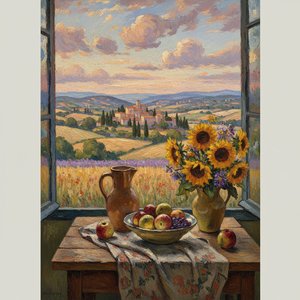
The Landscape of a Short Life
To look at the work of Carl Ludwig Kaaz is to encounter a career cut short by the physical reality of death. He died in Dresden at the age of thirty-seven, still working at his easel. This abrupt end leaves a body of work that feels concentrated, a concentrated effort to translate the topography of Europe into gouache, watercolor, and wash. He was a German painter and engraver who specialized in landscapes, a choice that defined his entire output from 1788 until 1810.
His technical foundation was built through a series of practical shifts. He began as a scribe and a bookbinder before finding his way to copperplate engraving and miniature painting in La Chaux-de-Fonds, Switzerland. This early training in precision and small-scale detail informed the way he approached larger landscapes later in life. He moved from the technical discipline of engraving to the academic rigor of the Dresden Academy of Fine Arts, studying under Johann Christian Klengel and Jacob Wilhelm Mechau.
Travel and Topography
Kaaz’s development was driven by movement. Between 1801 and 1804, he traveled through Paris and Italy alongside Traugott Leberecht Pochmann and Carl Anton Graff. This was not a mere sightseeing trip; it was a period of intense visual documentation. He returned to Germany with notebooks filled with sketches, which he later transformed into finished compositions. These sketches became the basis for his most significant works, including a large fresco at Schloss Frohburg in 1805 based on a view of Lake Nemi.
His social and professional circles were deeply embedded in the intellectual centers of the era. He was acquainted with Schiller and worked alongside Goethe at Karlsbad in 1808. In 1809, while teaching drawing lessons at the court in Weimar, he stayed at Goethe's home. This proximity to the leading minds of the time suggests a painter who was deeply integrated into the cultural fabric of his period, even if his primary focus remained the natural world.
The Visual Record
The surviving catalog of his work reveals a preoccupation with specific environments and light. His output includes:
- Kaaz Ischia
- Kaaz Wasserfall
- Kaaz Ideallandschaft
- Kaaz Fenster
- Kaaz Kohle
- Kaaz Selbstbildnis
His work is characterized by this direct engagement with subject matter, from the specific geography of Ischia to the more abstract Ideallandschaft. He also produced a painting for Schiller's drama William Tell, titled I am Liberated. While his life was brief, his ability to move from the minute detail of an engraving to the expansive scale of a fresco demonstrates a versatility that was grounded in a strict, observational discipline.
Soru ve Cevaplar
Carl Ludwig Kaaz sanatçısının renklere göre ayrılmış eserlerine nereden ulaşabilirim?
Renk Spektrumu sayfası, Carl Ludwig Kaaz adlı sanatçının eserlerini renklere göre düzenler.
Carl Ludwig Kaaz adlı sanatçının eserlerini belirli bir renk paletine göre nasıl bulabilirim?
Carl Ludwig Kaaz'in eserlerine, sanatçının Renk Paletlerine Göre sayfasından renk paletine göre göz atabilirsiniz.
Carl Ludwig Kaaz tarafından üretilen tüm eserleri nasıl görebilirim?
bu web sitesi üzerindeki Carl Ludwig Kaaz imzalı tüm eserlere sanatçının Tüm Sanat Eserleri sayfasından göz atabilirsiniz.