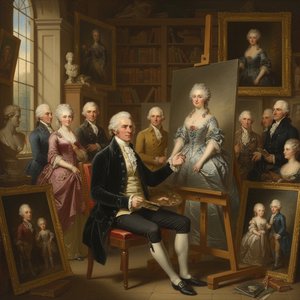
The Precision of Memory
To look at the work of Alexandre De Latour is to witness a specific kind of technical discipline that modern art often lacks. He was not merely a painter; he was a Belgian miniaturist who mastered the ability to reconstruct faces with startling accuracy from memory alone. This skill suggests a mind trained for intense observation rather than mere decoration. His career spanned the shifting political landscapes of the French First Republic, Napoleonic France, and the United Kingdom of the Netherlands, yet his focus remained fixed on the small-scale intimacy of the portrait.
His technical foundation was built within his own family home. He began with lessons from his mother, Marie de Latour, a specialist in miniatures herself. This early immersion provided him with a direct lineage of skill. He later refined this through formal training under Louis-Marie Autissier in Brussels and Jean-Baptiste Jacques Augustin in Paris. The influence of Augustin is particularly visible in the way De Latour handled detail. It was a rigorous, structured approach to the miniature format.
Royal Appointments and Professional Standing
De Latour did not paint in a vacuum; his career was defined by official recognition from the highest levels of European authority. His talent earned him the position of official miniaturist for the House of Orange under King William I. Following the establishment of the Kingdom of Belgium in 1831, he maintained this status as an official miniaturist for the new kingdom. These were not mere titles. They required a level of reliability and precision that could satisfy the demands of a royal court.
His professional reach extended across borders through several key achievements:
- Membership in the Royal Academy of Fine Arts in Antwerp.
- Membership in the Royal Academy of Visual Arts in Amsterdam.
- Regular exhibitions at the Paris Salon between 1804 and 1810.
- A significant showing at the Salon in Lille in 1822.
The Physical Record
While his miniatures are his primary legacy, De Latour also produced small-format oil paintings and landscapes. His work survives today in several major institutions, proving that his technical reach went beyond the tiny scale of portraiture. The presence of his portraits in the Wallace Collection in London and the Royal Museums of Fine Arts of Belgium confirms the historical weight of his output. He left behind a body of work that functions as a precise visual record of the people and eras he inhabited.
His son, Édouard, followed him into the profession as a genre painter, ensuring the continuation of this specific Belgian tradition. The works of Alexandre De Latour remain anchored in the concrete reality of his subjects, from the Portrait of Countess Elisaveta Vorontsova to his various depictions of gentlemen and ladies in empire dress. He did not seek to reinvent the medium; he sought to perfect it.
Soru ve Cevaplar
Alexandre De Latour hangi dönem sanatçısıdır?
Alexandre De Latour, 19th Century döneminde eserlerini vermiştir. Bu dönem, sanatçının çalışmalarını tarihsel bir bağlama oturtur.
Alexandre De Latour sanatçısının anahtar kelimelere göre gruplandırılmış eserlerine nereden ulaşabilirim?
Alexandre De Latour sanatçısının Anahtar Kelimelerle sayfası, sanatçının eserlerini anahtar kelimelerine göre gruplandırır.
Alexandre De Latour hangi akımlarda eser verdi?
Tüm Sanat Akımları sayfası, Alexandre De Latour eserlerini sanat akımlarına göre gruplandırır.
Alexandre De Latour adlı sanatçının eserlerinin renk profilini nerede görebilirim?
Alexandre De Latour'in bu web sitesi üzerinde yer alan eserlerindeki renk kullanımı, sanatçının Palet Genomu sayfasından incelenebilir.