The Genesis of Fragmentation: Precursors to Cubism
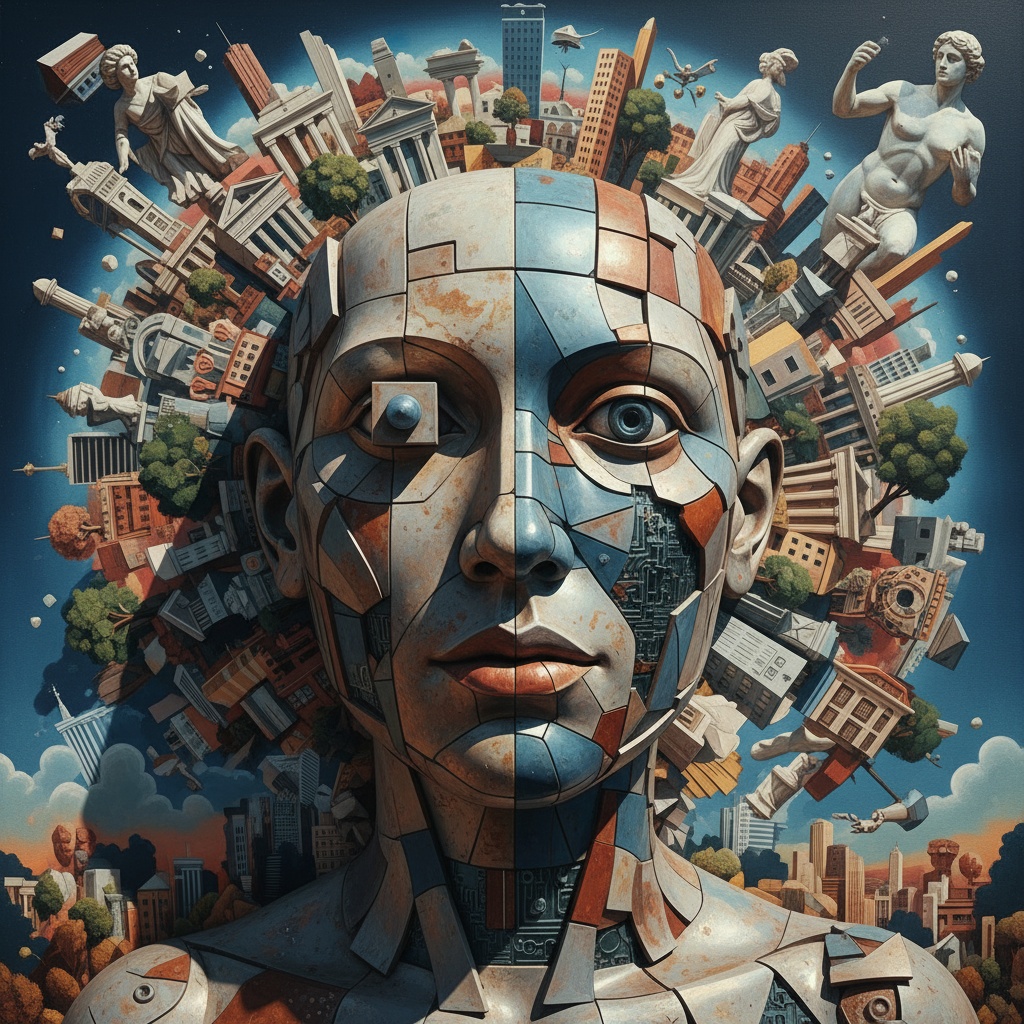
Cubism is an early-20th-century avant-garde art movement which began in Paris. It revolutionized painting and the visual arts, and sparked artistic innovations in music, ballet, literature, and architecture. Cubist subjects are analyzed, broken up, a...
Before the radical reshaping of form that we recognize as Cubism, a quiet revolution was brewing within the ateliers and intellectual circles of early 20th-century Paris. It wasn’t born in a vacuum; rather, it emerged from a confluence of artistic dissatisfaction with traditional representation and a burgeoning fascination with alternative ways of perceiving reality. The established conventions of mimicking nature – painstakingly recreating light, shadow, and perspective – began to feel inadequate for artists grappling with the accelerating pace of modern life and the complexities of human experience. Paul Cézanne, though not a Cubist himself, laid crucial groundwork. His insistence on reducing natural forms to their geometric essences—cylinders, spheres, cones—wasn’t about simplification, but about revealing the underlying structure of the world. He sought to represent objects as they existed in three dimensions on a two-dimensional plane, challenging the single fixed viewpoint that had dominated Western art for centuries. This pursuit of essential form resonated deeply with Pablo Picasso and Georges Braque, who would soon take Cézanne’s ideas to their logical extreme.
Simultaneously, exposure to non-Western art forms—particularly African masks and sculptures—profoundly impacted the developing Cubist aesthetic. These objects weren't concerned with realistic depiction; instead, they employed stylized abstraction to convey deeper spiritual or cultural meanings. Picasso, captivated by their raw power and expressive qualities, began incorporating similar elements into his work, abandoning the pursuit of naturalistic representation in favor of a more symbolic and fragmented approach. This wasn’t merely an aesthetic choice; it reflected a broader questioning of Western artistic traditions and a desire to explore new modes of visual language. The intellectual climate also played a vital role, with advancements in science—particularly Einstein's theories of relativity—challenging traditional notions of time and space, further fueling the artists’ experimentation.
Analytical Cubism: Dissecting Form and Space
 Portrait of Felipe IV
Explore Picasso's 'Portrait of Felipe IV,' a striking example of Analytic Cubism. Witness the fragmented depiction of the Spanish king, showcasing Picasso’s revolutionary style and influence.
The period between 1908 and 1912 witnessed the birth of Analytical Cubism, a phase characterized by its rigorous intellectual approach to representation. Picasso and Braque embarked on a systematic deconstruction of objects, breaking them down into fragmented geometric forms and reassembling them on the canvas in a manner that challenged conventional perspective. Imagine taking an object—a guitar, a bottle, a human figure—and viewing it from multiple angles simultaneously, then attempting to represent all those viewpoints within a single image. This wasn’t about creating a visual puzzle; it was about capturing the totality of the object's existence, its essence revealed through careful analysis and reconstruction. Portrait of Georges Braque, painted by Picasso in 1908, exemplifies this approach perfectly. The subject is barely recognizable as a human face; instead, it’s rendered as an intricate network of intersecting planes and muted tones—ochres, browns, grays—that suggest form without explicitly depicting it.
Color was deliberately subdued during this phase, serving primarily to emphasize the structural elements rather than distract from them. The artists focused on exploring the interplay of lines, angles, and planes, creating a sense of depth and volume through subtle variations in shading and overlapping forms. Works like Braque’s Violin and Palette further illustrate this analytical approach, with objects dissected into their constituent parts and reassembled in a way that challenges our perception of reality. The goal wasn't to reproduce what they *saw*, but rather to represent what they *knew* about the object—its underlying structure, its multiple perspectives, its very essence.
Synthetic Cubism: Rebuilding Reality Through Collage
 Deconstructing Reality: Cubist Expressionism's Aesthetic & Philosophical Foundations
Explore the profound aesthetic & philosophical foundations of Cubist Expressionism. Discover key artists, movements, and lasting influence on modern art history. A guide for discerning collectors.
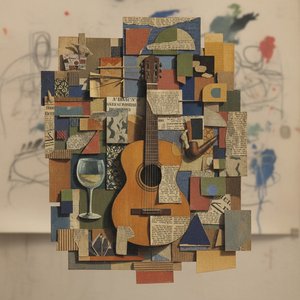
Around 1912, Analytical Cubism began to evolve into Synthetic Cubism, a phase marked by a shift in focus from dissecting objects to rebuilding them. Instead of breaking down forms, Picasso and Braque started constructing images using simpler shapes, brighter colors, and—most significantly—collage elements. This introduction of real-world materials—newspaper clippings, fabric scraps, patterned paper—was a revolutionary departure from traditional painting techniques. Still Life with Chair Caning, painted by Picasso in 1912, is a seminal example of this new approach. The inclusion of an actual piece of oilcloth printed to resemble chair caning blurs the boundaries between art and reality, challenging our perception of representation.
Synthetic Cubism wasn’t simply about adding texture or visual interest; it was about questioning the very nature of painting itself. By incorporating elements from everyday life, the artists sought to create a more dynamic and multifaceted representation of the world. The brighter color palettes and simpler shapes also contributed to this sense of dynamism, creating images that were less austere and more accessible than their Analytical predecessors. This phase saw a greater emphasis on composition and pattern, with objects often arranged in a flattened, decorative manner. The use of collage also allowed for a new level of ambiguity and interpretation, inviting viewers to engage actively with the artwork and construct their own meaning.
Philosophical Underpinnings: Beyond Aesthetics – The Intellectual Roots of Cubism
Cubism wasn’t merely an aesthetic innovation; it was deeply rooted in philosophical inquiry. The artists weren't simply trying to create visually striking images; they were grappling with fundamental questions about perception, reality, and the nature of representation. The influence of Henri Bergson, a French philosopher who challenged traditional notions of time and space, cannot be overstated. Bergson’s concept of *duration*—the idea that time is not linear but rather a continuous flow of experience—resonated deeply with Picasso and Braque, influencing their attempts to represent multiple perspectives simultaneously.
Furthermore, the artists were influenced by advancements in science, particularly Einstein's theory of relativity, which challenged traditional notions of absolute space and time. This intellectual context encouraged them to question the fixed viewpoint that had dominated Western art for centuries, leading them to explore new ways of visualizing reality. The fragmentation of form wasn’t simply a stylistic choice; it was a reflection of their belief that reality is not static but rather a complex and multifaceted phenomenon. Portrait of Felipe IV, Picasso's striking reinterpretation of the Spanish king, embodies this philosophical approach—a fragmented depiction challenging traditional notions of power and representation.
Cubism’s Lasting Influence: From Painting to Sculpture and Beyond
The impact of Cubism extended far beyond the realm of painting. It sparked a revolution in sculpture, architecture, and design, influencing generations of artists across various disciplines. Sculptors like Alexander Archipenko adopted Cubist principles, breaking down forms into geometric shapes and exploring new ways of representing three-dimensional space. Architects incorporated Cubist aesthetics into their designs, creating buildings with fragmented facades and unconventional angles. The movement’s influence can also be seen in the development of other abstract art styles, such as Constructivism and Neo-Plasticism.
Even today, Cubism continues to inspire artists and designers around the world. Its emphasis on abstraction, fragmentation, and multiple perspectives remains relevant in a society increasingly characterized by complexity and ambiguity. The legacy of Picasso and Braque is not simply about creating visually striking images; it’s about challenging our perception of reality and encouraging us to see the world in new ways. The principles pioneered during the Analytical and Synthetic phases continue to resonate, informing contemporary art practices and shaping our understanding of visual language.
Collecting Cubist Art: A Guide for Discerning Enthusiasts
Acquiring a work representative of the Cubist movement is an investment not only in aesthetic beauty but also in a pivotal moment of art history. However, navigating this market requires careful consideration. Due to its revolutionary nature and relatively short period of active production, original Cubist works are rare and command significant prices. Authenticity is paramount; thorough provenance research—tracing the artwork’s ownership history—is essential. Consulting with reputable art dealers and appraisers can provide valuable insights.
When considering a purchase, pay attention to the phase of Cubism it represents – Analytical works tend to be more subdued in color and focus on form dissection, while Synthetic pieces incorporate collage and brighter palettes. The artist’s signature and any accompanying documentation should be carefully examined for verification. OriginalUniqueArt.com offers high-quality handmade oil paintings reproducing masterpieces of Cubism, providing an accessible entry point to experience the movement's brilliance. Whether you seek a faithful reproduction or a custom piece inspired by Cubist principles, our team of skilled artists and art consultants can guide you through the process, ensuring a satisfying acquisition that honors the legacy of Picasso, Braque, and their groundbreaking vision.