Önizle
 Gönder
 Paylaş
 Detaylar
 Rehber

 Dosyayı İndir
 Benzerleri
 X-Işını
 Slayt Gösterisi
 İstatistikler
Coloful Ensemble


 Devamını Oku
Giclée / Sanat Baskısı
Hızlı üretim ve esnek bitiş seçenekleriyle müze kalitesinde giclée veya kanvas baskı. ( El Yapımı Tablo Satın Al Dijital Görsel Satışına Geç)




P118B ₺10

P118H ₺10

P118W ₺10

P438Z ₺10

P508JH ₺12

P508YH ₺12

P805H ₺10

P805Z ₺10

P919BZ ₺10

P919G ₺10

P919XJ ₺10

P959ZH ₺10

P968JZ ₺12

W106C ₺8

W218G ₺10

W218JH ₺8

W218Y ₺10

W307PJ ₺10

W316G ₺10

W316PJ ₺8

W316Y ₺10

W398PJ ₺8

W4111J ₺10

W500HY ₺15

W500JH ₺15

W692G ₺12

W849H ₺8

W940BG ₺15

W953PJ ₺8




Eserin orijinal oranlarıyla uyumlu, önceden belirlenmiş boyutlarımız arasından seçim yapın.

Çerçevenize veya duvarınıza uygun olması için ihtiyacınız olan genişlik ve yüksekliği yazın. Bir baskı yalnızca kesilebilir, görselden daha büyük hale getirilemez; bu nedenle farklı bir formdaki boyut seçimi, görselin bir kısmının kaybına neden olur. Herhangi bir baskı yapmadan önce onaylamanız için size bir dijital taslak gönderiyoruz. Bu sayfada gösterilen resim gerçek kesimi göstermez — bunu yalnızca taslak gösterir.
Dünya Çapında Teslimat (); standart 4/5 hafta yerine 2 haftada. (25 Ekim)

Dünya Çapında Ücretsiz Ekspres Kargo

Yüksek Kaliteli Keten Tuval

Tam Nakliye Sigortası

Gümrük Vergisi İadesi Garantisi

Gerçek Renk Uyumu Garantisi

100 Günlük İade Koşulları (Sadece Üretim Hatalı Ürünler İçin)

%100 Para İade Garantisi

Toplu Alım Avantajı
 Cam seçeneği yalnızca 110 cm altındaki boyutlar için mevcuttur.

Coloful Ensemble
Giclée / Sanat Baskısı
Baskı Boyutu
-


Toplam Fiyat
₺ 3913
A Symphony of Form and Color: Exploring Kandinsky’s ‘Colorful Ensemble’
‘Colorful Ensemble’, painted in 1938 by the visionary Russian artist Wassily Kandinsky, is a captivating example of abstract art that transcends mere representation. Measuring 45.7 x 35 inches (116.0 x 89.0 cm), this oil and gloss on canvas resides at the Centre Georges Pompidou in Paris, inviting viewers into a world governed by feeling and intuition.
Kandinsky: Pioneer of Abstract Expression
Wassily Kandinsky (1866-1944) stands as a monumental figure in the history of modern art. Initially trained in law and economics, he was profoundly moved by Impressionist works – particularly Monet’s “Haystacks” – which ignited his artistic calling. He progressively abandoned representational forms, driven by a belief that color and composition could directly evoke emotional responses, independent of recognizable objects. His theoretical writings, notably Concerning the Spiritual in Art, articulated this philosophy and cemented his position as one of the first truly abstract artists.
Deconstructing Reality: An Analysis of ‘Colorful Ensemble’
‘Colorful Ensemble’ is a dynamic interplay of geometric shapes, swirling lines, and vibrant hues. While not depicting a specific scene, the composition suggests an underlying structure – some perceive hints of a fragmented face or figure emerging from the abstract chaos. Kandinsky masterfully employs layering and overlapping forms to create depth and movement within the two-dimensional space. The palette is rich and varied, featuring bold primaries alongside softer earth tones, all contributing to a sense of energetic harmony. The meticulous application of paint, with its visible brushstrokes and subtle gloss variations, adds textural complexity.
Expressionism and the Inner Landscape
This artwork is firmly rooted in the Expressionist movement, which flourished in the early 20th century. Expressionism sought to convey subjective emotions and inner experiences rather than objective reality. Kandinsky’s work exemplifies this ethos; ‘Colorful Ensemble’ isn't about *what* it depicts but *how* it makes you feel. The painting invites introspection, prompting viewers to connect with their own emotional responses to the colors, shapes, and overall composition.
Symbolism and Interpretation
Kandinsky believed that each color possessed a spiritual quality and could evoke specific emotions. While he resisted rigid symbolic interpretations, his use of color was deliberate and meaningful. Circles often represented wholeness and spirituality, while triangles suggested dynamism and aggression. The interplay between these forms in ‘Colorful Ensemble’ creates a complex emotional landscape open to individual interpretation. Is it a celebration of life's energy? A reflection on inner turmoil? Or perhaps a glimpse into the artist’s subconscious?
Emotional Resonance and Lasting Impact
‘Colorful Ensemble’ is more than just an aesthetically pleasing arrangement of shapes and colors; it’s an invitation to experience art on a deeply personal level. Its enduring appeal lies in its ability to bypass the intellect and speak directly to the emotions. For collectors, this painting represents a significant investment in a cornerstone of modern art history. For interior designers, a high-quality reproduction can inject a space with energy, sophistication, and intellectual depth. It’s a piece that continues to inspire awe and provoke thought decades after its creation.
- Style: Abstract Expressionism
- Medium: Oil and gloss on canvas
- Dimensions: 45.7 x 35 inches (116.0 x 89.0 cm)
- Location: Centre Georges Pompidou, Paris
Soru ve Cevaplar
"Coloful Ensemble" ne hakkında ve nasıl bir atmosfere sahip?
"Coloful Ensemble", abstract, color field, geometric, dynamic, expressionism, kandinsky, composition, spirituality konularını sergilemekte olup, yansıttığı duygu Mystical şeklindedir.
Vasılı Vasılıeviç Kandinskiy imzalı "Coloful Ensemble" eserinin bir baskısını nasıl temin edebilirim?
Vasılı Vasılıeviç Kandinskiy imzalı "Coloful Ensemble" eserinin bir baskası doğrudan ilgili Sanat Baskısı sayfasından sipariş edilebilir: pamuklu kanvas veya arşivlik kanvas kağıt üzerine yüksek kaliteli sanat baskısı.
Vasılı Vasılıeviç Kandinskiy imzalı "Coloful Ensemble" eserinin sanat tarihindeki yeri nedir?
Vasılı Vasılıeviç Kandinskiy imzalı "Coloful Ensemble", Modern dönemindeki Abstract Expressionism akımına aittir. Bu iki unsur birlikte eserin sanat tarihindeki yerini belirler.
Sanatçı Biyografisi
A Life Immersed in Color and Spirit
Wassily Wassilyevich Kandinsky, born December 4, 1866, in Moscow, Russia, was a revolutionary figure who irrevocably altered the course of modern art. His journey wasn’t one of immediate artistic calling; initially destined for a career in law and economics at the University of Moscow, it was a profound encounter with Impressionist painting – specifically Claude Monet's “Haystacks” – and a deeply moving experience witnessing Wagner’s opera "Lohengrin" that ignited within him an irrepressible desire to pursue art. This pivotal moment, occurring around age thirty, marked not merely a career change but a complete transformation of perspective, setting him on a path toward pioneering abstraction. He soon relocated to Munich, enrolling at the prestigious Academy of Fine Arts and studying under Franz von Stuck, though even within formal training, Kandinsky’s spirit yearned for exploration beyond conventional boundaries. Early influences included Russian folk art, gleaned from an ethnographic expedition to the Vologda region in 1889, which instilled a fascination with vibrant color palettes and symbolic imagery. This foundation would prove crucial as he began to develop his unique artistic language. These early explorations weren’t simply about aesthetic preference; they were rooted in a deep cultural connection and a burgeoning understanding of how art could communicate beyond the literal. He experimented with landscapes and portraits, demonstrating considerable skill but always feeling constrained by representational limitations.The Dawn of Abstraction: From Expressionism to Inner Necessity
Kandinsky’s early works reveal a strong expressionistic bent, characterized by bold colors and emotional intensity – pieces like “Papeln (Poplars)” from 1902 exemplify this period. However, he wasn't content with merely representing the external world; he sought to express inner realities, spiritual truths that transcended mere visual depiction. This quest led him gradually away from representational art and toward a revolutionary exploration of color, form, and their emotional resonance. He believed that colors possessed inherent psychological effects, capable of evoking specific feelings and sensations in the viewer. This conviction was deeply intertwined with his burgeoning interest in Theosophy, a spiritual movement emphasizing esoteric knowledge and universal brotherhood. As he delved deeper into these ideas, Kandinsky’s paintings became increasingly non-objective, shedding recognizable forms in favor of abstract compositions driven by an “inner necessity.” This wasn't simply about abandoning representation; it was about discovering a new visual language capable of expressing the intangible realms of emotion and spirituality. He sought to create a visual equivalent of music, where color and form harmonized to evoke profound emotional responses.- Notable Early Works: “Papeln (Poplars),” “Fruitful Tree,” “Moscow Landscape”
- Influences: Impressionism (Monet), Russian Folk Art
Geometric Harmony and Spiritual Resonance
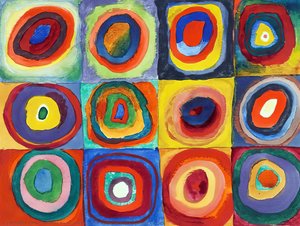
The period following his involvement with the influential artist group Der Blaue Reiter (The Blue Rider), which he co-founded in Munich in 1911, saw a further evolution in Kandinsky’s style. While earlier works often featured fluid, organic shapes, he began to explore geometric abstraction, focusing on the interplay of circles, triangles, and squares. “Several Circles” (140 x 140 cm) stands as a prime example of this phase – a dynamic composition where color and form interact in a harmonious yet energetic dance. He meticulously studied mathematical principles and sought to translate them into visual terms, believing that geometric forms possessed inherent symbolic meaning. This wasn’t cold or sterile geometry; rather, it was imbued with spiritual significance. Kandinsky argued that art should not aim to imitate nature but rather to reveal the artist’s inner world and connect with the viewer on a deeper, more intuitive level.- Key Artistic Developments: Shift from Expressionism to Geometric Abstraction
- Theoretical Writings: “Concerning the Spiritual in Art” (1911)
Bauhaus Influence and Lasting Legacy
The outbreak of World War I forced Kandinsky's return to Russia in 1914, but following the Russian Revolution, he found himself increasingly at odds with the prevailing artistic climate. In 1920, he accepted a teaching position at the Bauhaus school in Germany, where he profoundly influenced generations of artists with his theories on color, form, and abstraction. The Bauhaus provided an ideal environment for Kandinsky to further develop his ideas and explore new creative avenues. He continued to experiment with geometric forms and vibrant colors, often incorporating layered impasto techniques to create textured surfaces that added depth and complexity to his compositions – as seen in later works like “An Intimate Party” (1942). After the closure of the Bauhaus by the Nazi regime in 1933, Kandinsky moved to France, where he remained for the rest of his life. His impact on modern art is immeasurable; he is widely recognized as a pioneer of abstract expressionism and a key figure in the development of non-representational painting. His works are held in major museums worldwide, including the Tretyakov Gallery in Moscow, which houses his monumental “Composition VII,” a testament to his artistic vision and enduring legacy. Kandinsky died December 13, 1944, in Neuilly-sur-Seine, France.
Vasılı Vasılıeviç Kandinskiy
1866 - 1944 , Rusya
Kısa Bilgiler
- Artistic Movement Or Style: Abstr Ekspres
- Artists Or Movements Influenced By This Artist: ['Abs Ekspres']
- Artists Who Influenced This Artist:
- Claude Monet
- Richard Wagner
- Date Of Birth: 1866
- Full Name: Wassily Wassilyevich Kandinsky
- Nationality: Rus
- Notable Artworks:
- Murnau Rainbow
- Tempered Elan
- Several Circles
- Place Of Birth: Moscow, Russia
İlgili Yazılar

Kandinsky's Masterpieces: 25 Paintings That Define Abstract Art | OriginalUniqueArt
Journey through Wassily Kandinsky's 25 most iconic abstract paintings. Explore his revolutionary use of color, form & spiritual expressionism. Find museum-quality Kandinsky reproductions and elevate your home decor with OriginalUniqueArt.com. Discover all masterpieces on OriginalUniqueArt.com!
Color Field Painting: The Emotional Power of Pure Abstraction and Chromatic Depth
Explore the profound emotional depth of Color Field painting. Discover the history of mid-century abstraction, from Rothko to Newman, and learn how pure color transforms the viewer's experience through our expert art history guide.

Geometrik Soyutlamanın Öncü Eserleri: Sanat Tarihinin İzinde 🖼️🎨
Geometrik Soyutlamanın 10 başyapıtını keşfedin! Mondrian, Malevich ve Kandinsky gibi sanatçıların ikonik eserleriyle modern sanatın derinliklerine yolculuk edin. Evinizi lüks sanat baskılarıyla renklendirin. OriginalUniqueArt.com'da tüm koleksiyonu inceleyin!

Neo-Abstract Art: The High-Impact Evolution of Modern Visual Energy and Geometric Sophistication
Discover the power of Neo-Abstract art. Explore how bold geometric forms and high-impact visual energy are redefining modern design. Learn to curate sophisticated, high-energy spaces with the latest trends in contemporary abstraction and structural color.

Soyut Ekspresyonizmin İzinden: Sanat Tarihini Derinleştiren 10 Başyapıt
Soyut Ekspresyonizmin zirvesi! Pollock, Rothko ve daha fazlasıyla sanat tarihini şekillendiren 10 başyapıtı keşfedin. Sanatçı hikayeleri, renklerin gücü ve evinizi dönüştürecek müze kalitesinde reprodüksiyonlar için OriginalUniqueArt.com'u ziyaret edin.