
 Gerçek Boyutta Önizle
 Paylaş
 Paylaş
 Detayları Gör
 Rehber

 İndir
İndir
 Benzer ürünler
 X-Işını
 Slayt Gösterisi
 Soru & Cevap
 İstatistikler
Black Cross

- 46.0 x 46.0 cm


 Tümünü Gör
Web önizlemesinin çok ötesinde, baskıya hazır bir dosya edinin. Sattığımız her dijital görüntü, stok veri tabanımızdaki yüksek çözünürlüklü bir ana dosyadan —genellikle 5.000 ila 15.000 piksel genişliğinde— gelir; böylece büyük boyutlarda baskı alabilir, dar kırpmalar yapabilir veya ince detayları güvenle yeniden üretebilirsiniz.
Stüdyomuzdan çıkan hiçbir dosya işlenmeden çıkmaz. Bir dijital uzman, renkleri orijinal tabloyla karşılaştırarak kontrol eder ve gerekirse düzeltir; ardından profesyonel rötuş araçlarıyla netliği ve detayları artırır — bunu yaparken her zaman sanatçının fırça darbelerine ve üslubuna sadık kalır. Sonuç, filtrelenmiş bir tarama gibi değil, bizzat tablonun kendisi gibi görünen bir görüntüdür.
İşlem tamamlanmadan önce onayınız alınır: Uzmanımız, incelemeniz için görseli 72 saat içinde e-posta ile gönderir. Memnun kalmadınız mı? İyileştirme veya düzeltme talep edebilir ya da kalite beklentinizin altında kalırsa iade isteyebilirsiniz.
Yayıncıların, tasarım stüdyolarının, galerilerin ve matbaaların güvendiği kalite budur.
Dijital Görsel Sanatlar
Kişisel kullanım, baskı ve yaratıcı projeleriniz için yüksek çözünürlüklü bir dosya indirin. ( Baskı Satışına Geç El Yapımı Tablo Satın Al)
Her Dijital Görüntü Siparişine Dahil Olanlar
Uzman Dijital Teslimat Garantisi
OriginalUniqueArt.com seçtiğinizde, sadece bir görsel edinmekle kalmaz; titizlikle hazırlanmış, profesyonelce iyileştirilmiş dijital bir sanat eserine sahip olur ve memnuniyet garantisiyle güvence altına alınırsınız. Siparişinizle birlikte otomatik olarak sunulan her şey şunlardır:

Hızlı E-posta ile Teslimat
Yüksek çözünürlüklü dijital görüntü dosyanız, siparişinizin ardından en geç 72 saat içinde e-posta ile size gönderilecek ve hemen kullanıma hazır olacaktır.

Yapay Zeka Destekli Dijital Görüntü İşleme
Sanat eseriniz; maksimum detay, netlik ve renk doğruluğu sağlamak amacıyla gelişmiş yapay zeka araçları ve manuel düzenleme kullanılarak profesyonelce optimize edilmektedir.

Ömür Boyu Ücretsiz Yeniden Gönderim
Dosyanızı yanlışlıkla mı sildiniz yoksa kayıp mı oldu? Endişelenmeyin; dosyanızı dilediğiniz zaman size ücretsiz olarak tekrar göndereceğiz.

Hiçbir Zaman İthalat Ücreti Ödemeyin
Sanat eserinizin tadını gümrük vergisi, harç veya teslimat ücreti ödemeden anında çıkarın; dijital indirmeler her zaman vergiden muaftır.

Renk Doğruluğu Garantisi
Profesyonel araçlar ve renk yönetimi kullanarak dijital görselinizin orijinal renklere mümkün olduğunca yakın yansıtılmasını sağlıyoruz.

100 Günlük Memnuniyet Garantisi
If you're not satisfied with your digital image, we'll revise it or refund 100% within 100 days - no questions asked.

100% Para İadesi Garantisi
Memnun kalmadınız mı? Dijital dosyanızı teslim aldıktan sonraki 100 gün içinde, hiçbir soru sorulmaksızın tam para iadesi alabilirsiniz.

Toplu Sipariş İndirimleri
Buy 3 images, save 10% - Buy 5, save 15% - Buy 10+, save 20%. Great for creative projects, galleries, and agencies.
A Geometric Symphony of Faith and Form
In the vibrant landscape of late twentieth-century abstraction, few works capture the intersection of spiritual iconography and geometric precision as strikingly as Samia Halaby’s Black Cross. Created in 1969, this captivating piece serves as a profound meditation on the power of shape to convey deep-seated cultural and religious meaning. At first glance, the viewer is met with a radiant central cruciform, where a brilliant yellow core radiates outward, bounded by deep, contemplative blues. This interplay of light and shadow does not merely depict a symbol; it breathes life into it, transforming a static icon into a pulsating, energetic entity that seems to vibrate against the canvas.
The composition is a masterclass in balanced tension. Surrounding the central cross, a constellation of orange squares drifts through the space, creating a rhythmic movement that guides the eye across the 46 x 46 cm surface. These geometric elements act as celestial satellites, grounding the ethereal light of the cross within a structured, mathematical reality. The technique reflects a sophisticated understanding of color theory, where the warmth of the orange and yellow provides a striking counterpoint to the cool, stabilizing presence of the blue edges, resulting in a visual harmony that is both intellectually stimulating and aesthetically soothing.
The Intersection of Abstraction and Symbolism
To behold Black Cross is to witness the dialogue between the abstract and the sacred. While the painting avoids the literalist traps of traditional religious art, it utilizes the language of abstraction to evoke the essence of the cross. The use of bold, non-representational shapes allows the viewer to experience the spiritual weight of the symbol without the distraction of figurative detail. This approach aligns with the broader movements of the era, where artists sought to strip away the superficial to reach a more primal, universal truth through color and form.
For the discerning collector or interior designer, this piece offers an unparalleled opportunity to introduce a focal point of profound depth into a contemporary space. The painting’s ability to command attention through its high-contrast palette makes it an ideal centerpiece for modern galleries, minimalist living rooms, or sophisticated executive suites. It is more than a mere decoration; it is a conversation starter that invites contemplation on the nature of belief, the structure of the universe, and the enduring power of geometric beauty. Owning a high-quality reproduction of this work allows one to bring a fragment of 1960s avant-garde history into the modern home, providing an atmosphere of intellectual rigor and soulful elegance.
Soru ve Cevaplar
"Black Cross" için önerilen kullanım alanı ve amacı nedir?
Samia Halaby imzalı "Black Cross", Geometry için önerilmektedir; ideal olarak bir Coworking içerisinde sergilenmesi uygundur. Kullanım amacı ve mekan, reprodüksiyonun nereye yakışacağına dair yol gösterir.
Samia Halaby imzalı "Black Cross" hangi oda için öneriliyor?
Samia Halaby imzalı "Black Cross" için önerilen alan bir Coworking'dur. Bu öneri, elbette iç mekanınıza göre uyarlanabilir.
"Black Cross" eseri tarihsel olarak nerede konumlanıyor?
Samia Halaby imzalı "Black Cross", Modern dönemindeki Abstract Art akımına aittir. Bu iki unsur birlikte eserin sanat tarihindeki yerini belirler.
Sanatçı Özgeçmişi
A Visionary of Abstraction and Activism
Samia Halaby stands as a monumental figure in the landscape of contemporary art, a Palestinian-American pioneer whose multifaceted practice spans the realms of abstract painting, computer art, and profound scholarship. Born in Jerusalem, her early life was shaped by the vibrant textures of Palestine—memories of lush gardens and the rhythmic dance of leaves that would later inform her sensory approach to color and form. The displacement of her family during the Nakba in 1948, which led them from Yafa to Lebanon and eventually to the United States, instilled in her a lifelong commitment to activism and a deep connection to the plight of her homeland. Her work is not merely an aesthetic pursuit but a complex dialogue between personal memory, historical struggle, and the universal language of geometry.
Her artistic evolution is marked by a remarkable ability to bridge disparate worlds. As a scholar and educator, she has navigated the intersections of Islamic architectural geometry and the raw, emotive energy of Western abstract expressionism. This synthesis is evident in her mastery of movement; works such as Pink Flying Over Pink demonstrate a breathtaking fluidity where floral forms seem to defy gravity, caught in a sudden gust of wind. In these compositions, the boundaries between flora and atmosphere dissolve into a rhythmic display of color, utilizing a palette that breathes with life and controlled spontaneity.
Technique, Tradition, and Digital Frontiers
Halaby’s technical repertoire is as diverse as her intellectual interests. She has been recognized for her contributions to both traditional media and the burgeoning field of digital art. Her paintings often employ layered acrylics and intense color contrasts to create dynamic, Op Art-inspired experiences, while her earlier oil works, such as White Cross, showcase a profound minimalist presence through striking geometric designs. There is a recurring theme of structural rhythm in her work, where the complex geometries found in early Islamic art meet the experimental spirit of the Soviet avant-garde.
Beyond the canvas, Halaby’s influence extends into the digital age, where she has been a pioneer of computer art. This exploration of new frontiers reflects her lifelong curiosity and her refusal to be confined by traditional boundaries. Her practice is characterized by:
- The use of pointillism and pastel tones to evoke serenity and joy in works like Morning Rain.
- A deep integration of Islamic geometric influences within contemporary abstract frameworks.
- An exploration of synesthetic experiences, where colors and shapes correlate with sensory perceptions.
- A commitment to using art as a medium for protesting injustices related to class, gender, and race.
Legacy and Global Recognition
The significance of Samia Halaby’s oeuvre is reflected in the prestigious institutions that house her work and the international honors she has received. Her paintings are part of esteemed collections worldwide, including the Solomon R. Guggenheim Museum in New York, the Institut du Monde Arabe in Paris, and the Palestinian Museum in Birzeit. Her inclusion in the 2024 Venice Biennale and her recognition as the recipient of the MUNCH Award 2025 underscore her standing as a visionary whose impact transcends borders.
As an educator, her legacy is further cemented by her historic role as the first female associate professor at the Yale School of Art during the 1970s. Through her scholarship and her art, Halaby continues to challenge the margins of the art world, ensuring that the narratives of Palestinian identity and the complexities of abstraction remain at the forefront of global cultural discourse. Her life’s work remains a testament to the power of art to act as both a mirror to history and a window into the infinite possibilities of form and color.
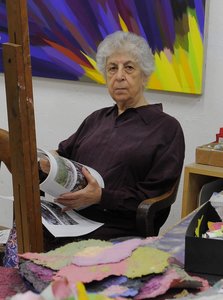
Samia Halaby
1936 - , Palestine
Kısa Bilgiler
- Artistic Movement Or Style: Abstract painting and Computer art
- Artists Or Movements Influenced By This Artist: ['Contemporary abstraction in the Arab world']
- Full Name: Samia A. Halaby
- Nationality: Palestinian-American
- Notable Artworks:
- Pink Flying Over Pink
- Pyramid
- White Cross
- Morning Rain
- Place Of Birth: Jerusalem, Palestine
- Date Of Birth: 1936