

 Önizle
 Gönder
 Paylaş
 Detaylar
 Rehber

 Dosyayı İndir
 Benzerleri
 X-Işını
 Slayt Gösterisi
 İstatistikler
Nude Study
 Acrylic On Canvas
- WallArt
- High Renaissance
 1515
1515 41.0 x 28.0 cm
 Devamını Oku
El Yapımı Yağlı Boya Reproduksiyon
Sanatçılarımız tarafından sipariş üzerine hazırlanan; istediğiniz boyut ve çerçevede, tuval üzerine el boyaması yağlı boya. ( Baskı Satışına Geç Dijital Görsel Satışına Geç)




P118B ₺10

P118H ₺10

P118W ₺10

P438Z ₺10

P508JH ₺12

P508YH ₺12

P805H ₺10

P805Z ₺10

P919BZ ₺10

P919G ₺10

P919XJ ₺10

P959ZH ₺10

P968JZ ₺12

W106C ₺8

W218G ₺10

W218JH ₺8

W218Y ₺10

W307PJ ₺10

W316G ₺10

W316PJ ₺8

W316Y ₺10

W398PJ ₺8

W4111J ₺10

W500HY ₺15

W500JH ₺15

W692G ₺12

W849H ₺8

W940BG ₺15

W953PJ ₺8




Eserin orijinal oranlarıyla uyumlu, önceden belirlenmiş boyutlarımız arasından seçim yapın.

Çerçevenize veya duvarınıza uygun olması için ihtiyacınız olan genişliği ve yüksekliği yazın. Bu eser el boyamasıdır; bu nedenle farklı bir formdaki boyutlar için sanatçı, resmin etrafına biraz daha fazla boya ekleyebilir veya biraz daha kırpabilir — seçim sizin. Boyama işlemi başlamadan önce onaylamanız için size bir dijital taslak gönderiyoruz. Bu sayfada gösterilen resim gerçek sonucu yansıtmamaktadır — gerçek sonucu yalnızca taslak göstermektedir.
Siparişten sonra, OriginalUniqueArt.com ekibi talimatlar için müşteriye e-posta gönderecek ve bir taslak önizleme sunacaktır
Dünya Çapında Teslimat (); standart 5 hafta yerine 3/4 haftada. (21 Ekim). Kaliteden ödün verilmez.

Dünya Çapında Ücretsiz Ekspres Kargo

Yüksek Kaliteli Keten Tuval

Tam Nakliye Sigortası

Gümrük Vergisi İadesi Garantisi

Gerçek Renk Uyumu Garantisi

100 Günlük İade Koşulları (Sadece Üretim Hatalı Ürünler İçin)

%100 Para İade Garantisi

Toplu Alım Avantajı
 Cam seçeneği yalnızca 110 cm altındaki boyutlar için mevcuttur.

Nude Study
Baskı Tekniği
Baskı Boyutu
-


Toplam Fiyat
₺ 14651
A Study in Male Form and Reflection: Raphael’s ‘Nude Study’ (1515)
Raphael’s “Nude Study,” painted in 1515, is more than simply a depiction of two nude male figures; it's a profound meditation on masculinity, power, and the very nature of representation. Emerging from the vibrant artistic crucible of Urbino – a city renowned for its humanist ideals and patronage under Duke Federico da Montefeltro – Raphael’s early works already demonstrated an extraordinary command of anatomy and a nascent ability to imbue his subjects with psychological depth. This particular piece, executed during a period of intense experimentation within his studio, reveals the artist grappling with complex themes through a deceptively simple composition.
The painting immediately draws the eye to the central figures, positioned before an ornate mirror that dominates the background. The mirroring effect creates a captivating visual loop, doubling the presence of the men and subtly suggesting notions of duality – perhaps representing opposing forces or even the artist’s own internal struggles with artistic identity. The figures themselves are rendered with a remarkable sensitivity to light and shadow, characteristic of Raphael's developing style. Notice how he masterfully uses *chiaroscuro*—the dramatic contrast between light and dark—to sculpt their forms, emphasizing musculature and creating a sense of volume that transcends mere representation. The smooth, almost porcelain-like quality of the skin speaks to Raphael’s meticulous study of human anatomy, informed by his father's artistic practice and the prevailing Renaissance interest in classical ideals of beauty.
The Weight of Weapons and Ancient Echoes
Crucially, these are not idealized figures adrift in a timeless realm. Both men are armed – one holding a sword, the other a bow – elements that immediately anchor the scene within a historical context. While the precise narrative remains open to interpretation, the inclusion of weaponry hints at potential allegorical meanings. Some scholars suggest connections to ancient Greek mythology, perhaps referencing scenes from heroic tales where male figures embody strength and martial prowess. Others propose a Roman influence, recalling depictions of gladiators or warriors engaged in battle. The juxtaposition of nudity with weapons creates a tension, suggesting vulnerability alongside power, a delicate balance that is central to the painting’s emotional resonance.
The positioning of the figures – one turned away from the viewer and the other facing forward – further complicates the narrative. This deliberate asymmetry invites speculation about their relationship and intentions. Is there an unspoken dialogue between them? Does the averted figure represent a hidden truth or a concealed emotion? Raphael’s masterful use of space and perspective encourages the viewer to actively participate in constructing the story, transforming the painting into a dynamic invitation to interpretation.
Technique and the Urbino Renaissance
Raphael's technique in “Nude Study” is a testament to his burgeoning skill and the artistic innovations flourishing during the Urbino Renaissance. He employed *sfumato*, a subtle blurring of lines and edges, particularly around the figures’ contours, creating an ethereal quality that softens their forms and imbues them with a sense of grace. The use of oil paint allowed for layering and blending, contributing to the painting's rich textures and luminous colors. The palette is restrained – primarily earthy tones punctuated by subtle highlights – reflecting the refined aesthetic sensibilities of the time.
Furthermore, this work exemplifies Raphael’s early engagement with humanist principles. He wasn’t simply replicating classical forms; he was actively analyzing them, understanding their underlying structure and applying that knowledge to create a distinctly modern interpretation. The attention to detail, the psychological depth conveyed through gesture and expression, and the masterful manipulation of light and shadow all point to a young artist poised to become one of the most celebrated figures in Western art history.
A Timeless Reflection: Reproduction Options
OriginalUniqueArt offers exquisite, hand-painted reproductions of Raphael’s “Nude Study,” meticulously crafted to capture the essence of this captivating masterpiece. Our skilled artisans utilize archival-quality materials and techniques that faithfully replicate the original's luminosity and texture. Whether you seek a stunning addition to your art collection or a sophisticated element for your interior design, our reproductions provide an authentic and enduring representation of Raphael’s profound exploration of human form and reflection. Explore our range of sizes and framing options today – each reproduction is a testament to the enduring power of Renaissance artistry.
Soru ve Cevaplar
Raffaello imzalı "Nude Study" eserinin renk kimliği nedir?
"Nude Study", Driftwood (#ab7b6a) tarafından yönetilen Monochrome bir palet ile tanımlanmaktadır."
Raffaello imzalı "Nude Study" eserinin renk doygunluğu nedir?
"Nude Study" eserinin renk paleti, Muted düzeyinde bir doygunluğa sahiptir.
Raffaello imzalı "Nude Study" tanınmış bir sanat eseri mi?
"Nude Study", Iconic olarak sınıflandırılmaktadır.
Sanatçı Biyografisi
Raffaello Sanzio: Rönesansın Işığı ve Uyumunun Ustası
Rönesans’ın en parlak yıldızlarından biri olan Raffaello Sanzio da Urbino, dünyaya 1483 yılında İtalya'nın küçük ama zihinsel açıdan canlı bir şehir devleti olan Urbino'da gözlerini açtı. Babası Giovanni Santi, sadece bir ressam değil, aynı zamanda Duke Federico da Montefeltro’nun şairi ve sanat alanındaki yenilikleri arayan bir düşünürdü. Bu soylu çevrede büyümek, genç Raffaello’nun sanatsal ve entelektüel gelişimini derinden etkiledi. Babasının erken ölümü, ona sorumluluk yüklerken aynı zamanda ailesinin atölyesinde yeteneklerini geliştirmesi için de bir fırsat yarattı. İlk dönem eserlerinde bile ortaya çıkan zarif duruşu ve detaylara gösterdiği özen, olgunlaşmış tarzının habercisiydi.
Umbria’dan Floransa’ya: Yeni Etkilerin Peşinde
Raffaello'nun sanatsal yolculuğu, sürekli bir evrim sürecinden geçti. Perugia'da Pietro Perugino yönetimindeki eğitimiyle Umbriya tarzının temellerini attı – yumuşak modellemeler, uyumlu kompozisyonlar ve sakin dini sahnelerle karakterize edilen bir stil. Ancak Raffaello’nun doyumsuz merakı onu yeni zorluklara yöneltti. 1504 yılında Floransa'ya yaptığı yolculuk, Leonardo da Vinci ve Michelangelo gibi sınırları zorlayan sanatçılarla tanışmasına vesile oldu. Leonardo’nun sfumato tekniğini, yani ışık ve gölge geçişlerindeki inceliği; Michelangelo’nun ise güçlü anatomik detaylarını ve dramatik kompozisyonlarını büyük bir dikkatle inceledi. Bu Floransa dönemi, Raffaello için gerçek bir eriyiş noktası oldu; onu yeni sanatsal olanaklarla yüzleştirdi ve bunları kendi özgün vizyonuyla sentezlemeye zorladı. Özellikle bu dönemde Madonna serilerindeki artan dinamizm ve psikolojik derinlik, bu etkilerin somut kanıtı olarak görülebilir.
Roma’daki Zafer: Komisyonlar ve Başyapıtlar
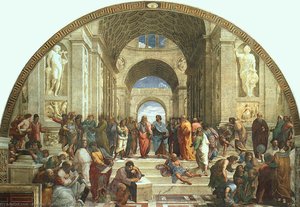
1508 yılında Raffaello'nun kariyerini değiştirecek bir daveti aldı – Papa II. Julius tarafından Roma'ya çağrıldı. Bu, onun en verimli ve kutlu döneminin başlangıcı oldu. Roma, ona eşsiz fırsatlar sundu; Vatikan’daki papal saraylarını nefes kesici fresklerle süsleme imkanı buldu. Athena Okulu (La Scuola di Atene), belki de en ünlü eseri olarak, kompozisyon, perspektif ve felsefi alegori konusundaki ustalığını gözler önüne seriyor. Bu görkemli mekanda Raffaello, Antik Yunan’dan figürleri – Plato, Aristoteles, Pisagor, Öklid gibi – bir araya getirerek insan aklının ve bilgi peşinde koşmanın kutlaması niteliğinde canlı bir tablo yarattı. Daha sonra Leo X ve diğer papalar için de çalışarak Stanze della Segnatura ve Stanza d'Eliodoro gibi devasa projelerde yer aldı. Bu odalardaki freskleri sadece dekoratif değil, aynı zamanda papal gücüne, dini inançlara ve Rönesans ideallerine dair derin açıklamalar niteliğindedir.
Zarafet ve Uyumun Sentezi: Raffaello'nun Sanatsal Tarzı
Raffaello’nun sanatsal tarzı genellikle zarafet, açıklık ve idealize edilmiş güzelliğin uyumlu bir karışımı olarak tanımlanır. Farklı etkileri – Umbriya geleneği, Floransa yenilikleri, Antik Yunan – kendi eşsiz estetiğine sentezleme konusunda olağanüstü bir yeteneğe sahipti. Kompozisyonları titizlikle planlanmıştır; Rönesans ilkelerinin derinlemesine anlaşılmasını yansıtan bir düzen ve orantı duygusu sergiler. Figürleri sakin bir onur ve duygusal ifade yayar, insan mükemmelliği idealini somutlaştırır. Aynı zamanda usta bir renkleyiciydi; hem görsel olarak büyüleyici hem de zihinsel olarak uyarıcı eserler yaratmak için zengin, aydınlık tonlar kullandı. Michelangelo’nun sıklıkla dramatik ve çalkantılı tarzının aksine Raffaello'nun çalışması sakinlik ve uyum duygusu yayar – bu nitelik yüzyıllardır izleyicileri büyülemiştir.
Mirası ve Süregelen Etkisi
Raffaello’nun 1520 yılında otuz yedi yaşında erken ölümü, potansiyeliyle dolu bir kariyeri kesintiye uğrattı. Ancak mirası, Batı sanat tarihinin en önemli figürlerinden biri olarak yaşamaya devam ediyor. Çalışmaları, Yüksek Rönesans estetiğinin temel taşı haline geldi ve nesiller boyunca sanatçılara örnek oldu. Michelangelo’nun etkisi daha sonra sanatsal söylemi domine etse de, Raffaello'nun açıklık, uyum ve idealize edilmiş güzelliğe verdiği önem Neoklasik dönemde Johann Joachim Winckelmann gibi eleştirmenler tarafından yeniden canlandırıldı. Bugün, resimleri hala hayranlık ve takdir uyandırıyor; teknik parlaklıkları, duygusal derinlikleri ve kalıcı çekicilikleriyle izleyicileri büyülemeye devam ediyor. Onun etkisi sayısız takip eden eserde görülebilir, bu da onu Rönesans’ın gerçek bir ustası olarak pekiştirir – sadece konularının fiziksel görünümünü değil, aynı zamanda insan zarafetinin ve onurun özünü de yakalayan bir ressam.

Raffaello
1483 - 1520 , İtalya
Kısa Bilgiler
- Artistic Movement Or Style: Yüksek Rönesans
- Artists Or Movements Influenced By This Artist: ['Neoklasik resim']
- Artists Who Influenced This Artist:
- Leonardo da Vinci
- Michelangelo
- Date Of Birth: 1483
- Date Of Death: 1520
- Full Name: Raphael
- Nationality: İtalyan
- Notable Artworks:
- Atina Okulu
- Sistine Madonna
- Dönüşüm
- Place Of Birth: Urbino, İtalya
İlgili Yazılar
Michelangelo'nun En İyi 25 Eseri: Rönesans Sanatının İkonları Evlerinize Geliyor
Michelangelo'nun en iyi 25 eserini keşfedin! Rönesans sanatının zirvesinden ikonik heykeller, freskler ve tablolarla evinizi zenginleştirin. Sanat tarihine yolculuk yapın ve OriginalUniqueArt.com'da benzersiz dekorasyon fikirleri bulun.
The Renaissance Trinity: A Comparative Study of Leonardo, Michelangelo, and Raphael
Explore the profound genius of the Renaissance Trinity. Delve into a comparative study of Leonardo da Vinci, Michelangelo, and Raphael, uncovering their unique contributions to art history, technique, and the enduring legacy of Italian High Renaissance mastery.

The Enduring Allure of the Nude: A Historical & Artistic Exploration of the Human Form
Explore the captivating history of nude art! Discover iconic paintings & artists from classical to modern eras. Uncover symbolism, techniques & find museum-quality reproductions at OriginalUniqueArt.
Raffaello'nun En İyi 25 Eseri: Sanat Tarihine Yolculuk | OriginalUniqueArt
Raffaello'nun en iyi 25 eserini keşfedin! Rönesans sanatının zirvesinden ikonik tablolar, freskler ve portrelerin hikayelerini okuyun. Ev dekorasyonunuz için yüksek çözünürlüklü sanat baskıları OriginalUniqueArt'ta. Koleksiyonu şimdi keşfedin!
Leonardo da Vinci'nin En İyi 25 Eseri: Sanat Tarihine Yolculuk
Leonardo da Vinci'nin en iyi 25 eserini keşfedin! Rönesans sanatının zirvesinden Mona Lisa, Son Akşam Yemeği ve daha fazlası… Sanat tarihine yolculuk yapın, teknikleri öğrenin. OriginalUniqueArt.com’da yüksek kaliteli reproduksiyonlarla evinizi zenginleştirin.




![Stanze Vaticane - Heliodorus'un Tapınak'tan Kovuluşu (detay) [02]](/media/artworks/images-thumb/3a/23/3a2308b63b60b5cb105575e135028d92.jpg)
