Baskı Satışına Geç
 Tümünü Gör







































 Herhangi bir kenarı 105 cm'den (yaklaşık 41 inç) büyük olan sanat eserleri veya reprodüksiyonlar için çerçeve, demonte edilmiş bir kit halinde gönderilecektir. Bu yöntem, güvenli teslimat sağlar ve taşıma sırasında oluşabilecek hasarları önler.


Pablo Picasso’s Fragmented Narrative: David and Bethsheba
Pablo Ruiz y Picasso, born in Málaga, Spain, on October 25, 1881, stands as one of the most influential figures in twentieth-century art. Legend recounts that his earliest utterances were “piz,” an earnest attempt to pronounce ‘pencil,’ reflecting a lifelong dedication to visual expression—a predisposition nurtured by his father’s artistic guidance and shadowed by personal tragedies that subtly informed his oeuvre. Even during formal studies at Barcelona’s School of Fine Arts and brief explorations of the Royal Academy of San Fernando, Picasso consistently resisted convention, prioritizing experimentation over adherence to established norms. This rebellious spirit propelled him toward groundbreaking innovations that would redefine artistic boundaries.- Subject Matter: Picasso reimagined Lucas Cranach's iconic biblical scene depicting King David’s illicit desire for Bathsheba—a tale of ambition and transgression rendered in a strikingly unconventional manner.
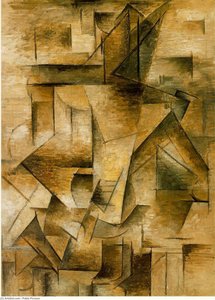
- Style & Movement: The artwork embodies the core tenets of Cubism alongside Surrealist influences. Fragmentation dominates, presenting multiple perspectives simultaneously, disrupting spatial illusion and challenging traditional artistic conventions.
Technique: Linocut Printing – A Bold Geometric Aesthetic
The piece’s execution is masterful linocut printing—a technique renowned for its ability to produce striking graphic images with exceptional precision. Picasso meticulously carved into a sheet of linoleum, transferring the image onto paper through ink application. This process yielded ten states between 1947 and 1949, demonstrating his unwavering commitment to exploring textural nuances and tonal variations within this medium. The resulting print possesses a characteristic etched appearance—a testament to linocut’s inherent qualities—characterized by sharply defined lines and angular shapes that contribute to the artwork's dynamic energy.- Material: Linoleum, Ink
- Process: Relief Printing – Carving into Linoleum
Symbolism & Emotional Resonance: Deconstructing Reality
Beyond its formal considerations, ‘David and Bethsheba’ resonates with profound symbolic depth. Picasso deliberately dismantles Cranach's composition—a deliberate act of artistic appropriation—to convey a sense of disorientation and unease. The arrangement of objects – a chair, table, vase, jewelry, foliage – feels unsettlingly fragmented, mirroring the broader Surrealist preoccupation with subconscious imagery and destabilizing perceptions of reality. This stylistic choice isn’t merely decorative; it serves as a conduit for conveying themes of alienation and questioning established narratives.Historical Context & Artistic Legacy
Created during Picasso's prolific period, ‘David and Bethsheba’ exemplifies the artistic fervor of the early 20th century—a time marked by seismic shifts in artistic thought and practice. It stands as a pivotal contribution to Cubist aesthetics, furthering the movement’s exploration of geometric abstraction and multiple viewpoints. Furthermore, it aligns with Surrealism's fascination with dreamlike imagery and psychological complexity. Picasso’s enduring influence extends far beyond his own lifetime, inspiring generations of artists and cementing his place among the titans of modern art.Soru ve Cevaplar
"David and Bethsaba" eserinde hangi ruh hali ve duygu bir araya geliyor?
"David and Bethsaba" eserinde, Dramatic bir ruh hali Melancholic bir duyguya eşlik ediyor.
"David and Bethsaba" için önerilen kullanım alanı ve amacı nedir?
Pablo Picasso imzalı "David and Bethsaba" için kaydedilen iki öneri; kullanım (Accent) ve alan (Living Room) şeklindedir.
Pablo Picasso imzalı "David and Bethsaba", Cubism akımı içerisinde nasıl bir duygu yansıtıyor?
"David and Bethsaba" eserinin Melancholic duygusu, Cubism üslubuyla birleşiyor.
Bu tablo hakkında daha fazla bilgi
 Gerçek Boyutta Önizle
 Paylaş
 Paylaş
 Detayları Gör
 Rehber

 İndir
İndir
 Benzer ürünler
 X-Işını
 Slayt Gösterisi
 Soru & Cevap
 İstatistikler