Abstract Expressionism · 1953
Untitled (Mark Rothko, 1953)
Untitled, Mark Rothko (1903–1970) tarafından yapıldı. 1953 yılına aittir. Abstract Expressionism akımına aittir. Oil On Canvas ile yapılmıştır. Bilbao, İspanyadaki Guggenheim Müzesi Bilbao bünyesinde korunmaktadır. Boyutları 299 × 442 cm'dir.
- 1953
- Oil On Canvas
- 299 × 442 cm
- Guggenheim Müzesi Bilbao

 Gerçek Boyutta Önizle

 El Yapımı Yağlı Boya Tablo
 Paylaş
 Paylaş
 Bilgi formu


 İndir
 Benzer ürünler
 X-Işını
 Slayt Gösterisi
 Soru & Cevap

 İstatistikler
Untitled hakkında kısa bilgi
- Başlık
- Untitled
- Sanatçı
- Mark Rothko (1903–1970)
- Sanatçının doğum yeri
- Daugavpils, Letonya
- Tarih
- 1953
- Teknik
- Oil On Canvas
- Boyutlar
- 299 × 442 cm
- Nerede görülebilir
- Guggenheim Müzesi Bilbao, Bilbao, İspanya
- Dönem
- Modern
- Konu
- color field painting, emotional resonance, chromatic harmony, minimalism, atmospheric depth, geometric forms
Untitled neyi betimliyor?
The Creation of Untitled by Mark Rothko
To understand Untitled, one must look toward the origins of Mark Rothko. He was born in 1903 in a place now known as Daugavpils, Latvia. His early years were shaped by the atmosphere of the Pale of Settlement, a region marked by political unrest and the constant shadow of pogroms. This sense of instability followed his family when they emigrated to the United States in 1913, eventually settling in Portland, Oregon. These formative experiences of displacement and loss became a quiet foundation for the man he would become.
By 1953, Rothko had moved into a period of profound abstraction. He painted Untitled during this time, a year that sits within his prolific New York period. The work emerged from a long transition away from the structured realism of his youth. He had moved past the depiction of urban scenes and portraits, seeking instead a way to express the weight of human experience without relying on the literal shapes of the physical world. This shift allowed him to focus on the internal landscape of emotion.
The artist continued to refine this language of color until his death in 1970. In Untitled, we see the result of this lifelong search for a direct encounter with the viewer. He stripped away titles that might suggest a specific narrative, leaving us to face the pigment itself. The canvas becomes a space for quiet, heavy presence, inviting a confrontation with the fundamental mysteries of existence.
Visual Composition and Color Fields
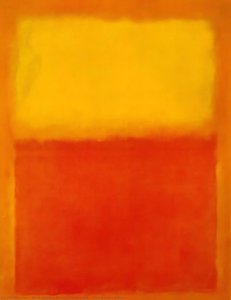
The canvas presents a large-scale encounter with two primary chromatic zones. A yellow background dominates the majority of the space, providing a luminous foundation for the composition. Overlaid upon this expanse is a section of red paint, which occupies a smaller area and is positioned toward the right side of the work. This arrangement creates a deliberate imbalance, drawing the eye across the field of color.
The interaction between these two sections is marked by a sense of quiet movement. In certain areas, the red pigment appears to be fading, which lends the surface a weathered quality. This subtle degradation suggests the passage of time, as if the colors are slowly receding into the canvas itself. The relationship between the expansive yellow and the concentrated red creates a tension that defines the visual structure of the piece.
Technique and Material Application
To understand this work, one must consider the patient, layered process Rothko employed. He utilized a method known as color field painting, moving away from the heavy, textured brushstrokes of traditional realism. Before any color was applied, he meticulously prepared the canvas with gesso, creating a smooth, receptive surface. This preparation allowed him to work with thin washes of oil paint, building the composition through a slow accumulation of pigment. Each layer was applied with a sense of lightness, allowing the colors to interact within the fibers of the cloth.
As the paint dried, it developed a characteristic matte sheen. This finish avoids the aggressive glare of high-gloss oils, instead offering a soft, diffused light that seems to emanate from within the canvas itself. The edges of the rectangular forms are never sharp or defined; they are intentionally blurred and soft. This technique allows the cadmium yellow and crimson to bleed into one another, creating a sense of depth and a breathing, permeable boundary between the hues.
Interpretations of Color and Form
The interaction between the two primary hues suggests a dialogue between opposing human states. The yellow field acts as a beacon, representing enlightenment and optimism. In contrast, the crimson section embodies passion, sacrifice, and primal emotion. These colors do not merely sit side by side; they meet in a way that suggests the tension inherent in the human condition.
The composition relies on the presence of these rectangular blocks to guide the viewer's internal experience. One might see these forms as the boundaries between consciousness and the unconscious. The scale of the canvas is intentional, designed to envelop the person standing before it. This immersion encourages a meditative state, where the viewer is no longer an observer but a participant in the space created by the pigment.
Related Works by Mark Rothko
To understand the evolution of this period, one might look toward his later explorations of color and scale. In 1956, he produced Orange and yellow, a work that continues his investigation into how luminous hues interact within a defined space. His practice also moved toward more specific, numbered compositions, such as No. 5 No. 22, which demonstrate his commitment to the language of abstraction through the use of large, breathing rectangular forms.
The artist also engaged deeply with the architecture of specific environments. He developed the Seagram murals, a series of paintings intended for a New York restaurant, though he eventually chose to donate them to the Tate Gallery in London. Similarly, his interest in how color occupies a room led to the creation of the Harvard Mural series, designed for a dining room at the Holyoke Center. These large-scale projects show his desire to create an immersive atmosphere where the viewer is enveloped by the presence of the paint.
Where to See This Artwork Today
This specific canvas, created around 1953, resides within the permanent collection of the Guggenheim Museum Bilbao. Located in Bilbao, Spain, the museum provides a space where this work can be experienced in its intended scale. The institution is part of the Solomon R. Guggenheim Foundation and maintains a collection that spans the 20th and 21st centuries.
Visiting the museum allows for a direct encounter with the subtle shifts in color that define this piece. The architecture of the building provides a contemporary setting for such a significant work of the mid-twentieth century. It remains a central part of the museum's holdings, offering a quiet moment of reflection within the broader context of modern and contemporary art.
Untitled adlı eseri hangi müze bünyesinde barındırmaktadır?
Guggenheim Müzesi Bilbao
Bilbao, İspanya
Guggenheim Müzesi Bilbao'nun Tarihçesi Guggenheim Müzesi Bilbao'nun kökenleri, Bask Hükümeti'nin yeni bir kültürel kurumun kurulmasını önerdiği 1991 yılına kadar uzanmaktadır. Bu girişim, İspanya'nın Bask Bölgesi'ndeki Bilbao'nun endüstriyel manzarasını dönüştürmeyi hedefleyen vizyoner bir adımdı. Bu hayali gerçeğe dönüştürmek adına Bask Hükümeti, inşaat maliyetleri için 100 milyon ABD doları ve eser alımları için 50 milyon dolarlık bir fon dahil olmak üzere çok önemli kaynaklar ayırdı.


Untitled için yüksek çözünürlüklü görseller

Protected by copyright: these files are for personal reference, not a licence to republish.
Mark Rothko, Untitled (1953), Guggenheim Müzesi Bilbao.
Untitled hakkında sorular ve cevaplar
Mark Rothko imzalı "Untitled" eseri bugün nerede sergileniyor?
Mark Rothko imzalı "Untitled", Guggenheim Müzesi Bilbao, Bilbao, İspanya bünyesinde sergilenmektedir. Müze bilgisi reprodüksiyonları değil, eserin orijinalini ifade eder.
"Untitled" hangi yıl yapıldı?
"Untitled", 1953 yılına tarihlenmektedir. Bu tarih, eseri Mark Rothko kariyerinin ve dönemin içerisine yerleştirmektedir.
Mark Rothko imzalı "Untitled" hangi teknikle icra edilmiştir?
Mark Rothko imzalı "Untitled" eserinin tekniği Oil On Canvas kullanılarak uygulanmıştır. Çoğaltımlar, bu tekniğin görünümünü yansıtmayı amaçlamaktadır.
Orijinal Mark Rothko imzalı "Untitled" eserinin boyutları nedir?
Orijinal Mark Rothko imzalı "Untitled" eseri 442 x 299 cm boyutlarındadır.
"Untitled" neyi betimliyor?
Mark Rothko imzalı "Untitled" eserinde yer alan temalar color field painting, emotional resonance, chromatic harmony, minimalism, atmospheric depth, geometric forms, texture unsurlarını içermektedir. Bunlar birlikte, eserin konu içeriğini özetlemektedir.
"Untitled" eseri kamu malı mı?
Mark Rothko imzalı "Untitled", telif hakları ile korunmaya devam etmektedir statüsündedir. Bu durum, eserin görüntüsünün nasıl çoğaltılabileceğini belirler.
"Untitled" eserinin yaratıcısı kim?
"Untitled", Mark Rothko tarafından yaratılmıştır. Bu sayfadaki bilgiler Mark Rothko imzalı orijinal esere aittir.
Mark Rothko imzalı "Untitled" hangi sanat akımına dahil?
"Untitled", Abstract Expressionism akımına ait bir eserdir. Bu akım, eserin dahil olduğu sanatsal geleneği ifade eder.
"Untitled" adlı eser, Mark Rothko kariyerinin hangi dönemine ait?
"Untitled", Mark Rothko sanatçısının Mature Period dönemini temsil etmektedir."
Sanatçı hakkında, Mark Rothko

1903–1970, Letonya
Mark Rothko
Mark Rothko'nun İlk Yılları Mark Rothko, 1903 yılında Markus Yakovlevich Rothkowitz adıyla dünyaya geldi. Bugün Letonya'nın Daugavpils şehri olarak bilinen, o dönemlerde Rusya sınırları içinde yer alan Dvinsk'te doğan sanatçı, ailesiyle birlikte siyasi çalkantıların ve pogromların bitmek bilmeyen gölgesinin hissedildiği Yerleşim Bölgesi'nde (Pale of Settlement) büyüdü. Bu istikrarsız atmosfer, ailenin 1913 yılında Amerika Birleşik Devletleri'ne göç etmesiyle birlikte hayat boyu sürecek bir yolculuğun ilk adımı oldu. Ellis Adası üzerinden geçtikten sonra Oregon, Portland'da yeni bir hayata tutunmaya çalıştılar.
Mark Rothko Hakkında Mark Rothko tarafından yapılmış öne çıkan eserler
Mark Rothko tarafından yapılan diğer eserler
 Erken Yaşam ve Sanatsal Vizyonun Tohumları
Mark Rothko, 1903'te Dvinsk, Letonya'da (şimdiki Daugavpils) Markus Yakovlevich Rothkowitz olarak doğdu ve başlangıçtan itibaren sanatsal yolculuğunu derinden etkileyecek bir yerinden olma duygusunu içinde taşıd1950
 No 1 (Royal Red and Blue)
 No.61 (Pas ve Mavi)1953
 Turuncu ve sarı1956
Untitled üzerine denemeler
 Mastering Emotion: The Top 25 Most Iconic Mark Rothko ArtworksImmerse yourself in the profound emotion of Abstract Expressionism. Explore our curated guide to the top 25 Mark Rothko masterpieces, from …
 Action Painting vs. Color Field Painting: A Guide to Two Abstract StylesMaster the differences between Action and Color Field painting through expert analysis. Explore these abstract styles now.
 The Architecture of Emotion: A Connoisseur’s Guide to the Chromatic Sublimity of Mark RothkoExplore the profound emotional landscapes of Mark Rothko. An expert editorial on Color Field painting, decoding the spiritual depth, techni…