Yağlı Boya Versiyonu
 Elijah Boardman hakkında her şey







































 Herhangi bir kenarı 105 cm'den (yaklaşık 41 inç) büyük olan sanat eserleri veya reprodüksiyonlar için çerçeve, demonte edilmiş bir kit halinde gönderilecektir. Bu yöntem, güvenli teslimat sağlar ve taşıma sırasında oluşabilecek hasarları önler.


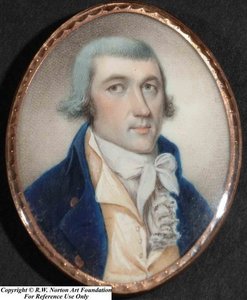
The Portrait of Elijah Boardman
The Portrait of Elijah Boardman by John Ramage is a work dated 1790. The subject of the painting is Elijah Boardman, an American politician who served as a senator from Connecticut. This portrait captures the likeness of Boardman during a period of significant political activity in the early United States.
John Ramage, the artist, was an Irish-born miniaturist and goldsmith. In this 1790 work, he depicts Boardman in a formal manner. The sitter is shown with white hair and is wearing a suit and tie. He is posed with a smile as he faces the viewer.
Visual Composition and Subject Matter
The portrait depicts a man positioned in a bust-length view. He possesses white hair and is captured in a moment of smiling as he poses for the viewer. His attire consists of a suit and a tie, clothing that suggests the fashion of the 18th century. The subject's facial expression and posture provide a sense of individual presence within the frame.
The composition is presented within a wooden frame that provides a sense of depth to the work. The subject's features are rendered with a focus on character and social standing. The arrangement of the figure against the background emphasizes the man's facial features and the specific details of his clothing.
Technique and Artistic Materials
The portrait is executed in watercolor on paper. This medium allows for a soft application of pigment, contributing to the work's old-fashioned appearance. The surface of the paper holds the washes of color that define the subject's features and attire. The light and shadow across the man's face and clothing are achieved through these diluted pigments, creating a sense of depth within the small scale of the work.
The artwork is presented within a frame. This frame is constructed from wood, providing a solid border that adds physical depth to the composition. The natural texture and warmth of the wood contrast with the delicate nature of the watercolor on paper. The combination of the organic material of the frame and the specific application of the watercolor contributes to the overall presentation of the piece.
Related Works by John Ramage
John Ramage produced several notable portrait miniatures during his career in North America. In 1789, he painted a portrait of George Washington, which is recognized as the first official depiction of the president while in office. This work was commissioned by Martha Washington and was executed on ivory. Other works from this period include a miniature of John Maunsell from 1785. This piece depicts a figure in a red coat, showing the artist's ability to render specific clothing and character through fine linear strokes.
The artist's portfolio also contains a miniature of James McGill. His practice involved creating portraits for various members of New York society. This included commissions for the Van Rensselaer family, whose portraits are part of his body of work. These various miniatures demonstrate the technical application of cross-hatching and delicate shading on elliptical ivory supports, a method used to define the facial features and social standing of his subjects.
Soru ve Cevaplar
Elijah Boardman adlı bu eser el ile mi boyanmıştır yoksa baskı mıdır?
El ile boyanmıştır: eğitimli bir ressam, Elijah Boardman eserini keten kanvas üzerine yağlı boya ile yeniden çalışır.
Elijah Boardman için hangi boyutu seçmeliyim?
Orijinal eser 5 x 4 cm boyutlarındadır. Boyutlar 35.4 x 28.3 cm (₺10035) ile 245.8 x 196.6 cm (₺88914) arasında değişmektedir; bu sayfadaki tablo ana seçenekleri ve fiyatlarını listelemektedir.
Teslimat ne kadar sürer?
Dünya çapında ücretsiz ekspres kargo ile teslimat 4 ila 5 hafta sürmektedir; bu sayfa üzerinden acil üretim seçeneği de sunulmaktadır. Hiçbir koşul aranmaksızın, 100 gün içinde tam iade ile ürünü geri gönderebilirsiniz.
Elijah Boardman adlı eserin orijinali nerede?
Orijinal eser Metropolitan Sanat Müzesi, New York koleksiyonunda yer almaktadır.
John Ramage, Elijah Boardman eserinde hangi tekniği/malzemeyi kullanmıştır?
Watercolor
Bu tablo hakkında daha fazla bilgi
 Gerçek Boyutta Önizle

 Paylaş
 Paylaş
 Detayları Gör
 Bilgi formu


 İndir
 Benzer ürünler
 X-Işını
 Slayt Gösterisi
 Soru & Cevap

 İstatistikler