
 Gerçek Boyutta Önizle
 Paylaş
 Paylaş
 Detayları Gör
 Rehber

 İndir
İndir
 Benzer ürünler
 X-Işını
 Slayt Gösterisi
 Q&A
Q&A İstatistikler
The Virgin of the Consolation


 Tümünü Gör
Giclée / Sanat Baskısı
Hızlı üretim ve esnek bitiş seçenekleriyle müze kalitesinde giclée veya kanvas baskı. ( El Yapımı Tablo Satın Al Dijital Görsele Geç)




P118B ₺10

P118H ₺10

P118W ₺10

P438Z ₺10

P508JH ₺12

P508YH ₺12

P805H ₺10

P805Z ₺10

P919BZ ₺10

P919G ₺10

P919XJ ₺10

P959ZH ₺10

P968JZ ₺12

W106C ₺8

W218G ₺10

W218JH ₺8

W218Y ₺10

W307PJ ₺10

W316G ₺10

W316PJ ₺8

W316Y ₺10

W398PJ ₺8

W4111J ₺10

W500HY ₺15

W500JH ₺15

W692G ₺12

W849H ₺8

W940BG ₺15

W953PJ ₺8




Eserin orijinal oranlarıyla uyumlu, önceden belirlenmiş boyutlarımız arasından seçim yapın.

Çerçevenize veya duvarınıza uygun olması için ihtiyacınız olan genişlik ve yüksekliği yazın. Bir baskı yalnızca kesilebilir, görselden daha büyük hale getirilemez; bu nedenle farklı bir formdaki boyut seçimi, görselin bir kısmının kaybına neden olur. Herhangi bir baskı yapmadan önce onaylamanız için size bir dijital taslak gönderiyoruz. Bu sayfada gösterilen resim gerçek kesimi göstermez — bunu yalnızca taslak gösterir.
Dünya Çapında Teslimat (); standart 4/5 hafta yerine 2 haftada. (2 Kasım)

Dünya Çapında Ücretsiz Ekspres Kargo

Yüksek Kaliteli Keten Kanvas

Tam Nakliye Sigortası

Gümrük Vergisi İadesi Garantisi

Gerçek Renk Uyumu Garantisi

100 Günlük İade Politikası (Sadece Kusurlu Ürünler İçin)

%100 Para İade Garantisi

Toplu Alım İndirimi
 Cam seçeneği yalnızca 110 cm altındaki boyutlar için mevcuttur.

The Virgin of the Consolation
Giclée / Sanat Baskısı
Reproduksiyon Boyutu
-


Toplam Tutar
₺ 3933
A Vision of Devotion: The Soul of Ensor’s Masterpiece
In the quiet corners of art history, few works possess the haunting, introspective power of James Ensor’s The Virgin of the Consolation. Painted around 1908, this profound achievement in Belgian Expressionism transcends mere portraiture to offer a meditation on faith, vulnerability, and the sacred. The canvas presents a scene of deep emotional resonance: a woman, draped in regal sapphire blue and adorned with a subtle crown, stands as a pillar of spiritual authority. Before her, a man kneels in a posture of palpable reverence, his gaze fixed upward with an intensity that bridges the gap between the earthly and the divine. It is a tableau that captures a fleeting moment of quiet contemplation, inviting the viewer to step into a space where the boundaries between the physical world and the spiritual realm begin to blur.
The composition is masterfully orchestrated to draw the eye inward, toward the emotional heart of the narrative. Framed by a somber archway that suggests an intimate sanctuary, the scene is further enriched by two canvases hanging above the central figures, depicting biblical scenes. These secondary paintings serve as visual echoes, reinforcing the Virgin Mary’s role as a conduit for divine grace and anchoring the work within a long tradition of sacred storytelling. For the discerning collector or interior designer, this piece offers more than just aesthetic beauty; it provides a focal point of profound depth, capable of anchoring a room with its heavy, contemplative atmosphere.
The Expressive Language of Light and Texture
Ensor’s technical execution is a testament to the transformative power of the Expressionist movement. Eschewing the rigid constraints of objective realism, he employs a muted, sophisticated palette dominated by deep blues, earthy browns, and shadowy tones. This choice of color creates an atmosphere of subdued solemnity, perfect for evoking the weight of religious devotion. The artist’s hand is visible in every thick, deliberate brushstroke, which lends a remarkable textural richness to the canvas. These impasto-like applications do not merely depict form; they emphasize the physicality of the paint itself, mirroring the psychological intensity and the raw, human emotions of the subjects depicted.
There is a deliberate distortion of perspective and form within the work that serves to amplify its emotional impact. By manipulating space, Ensor directs the viewer’s focus toward the interplay of light and shadow on the figures' faces and garments. This technique creates a sense of movement and life within the stillness of the scene. For those seeking to incorporate high-quality reproductions into a curated space, the tactile quality of Ensor’s style offers a sophisticated layer of visual interest, making it an ideal selection for environments that value texture, nuance, and the evocative power of fine art.
A Legacy of Shadows and Symbolism
To understand The Virgin of the Consolation, one must understand the world of James Ensor. Born in the seaside town of Ostend, Belgium, Ensor’s upbringing was steeped in the vibrant, often unsettling imagery of carnivals and masks. While much of his work explores the grotesque and the masked, this particular piece reveals a more tender, albeit haunting, side of his genius. The juxtaposition of the woman's regal crown with her apparent vulnerability speaks to the complexities of maternal devotion and the anxieties of the early 20th century, making the painting feel remarkably modern in its psychological depth.
The painting stands as a singular achievement that balances the unsettling with the sublime. It is a work that does not merely ask to be seen, but to be felt. Whether placed in a private gallery or used as a centerpiece in a thoughtfully designed interior, this reproduction of Ensor’s vision brings with it a sense of history and a profound emotional gravity. It remains an enduring invitation to contemplate the mysteries of faith and the enduring beauty found within the shadows of the human experience.
Soru ve Cevaplar
James Ensor imzalı "The Virgin of the Consolation" nasıl bir renk uyumu sergiliyor?
James Ensor imzalı "The Virgin of the Consolation", Softly Mixed Palette bir renk uyumu sergiliyor.
Surrealist Expressionism akımına ait olan "The Virgin of the Consolation" adlı eser hangi ülkeye aittir?
"The Virgin of the Consolation", yaratıcısının doğum yeri üzerinden Surrealist Expressionism akımını Belçika ile ilişkilendiriyor.
"The Virgin of the Consolation" adlı eser, James Ensor'in külliyatında nerede konumlanıyor?
"The Virgin of the Consolation", James Ensor'in diğer eserleriyle birlikte Surrealist Expressionism üslubunu ve işlenen temaları paylaşmaktadır: expressionist style, religious symbolism, mask imagery, psychological depth, artist legacy.
Sanatçı Özgeçmişi
James Ensor: A Pioneer of Expressionism and Surrealism
James Sidney Edouard Ensor (Ostend, 13 April 1860-19 November 1949) was a Belgian painter and printmaker, an important influence on expressionism and surrealism who lived in Ostend for almost his entire life. He was associated with the artistic group Les XX.
Early Life and Artistic Training
Ensor’s father, James Frederic Ensor, born in Brussels to English parents, was a cultivated man who studied engineering in England and Germany. Ensor’s mother, Maria Catharina Haegheman, was Belgian. Ensor himself lacked interest in academic study and left school at the age of fifteen to begin his artistic training with two local painters. From 1877 to 1880 he attended the Académie Royale des Beaux-Arts in Brussels, where one of his fellow students was Fernand Khnopff. Ensor first exhibited his work in 1881.
The Emergence of Expressionist Style
During the late 19th century much of Ensor’s work was rejected as scandalous, particularly his painting Christ’s Entry Into Brussels (1888–89). The Belgium art critic Octave Maus famously summed up the response from contemporaneous art critics to Ensor's innovative (and often scathingly political) work: “Ensor is the leader of a clan. Ensor is the limelight. Ensor sums up and concentrates certain principles which are considered to be anarchistic. In short, Ensor is a dangerous person who has great changes. ... He is consequently marked for blows. It is at him that all the harquebuses are aimed. It is on his head that are dumped the most aromatic containers of the so-called serious critics.” Some of Ensor's contemporaneous work reveals his defiant response to this criticism.
Key Works and Recurring Themes
Ensor’s artistic style evolved dramatically over time, reflecting a profound engagement with psychological exploration and social critique. Initially influenced by Rembrandt, Redon, Goya, Japanese woodcuts, Brueghelian images and contemporary spoofs, Ensor developed a highly personal iconography and design. He rejected French Impressionism and Symbolism and lent himself to the expressive qualities of light, line, colour and the grotesque and macabre motifs such as carnival masks and skeletons, which he rendered in massive tableaux such as *The Aureoles of Christ* (1885–86) and *Skeletons Fighting over a Hanged Man* (1891). These grotesque metamorphoses culminate in Ensor’s most well-known and monumental mask tableau: *Christ’s Entry Into Brussels* (1888–89, oil on canvas, Los Angeles, J. Paul Getty Museum).
Legacy and Influence
Ensor is now widely recognized as a pivotal figure in the transition from 19th-century Symbolism to early 20th-century Expressionism and Surrealism—a true pioneer of modern art. His fearless exploration of the subconscious, his embrace of grotesque imagery, and his rejection of academic conventions paved the way for future generations of artists who dared to challenge artistic norms. Despite facing initial resistance, Ensor eventually gained recognition in his later years, being named a Baron by King Albert I in 1929 and awarded the Légion d’honneur in 1933. He died in Ostend in 1949, leaving behind a body of work that continues to captivate, disturb, and inspire.

James Ensor
1860 - 1949 , Belçika
Kısa Bilgiler
- Artistic Movement Or Style: Expressionism, Surrealism
- Artists Who Influenced This Artist:
- Bruegel the Elder
- Francisco Goya
- Whistler
- Date Of Birth: April 13, 1860
- Date Of Death: November 19, 1949
- Full Name: James Sidney Edouard Ensor
- Nationality: Belgian
- Notable Artworks:
- The Scandalized Masks
- Skeletons Fighting...
- Christ's Entry into Brussels
- Place Of Birth: Ostend, Belgium
Benzer Yazılar

Masterpieces of the English Countryside: Top 25 Sir Alfred James Munnings Artworks
Explore 25 iconic Sir Alfred James Munnings masterpieces. Discover timeless equine art on OriginalUniqueArt.com.
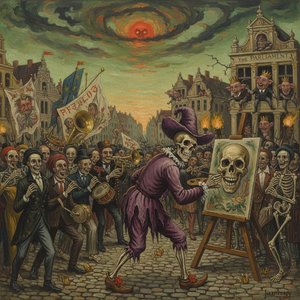
James Ensor's Grotesque Visions: Social Commentary & Artistic Innovation
Explore the unsettling yet captivating world of James Ensor, a pioneer of Expressionism. Discover his satirical masterpieces, symbolic imagery & lasting influence on modern art. High-quality reproductions available at OriginalUniqueArt.
The Raw Emotion of Expressionism: A Deep Dive into its History, Characteristics & Enduring Influence
Explore the raw emotion of Expressionism with OriginalUniqueArt. Discover its history, key artists like Kirchner & Munch, and lasting influence on modern art. Expert insights for collectors & enthusiasts.

James Abbott McNeill Whistler'ın En İyi 25 Eseri: Sanat ve Dekorasyon Rehberi | OriginalUniqueArt
James Abbott McNeill Whistler'ın en iyi 25 eserini keşfedin! Amerikan empresyonizminin öncüsü Whistler'ın nocturne resimleri, portreleri ve sanat tarihine damga vuran diğer başyapıtları OriginalUniqueArt.com'da. Ev dekorasyonunuz için lüks tabloları inceleyin.

Figurative Expressionism: Emotional Intensity & Subjective Reality in 20th-Century Art
Explore the powerful world of Figurative Expressionism with OriginalUniqueArt. Discover key artists like Kirchner & Beckmann, understand its emotional depth, and learn how to collect this influential 20th-century art movement.


