Yağlı Boya Versiyonu
 Carnival hakkında her şey







































 Herhangi bir kenarı 105 cm'den (yaklaşık 41 inç) büyük olan sanat eserleri veya reprodüksiyonlar için çerçeve, demonte edilmiş bir kit halinde gönderilecektir. Bu yöntem, güvenli teslimat sağlar ve taşıma sırasında oluşabilecek hasarları önler.


The Composition of Chaos
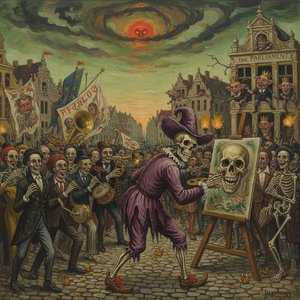
The canvas presents a dense arrangement of figures that occupy a shallow, crowded space. Within this composition, distorted faces and mask-like features emerge from a sea of movement. The palette relies on heavy applications of yellow, red, and white, which are set against dark outlines and deep shadows. Thick, jagged lines define the edges of the characters, creating a sense of physical friction between the overlapping forms. Ribbon-like shapes swirl through the frame, contributing to a flattened perspective where depth is difficult to discern.
The texture of the oil paint is tactile, with visible brushstrokes that remain prominent across the surface. These strokes follow organic, often irregular paths, reinforcing the movement of the crowd. Light falls unevenly across the scene, casting strange shadows upon the faces of the individuals. This lighting creates a theatrical effect, highlighting certain features while leaving others in murky obscurity. The figures themselves appear as a collection of grotesque and exaggerated shapes, their features rendered with a heavy, expressionistic hand.
Themes of Disguise and Social Unrest
The subject matter centers on a gathering of masked individuals, suggesting the atmosphere of a masquerade or a carnival. This choice of imagery draws from the artist's early life in Ostend, Belgium, where his parents operated a souvenir shop filled with shells and carnival masks. These objects provided a visual vocabulary for exploring themes of hidden identity and the fragility of outward appearances. The presence of these masks introduces an element of psychological tension, as the faces of the crowd are obscured by artificial layers.
The painting functions as a window into a nightmarish vision of social decay. Through the use of distorted anatomy and unsettling color contrasts, the work communicates a sense of profound unrest. The crowded nature of the composition mirrors the frantic energy of a festival, yet the underlying tone remains one of disorientation. By utilizing the medium of oil on canvas to create these heavy, textured forms, the artist captures a moment of intense, raw emotion that avoids traditional notions of beauty in favor of a more unsettling reality.
Soru ve Cevaplar
Carnival adlı bu eser el ile mi boyanmıştır yoksa baskı mıdır?
El ile boyanmıştır: eğitimli bir ressam, Carnival eserini keten kanvas üzerine yağlı boya ile yeniden çalışır.
Carnival için hangi boyutu seçmeliyim?
Orijinal eser 66.7 x 83.2cm boyutlarındadır. Boyutlar 28.2 x 35.4 cm (₺23764) ile 196.4 x 246.1 cm (₺102409) arasında değişmektedir; bu sayfadaki tablo ana seçenekleri ve fiyatlarını listelemektedir.
Teslimat ne kadar sürer?
Dünya çapında ücretsiz ekspres kargo ile teslimat 4 ila 5 hafta sürmektedir; bu sayfa üzerinden acil üretim seçeneği de sunulmaktadır. Hiçbir koşul aranmaksızın, 100 gün içinde tam iade ile ürünü geri gönderebilirsiniz.
Carnival adlı eserin orijinali nerede?
Orijinal eser Harvard Art Museums, Cambridge koleksiyonunda yer almaktadır.
James Ensor, Carnival eserinde hangi tekniği/malzemeyi kullanmıştır?
Oil On Canvas
Bu tablo hakkında daha fazla bilgi
 Gerçek Boyutta Önizle

 Paylaş
 Paylaş
 Detayları Gör
 Bilgi formu


 İndir
 Benzer ürünler
 X-Işını
 Slayt Gösterisi
 Soru & Cevap

 İstatistikler