Baskı Satışına Geç
 Devamını Oku







































 Herhangi bir kenarı 105 cm'den (yaklaşık 41 inç) büyük olan sanat eserleri veya reprodüksiyonlar için çerçeve, demonte edilmiş bir kit halinde gönderilecektir. Bu yöntem, güvenli teslimat sağlar ve taşıma sırasında oluşabilecek hasarları önler.


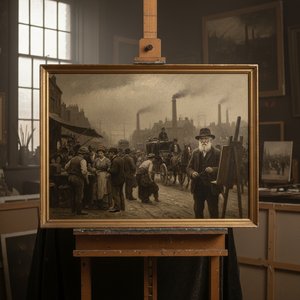
James Abbott McNeill Whistler’s Billingsgate: A Study in Atmospheric Harmony
James Abbott McNeill Whistler, born in Lowell, Massachusetts in 1834, stands as a pivotal figure in the burgeoning aesthetic movement of the mid-Victorian era—a painter who deliberately rejected narrative storytelling for pure artistic contemplation. His formative years were marked by constant relocation due to his father’s railroad engineering career, fostering within him an adaptability and exposure to diverse cultural landscapes that profoundly shaped his worldview. A brief, unsuccessful foray into military service at West Point underscored the incompatibility between Whistler's artistic inclinations and institutional discipline, followed by employment with the U.S. Coast and Geodetic Survey—a role that provided valuable observational experience but ultimately deferred the fulfillment of his lifelong ambition to pursue art professionally. These early influences instilled a deep conviction in Whistler’s mind: art should exist for its own sake, divorced from didactic purpose or moral instruction—a stance that would propel him into the vibrant intellectual circles of Europe and solidify his reputation as one of the era's most distinctive voices.- Subject Matter: Whistler’s ‘Billingsgate’ captures a quintessential scene of Victorian commerce – the bustling Billingsgate Fish Market on the Thames River in London. More than just a depiction of industry, it represents a deliberate effort to distill the essence of observation into tonal harmony and atmospheric effect.
- Style & Technique: The etching exemplifies Whistler's aesthetic principles; he eschewed meticulous detail in favor of capturing the mood and ambiance of the subject matter. Employing drypoint alongside etching needles, Whistler achieved remarkable textural nuances through hatching and cross-hatching—a technique that prioritizes tonal gradation over precise line rendering.
- Historical Context: Created in 1859, ‘Billingsgate’ reflects the broader preoccupation with Impressionism and tonalism prevalent during this period. Whistler's rejection of academic conventions aligned him with a movement seeking to liberate art from traditional constraints and explore subjective experience.
- Materials Used: Whistler utilized a copper printing plate meticulously etched with fine lines using etching needles and subsequently inked for printing on medium weight laid paper—a process that demanded precision and patience, reflecting Whistler’s unwavering commitment to craftsmanship.
Soru ve Cevaplar
"Billingsgate" adlı eser hangi sanatçıya atfediliyor?
"Billingsgate" adlı eserin James Abbott Mcneil Whistler tarafından yapıldığı düşünülmektedir.
Tonalist Aestheticism akımına ait olan "Billingsgate" adlı eser hangi ülkeye aittir?
"Billingsgate", yaratıcısının doğum yeri aracılığıyla Tonalist Aestheticism akımını Amerika Birleşik Devletleri ile ilişkilendiriyor.
Reading Public Museum bünyesinde bulunan James Abbott Mcneil Whistler imzalı "Billingsgate" adlı eserin yasal olarak çoğaltılması mümkün müdür?
Reading Public Museum bünyesinde bulunan James Abbott Mcneil Whistler imzalı "Billingsgate", kamu malıdır - telif hakkı süresi dolmuştur statüsündedir. Bu durum, görüntünün çoğaltılıp çoğaltılamayacağını belirler.
 Önizle
 Gönder
 Paylaş
 Detaylar
 Rehber

 Dosyayı İndir
 Benzerleri
 X-Işını
 Slayt Gösterisi
 Q&A
Q&A İstatistikler