Baskı Satışına Geç
 Tümünü Gör







































 Herhangi bir kenarı 105 cm'den (yaklaşık 41 inç) büyük olan sanat eserleri veya reprodüksiyonlar için çerçeve, demonte edilmiş bir kit halinde gönderilecektir. Bu yöntem, güvenli teslimat sağlar ve taşıma sırasında oluşabilecek hasarları önler.


A Kyoto Merchant’s Vision: The World of Ito Jakuchū
Ito Jakuchū (1716–1800) stands apart from his contemporaries as a singular voice in Edo period Japanese art—a figure whose artistic trajectory defied convention and cemented his legacy as one of Japan's most original masters. Unlike many artists of his time who adhered to established lineages, Jakuchu’s creative journey was profoundly shaped by his family’s prosperous mercantile background and an unwavering devotion to Zen Buddhist philosophy. His father, Ito Genzaemon, a successful grocer, afforded young Jakuchu the freedom to pursue his burgeoning talent for painting from a formative age—a circumstance that fostered not only artistic skill but also a nuanced understanding of societal shifts and the growing influence of Kyoto’s merchant class—a perspective subtly woven into Jakuchū's distinctive visual language. While familial obligations might have steered others toward business pursuits, Jakuchu’s heart resided in the realm of art, driven by an irresistible impulse to distill life’s essence onto silk and ink.Six Poetic Immortals: Symbolism and Composition
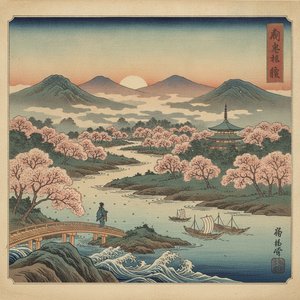
“Six Poetic Immortals” embodies Jakuchū's revolutionary approach to landscape painting—a genre traditionally dominated by meticulous detail and idealized vistas. Instead of striving for photographic accuracy, Jakuchū sought to capture a fleeting moment of sublime beauty, prioritizing atmosphere and suggestion over precise representation. The six figures seated on chairs are not merely subjects; they serve as conduits for Zen contemplation, embodying the ideals of harmony, balance, and detachment. Each posture conveys a specific meditative state—seated upright with eyes lowered, hands resting in repose—reflecting the core tenets of Zen Buddhism’s emphasis on mindfulness and inner stillness. The placement of the figures within the composition is equally deliberate: they are positioned to create a dynamic interplay between solidity and emptiness, mirroring the Buddhist concept of ‘mu,’ or no-thingness.Technique and Materiality: Jakuchū's Unique Approach
Jakuchū’s mastery lay not in technical virtuosity but in an uncanny ability to coax extraordinary effects from humble materials—primarily inkstone pigment and paper. He employed a technique known as “yakinaoshi,” or “late-night illumination,” which involved applying ink thinly over moistened paper, allowing it to dry slowly and revealing subtle gradations of color and texture as it oxidized. This process yielded an ethereal luminosity that defied conventional methods, capturing the elusive beauty of twilight landscapes with unparalleled grace. The artist’s meticulous attention to detail—evident in the rendering of folds in drapery and the expressive gestures of the figures—was tempered by a profound awareness of spontaneity and improvisation. Jakuchū famously declared, “I do not strive for perfection; I aim for something like it,” encapsulating his artistic philosophy—a commitment to capturing the spirit of nature rather than replicating its surface appearance.Historical Context: Edo Period Aesthetics
“Six Poetic Immortals” emerged during Japan’s Edo period (1689–1868)—an era characterized by relative peace and economic prosperity, fostering a flourishing artistic culture. However, unlike earlier periods marked by elaborate court patronage, Edo aesthetics prioritized simplicity and understated elegance—a reaction against the opulent grandeur of feudal Japan. Jakuchū's work aligns perfectly with this trend, reflecting Zen Buddhism’s influence on intellectual and artistic sensibilities—a movement that championed introspection and sought to transcend sensory experience in pursuit of enlightenment. The painting’s serene atmosphere and evocative imagery resonated deeply with audiences attuned to the spiritual values of the time, establishing “Six Poetic Immortals” as a cornerstone of Edo landscape art.Emotional Impact: Capturing Sublime Beauty
Ultimately, “Six Poetic Immortals” transcends mere visual representation—it aspires to evoke profound emotional responses in the viewer. The painting’s luminous colors and delicate textures convey a sense of tranquility and wonder, transporting the observer to a realm beyond everyday concerns. Jakuchū's masterful manipulation of light and shadow creates an illusion of depth and dimensionality, inviting contemplation on the mysteries of existence. As viewers immerse themselves in this captivating artwork, they are encouraged to embrace the beauty of impermanence—to appreciate the fleeting moments of sublime splendor that punctuate life’s journey—a timeless message conveyed with exquisite artistry by Ito Jakuchū.Soru ve Cevaplar
"Six Poetic Immortals" için önerilen kullanım alanı ve amacı nedir?
Itō Jakuchū imzalı "Six Poetic Immortals", Accent için önerilmektedir; ideal olarak bir Living Room içerisinde sergilenmesi uygundur. Kullanım amacı ve mekan, reprodüksiyonun nereye yakışacağına dair yol gösterir.
"Six Poetic Immortals" eserini tam ekran slayt gösterisi olarak izleyebilir miyim?
"Six Poetic Immortals" adlı eserin slayt gösterisine esere ait Slayt Gösterisi sayfasından ulaşabilirsiniz.
"Six Poetic Immortals" adlı eserde hangi teknik kullanıldı ve eser ne zaman yapıldı?
"Six Poetic Immortals", 1791 yılında, Acrylic On Canvas tekniğiyle yapılmıştır."
 Gerçek Boyutta Önizle
 Paylaş
 Paylaş
 Detayları Gör
 Rehber

 İndir
İndir
 Benzer ürünler
 X-Işını
 Slayt Gösterisi
 Q&A
Q&A İstatistikler