
 Gerçek Boyutta Önizle
 Paylaş
 Paylaş
 Detayları Gör
 Rehber

 İndir
İndir
 Benzer ürünler
 X-Işını
 Slayt Gösterisi
 Soru & Cevap
 İstatistikler
Mother And Child 4

 Tümünü Gör
Bu sayfada sergilenen eser telif hakkı yasasıyla korunmaktadır; bu da yasal olarak eserin birebir kopyasını oluşturamayacağımız veya satamayacağımız anlamına gelir. Bu koruma, aşağıdakiler gibi uluslararası anlaşmalar kapsamında uygulanmaktadır: Bern Sözleşmesi ve aşağıdakiler de dahil olmak üzere ulusal yasalarca belirlenen ABD Telif Hakkı Kanunu - 17. Başlık.
Bu yöntem, koruma altındaki sanat eserinin kopyalanmasını veya çoğaltılmasını içermediği için telif hakkı düzenlemelerine tam uyum sağlar. Bunun yerine, yaratıcı bir yeniden yorumlamadır; orijinalinden etkilenen ancak onunla aynı olmayan yeni bir tablodur.
Giclée / Sanat Baskısı
Hızlı üretim ve esnek bitiş seçenekleriyle müze kalitesinde giclée veya kanvas baskı. ( El Yapımı Tablo Satın Al Dijital Görsele Geç)




P118B ₺10

P118H ₺10

P118W ₺10

P438Z ₺10

P508JH ₺12

P508YH ₺12

P805H ₺10

P805Z ₺10

P919BZ ₺10

P919G ₺10

P919XJ ₺10

P959ZH ₺10

P968JZ ₺12

W106C ₺8

W218G ₺10

W218JH ₺8

W218Y ₺10

W307PJ ₺10

W316G ₺10

W316PJ ₺8

W316Y ₺10

W398PJ ₺8

W4111J ₺10

W500HY ₺15

W500JH ₺15

W692G ₺12

W849H ₺8

W940BG ₺15

W953PJ ₺8




Eserin orijinal oranlarıyla uyumlu, önceden belirlenmiş boyutlarımız arasından seçim yapın.

Çerçevenize veya duvarınıza uygun olması için ihtiyacınız olan genişlik ve yüksekliği yazın. Bir baskı yalnızca kesilebilir, görselden daha büyük hale getirilemez; bu nedenle farklı bir formdaki boyut seçimi, görselin bir kısmının kaybına neden olur. Herhangi bir baskı yapmadan önce onaylamanız için size bir dijital taslak gönderiyoruz. Bu sayfada gösterilen resim gerçek kesimi göstermez — bunu yalnızca taslak gösterir.
Dünya Çapında Teslimat (); standart 4/5 hafta yerine 2 haftada. (8 Kasım)

Dünya Çapında Ücretsiz Ekspres Kargo

Yüksek Kaliteli Keten Kanvas

Tam Nakliye Sigortası

Gümrük Vergisi İadesi Garantisi

Gerçek Renk Uyumu Garantisi

100 Günlük İade Politikası (Sadece Kusurlu Ürünler İçin)

%100 Para İade Garantisi

Toplu Alım İndirimi
 Cam seçeneği yalnızca 110 cm altındaki boyutlar için mevcuttur.

Mother And Child 4
Giclée / Sanat Baskısı
Reproduksiyon Boyutu
-


Toplam Tutar
₺ 3996
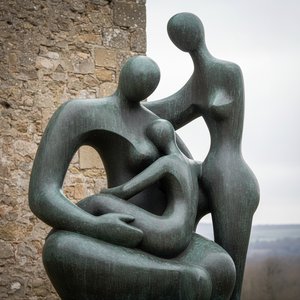
A Universal Bond: Exploring Henry Moore’s ‘Mother and Child 4’
This striking black and white photograph captures a sculpture by one of Britain's most important artists, Henry Moore. The work depicts two abstracted bird-like forms – a larger figure sheltering a smaller one – embodying the timeless theme of motherhood and familial protection. While the material is suggested to be wood or stone, its smooth, organic curves and textured surface speak to Moore’s mastery of form and his deep connection to natural materials. This particular piece, part of a prolific series exploring the mother-and-child motif, exemplifies Moore's signature style developed throughout his long career.Moore’s Sculptural Language: Form & Technique
Henry Moore is renowned for his semi-abstract sculptures, often focusing on the human figure – particularly reclining figures and *mother and child* compositions. He pioneered a technique called “direct carving,” where he worked directly with the material (often stone or wood), allowing the form to emerge organically rather than adhering strictly to a pre-conceived design. This approach is evident in ‘Mother and Child 4’ where the forms appear both monumental and intimately connected. The simplification of shapes, the emphasis on volume, and the interplay of positive and negative space are hallmarks of his style, influenced by prehistoric sculpture, African art, and the works of Michelangelo. Moore wasn't interested in literal representation; instead, he sought to capture the *essence* of form and emotion.Symbolism & Emotional Resonance
The mother-and-child theme held profound significance for Moore throughout his life. Having experienced hardship during World War I while serving as a soldier, he found solace in images of nurturing and protection. The abstracted forms in ‘Mother and Child 4’ transcend specific identities, becoming universal symbols of maternal love, vulnerability, and the enduring bond between generations. The protective gesture of the larger form enveloping the smaller one evokes feelings of safety, comfort, and unconditional care. While seemingly simple, the sculpture resonates with deep emotional power, prompting contemplation on fundamental human experiences. The use of birds as a metaphor adds another layer – suggesting freedom, fragility, and the instinct to nurture offspring.A Lasting Legacy: Moore in Context
Born in 1898, Henry Moore lived through periods of immense social and political change, which profoundly impacted his artistic vision. His work gained prominence in the post-war era, reflecting a desire for renewal and a search for universal values. Moore’s sculptures are now found in public collections and private homes worldwide, celebrated for their beauty, emotional depth, and enduring relevance. ‘Mother and Child 4’, like many of his works, continues to inspire artists and captivate audiences with its powerful simplicity and profound message. A reproduction of this sculpture would bring a sense of serenity, strength, and timeless elegance to any interior space.Soru ve Cevaplar
Henry Moore imzalı "Mother And Child 4" adlı eser kamu malı mıdır ve neden?
Henry Moore imzalı "Mother And Child 4", telif hakları ile korunmaya devam etmektedir statüsündedir. Telif hakkı süresi, sanatçının 1986 yılındaki ölümünden itibaren hesaplanmaktadır.
"Mother And Child 4" eserinin renk paleti ne kadar doygun?
"Mother And Child 4" eserinin renk paleti, Muted düzeyinde bir doygunluğa sahiptir.
Henry Moore imzalı "Mother And Child 4" eserinin görselini nereden indirebilirim?
Henry Moore imzalı "Mother And Child 4" eserinin dijital kopyasını yüksek çözünürlüklü dijital görsel indirme seçeneğiyle eserin Dijital İndirme sayfasından indirebilirsiniz.
Sanatçı Özgeçmişi
A Life Sculpted in Form: The World of Henry Moore
Henry Spencer Moore OM CH FBA (30 July 1898 – 31 August 1986) was an English visual artist. He is best known for his semi-abstract monumental bronze sculptures—particularly the reclining figure—which revolutionized modern British sculpture and established him as one of the most influential artists of the twentieth century. His journey from humble beginnings in Castleford, Yorkshire, to international acclaim exemplifies unwavering dedication to artistic exploration and a profound connection to both human form and the natural world.Early Life and Artistic Beginnings
Henry Spencer Moore was born in Castleford, West Yorkshire, England, on July 30, 1898, the son of Raymond Spencer Moore (1848–1922) and Mary Baker. Growing up amidst the rolling hills of Yorkshire profoundly shaped his aesthetic sensibility, imbuing his work with a sense of organic fluidity reminiscent of his birthplace. His father, a self-taught man with a passion for learning, instilled in him a belief in the transformative power of education, steering him away from the traditional path of a miner towards formal schooling. From an early age, Moore demonstrated an innate talent for modeling clay and carving wood—activities that foreshadowed his lifelong pursuit of sculptural form. Despite facing considerable hardship during his formative years, Moore’s determination to pursue artistic endeavors remained unshaken. He attended Leeds School of Art and subsequently enrolled at the Royal College of Art in London, immersing himself in the study of classical sculpture alongside pioneering movements like Cubism. This exposure to diverse artistic traditions fueled his creative vision and solidified his commitment to pushing boundaries within the realm of visual art.Influences and Artistic Style
Moore’s artistic education was significantly impacted by encounters with groundbreaking artistic ideas—most notably, pre-Columbian sculptures during a visit to Mexico in 1925. The simplicity and abstraction inherent in these ancient artworks liberated him from representational constraints, inspiring him to explore forms that prioritized gesture and volume over precise anatomical accuracy. This pivotal experience catalyzed the development of his signature sculptural style: semi-abstract monumental bronzes characterized by rounded, organic shapes—often punctuated by voids or apertures—that captured light and space with remarkable subtlety. He drew inspiration from classical sculpture, particularly Michelangelo’s sculptures of David and Pietà, recognizing their mastery of form and expressive power. However, Moore wasn't merely replicating established conventions; he synthesized these influences into something uniquely his own—a style that reflected both the grandeur of antiquity and the dynamism of modernism. His artistic explorations extended beyond sculptural technique to encompass broader philosophical considerations concerning the relationship between art and human experience.Major Sculptural Achievements
Henry Moore’s prolific output spanned decades, resulting in hundreds of sculptures ranging from intimate maquettes to colossal monumental works that transformed urban landscapes. Among his most celebrated achievements are *Reclining Figure: 1951*, a seminal sculpture embodying the essence of his artistic vision; *Family Group*, a poignant depiction of familial bonds rendered in bronze; and *Shelter Drawings*, a series of evocative sketches documenting Londoners’ resilience during the Blitz—demonstrating Moore's ability to translate sculptural principles into two-dimensional form. His monumental bronzes, notably *Large Torso*, *Drummond Tower*, and *Saint Patrick’s Cathedral*, stand as enduring symbols of artistic innovation and civic pride. These sculptures captivated audiences worldwide, cementing Moore’s legacy as one of the foremost sculptors of his era—a figure whose work continues to inspire artists and viewers alike. His unwavering dedication to exploring form, volume, and spatial relationships ensured that he would remain at the forefront of sculptural discourse throughout his lifetime.Legacy and Enduring Influence
Henry Moore's impact on twentieth-century art is undeniable. He challenged conventional notions of representation, advocating for abstraction as a means of conveying emotion and capturing the essence of human experience. His sculptures served as catalysts for artistic experimentation and fostered dialogue about the role of art in society—inspiring subsequent generations of sculptors to embrace bold new approaches. Moore’s work continues to resonate with audiences today, prompting contemplation on themes of vulnerability, resilience, and connection to the natural world. He established the Henry Moore Foundation in 1977, ensuring that his artistic legacy would endure through education and the promotion of creativity—a testament to his belief in the transformative power of art and its capacity to enrich human lives. His sculptures stand as enduring monuments to human ingenuity and a profound reminder of the beauty inherent in confronting adversity—solidifying his place among the most revered artists of the twentieth century.
Henry Moore
1898 - 1986 , İngiltere
Kısa Bilgiler
- Artistic Movement Or Style: Modernizm, Soyut heykeltıraşlık
- Artists Or Movements Influenced By This Artist: ['Cubizm']
- Artists Who Influenced This Artist: ['Michelangelo']
- Date Of Birth: 30 Temmuz 1898
- Date Of Death: 31 Ağustos 1986
- Full Name: Henry Spencer Moore
- Nationality: İngiliz
- Notable Artworks:
- Reclining Figure
- Aile Grubu
- Korunaklu Çizimleri
- Place Of Birth: Castleford, İngiltere
Benzer Yazılar

Bronze Sculptures That Defined Art History | OriginalUniqueArt
Journey through art history with our Top 10 bronze sculptures! Explore masterpieces by Rodin, Michelangelo & more. Discover stories behind iconic statues and find museum-quality reproductions for your home decor at OriginalUniqueArt.com.

The Enduring Legacy of Bronze: A Historical & Artistic Exploration for the Collector
Explore the rich history & enduring appeal of bronze sculpture with expert insights for collectors at OriginalUniqueArt. Learn about casting techniques, iconic artists, collecting tips & contemporary interpretations.

Bronze Age to Modern Masters: 10 Sculptures That Redefined Art | OriginalUniqueArt
Journey through art history with 10 legendary bronze sculptures – from Michelangelo's David to Rodin’s Thinker. Explore the stories, techniques & timeless beauty of these masterpieces. Find museum-quality reproductions & elevate your home decor on OriginalUniqueArt.com.
Henry Moore: Sculpting Modernity – Form, Emotion & the Human Condition
Explore the revolutionary sculptures of Henry Moore – abstract forms, reclining figures & powerful expressions of the human condition. Discover his legacy & artistic process with OriginalUniqueArt.

The Enduring Legacy of Bronze: History, Technique & Artistic Expression for the Collector
Explore the rich history & enduring appeal of bronze sculpture with expert insights for collectors at OriginalUniqueArt. Learn about casting techniques, iconic artists, and collecting tips.


