
 Baskı Satışına Geç
 Devamını Oku







































 Herhangi bir kenarı 105 cm'den (yaklaşık 41 inç) büyük olan sanat eserleri veya reprodüksiyonlar için çerçeve, demonte edilmiş bir kit halinde gönderilecektir. Bu yöntem, güvenli teslimat sağlar ve taşıma sırasında oluşabilecek hasarları önler.


A Vision of Faith: Giotto’s Saint Stephen
Saint Stephen, painted around 1320 by the revolutionary artist Giotto di Bondone, is more than just a religious depiction; it's a profound exploration of devotion, intellect, and the nascent humanism that would define the Renaissance. Currently residing in the Museo Horne in Florence, Italy, this tempera on wood panel (84 x 54 cm) offers a captivating glimpse into a pivotal moment in art history.The Subject & Symbolism
The painting portrays Saint Stephen, recognized as the first Christian martyr, a figure of immense significance within early Church history. He is depicted holding a book – symbolizing his wisdom and theological knowledge – and adorned with a crown, representing his ultimate triumph through faith. His downward gaze isn’t one of sorrow, but rather deep contemplation, suggesting an internal dialogue with the scriptures or perhaps a premonition of his impending sacrifice. The very act of depicting Stephen *with* these attributes—book and crown—elevates him beyond mere historical figure to a symbol of intellectual and spiritual fortitude.Artistic Style & Technique
Giotto’s style marks a decisive break from the Byzantine traditions that dominated Italian art for centuries. Instead of flat, stylized figures, he imbues Saint Stephen with a sense of volume and weight. The use of *chiaroscuro* – the interplay of light and shadow – subtly models the face and drapery, creating a more realistic and emotionally resonant image.- The rich gold background isn’t merely decorative; it evokes a divine realm, emphasizing Stephen's sanctity.
- Dominant colors of red and yellow contribute to the painting’s warmth and vibrancy, drawing the viewer into the scene.
- Giotto’s innovative use of perspective, though still rudimentary by later standards, creates a sense of depth and spatial awareness.
Historical Context & Giotto's Innovation
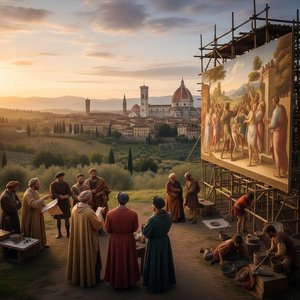
Giotto lived during the Proto-Renaissance, a period of transition between the medieval and Renaissance eras. He is credited with pioneering techniques that would become hallmarks of Renaissance art:- Naturalism: A move away from stylized representations towards more lifelike depictions.
- Emotional Realism: Capturing genuine human emotions in his figures, making them relatable and engaging.
- Spatial Awareness: Creating a sense of depth and three-dimensionality in his compositions.
Emotional Impact & Interior Design Considerations
Saint Stephen evokes a sense of quiet reverence and intellectual curiosity. The painting’s subdued palette and contemplative mood make it suitable for spaces dedicated to reflection – libraries, studies, or meditation rooms. Its relatively small size (84 x 54 cm) allows for versatile placement within various interior design schemes. A high-quality reproduction would serve as a focal point in a classically styled room, adding a touch of historical elegance and spiritual depth. The gold leaf detailing will beautifully catch the light, creating a warm and inviting atmosphere. This artwork isn’t just a visual experience; it's an invitation to contemplate faith, knowledge, and the enduring power of the human spirit.Soru ve Cevaplar
Giotto imzalı "Saint Stephen" eserinin renk paleti nasıl tanımlanıyor?
"Saint Stephen" eserinin renkleri Koyu tonlar bir palet oluşturmaktadır. Bu sınıflandırma, baskın renk ailelerini tanımlar.
"Saint Stephen" sanatçısının ana vatanında mı kaldı?
Hayır - sanat eseri yurt dışında bulunmaktadır. "Saint Stephen" adlı eser Italy bünyesinde sergilenirken, Giotto İtalya doğumludur.
Giotto imzalı "Saint Stephen" eserinin renk kimliği nedir?
Giotto imzalı "Saint Stephen", baskın rengin Bronz (#c38044) olduğu Koyu tonlar bir palet kullanıyor.
 Önizle
 Gönder
 Paylaş
 Detaylar
 Rehber

 Dosyayı İndir
 Benzerleri
 X-Işını
 Slayt Gösterisi
 Q&A
Q&A İstatistikler






![Scrovegni - [05] - Joachim'un Rüyası](/media/artworks/images-thumb/8f/67/8f67bb5da87296bd452b3f0b237b528d.jpg)


