- Ana Sayfa

- Kanvas baskı
- Gerhard Richter
- Star Picture
 Tabloyu Sipariş Et Görseli Satın Al
 Paylaş
 Paylaş
 Detayları Gör
 Favorilere ekle

 İndir
İndir
 Benzerlerini gör
 X-Işını
 Slayt Gösterisi
Star Picture
 Oil On Canvas
- WallArt
- Abstract Expressionism
 1969
1969 70.0 x 70.0 cm
 Tümünü Gör
Giclée / Sanat Baskısı
Hızlı üretim ve esnek bitiş seçenekleriyle müze kalitesinde giclée veya kanvas baskı.




P118B $10

P118H $10

P118W $10

P438Z $10

P508JH $12

P508YH $12

P805H $10

P805Z $10

P919BZ $10

P919G $10

P919XJ $10

P959ZH $10

P968JZ $12

W106C $8

W218G $10

W218JH $8

W218Y $10

W307PJ $10

W316G $10

W316PJ $8

W316Y $10

W398PJ $8

W4111J $10

W500HY $15

W500JH $15

W692G $12

W849H $8

W940BG $15

W953PJ $8




Eserin orijinal oranlarıyla uyumlu, önceden belirlenmiş boyutlarımız arasından seçim yapın.

Belirli bir çerçeveye veya alana uyması için kendi ölçülerinizi girebilirsiniz. Seçtiğiniz boyut orijinal görüntünün oranlarıyla eşleşmiyorsa, sanat eserini kırpacağız veya görüntüyü aynalanmış ya da düz dolgulu bir kenarlıkla genişleteceğiz. Üretim başlamadan önce onayınız için bir dijital taslak gönderilecektir.
Lütfen ekrandaki önizlemenin gerçek kırpma veya genişletmeyi yansıtmadığını unutmayın. Nihai kompozisyonu yalnızca taslak doğru bir şekilde gösterecektir.
Özel boyutlar mevcut olsa da, orijinal oranları korumak için önceden tanımlanmış listeden bir boyut seçmenizi öneririz.
Dünya Çapında Teslimat (); standart 4/5 hafta yerine 2 haftada. (20 Temmuz)

Dünya Çapında Ücretsiz Ekspres Kargo

Yüksek Kaliteli Keten Tuval

Tam Kapsamlı Nakliye Sigortası

Gümrük Vergisi İade Garantisi

Gerçek Renk Uyumu Garantisi

60 Günlük İade Politikası (Sadece Kusurlu Ürünler İçin)

%100 Para İade Garantisi

Toplu Alım İndirimi
 Cam seçeneği yalnızca 110 cm altındaki boyutlar için mevcuttur.

Star Picture
Giclée / Sanat Baskısı
Reproduksiyon Boyutu
-


Toplam Tutar
-
Eser Açıklaması
A Universe Contained: Exploring Gerhard Richter’s ‘Star Picture’
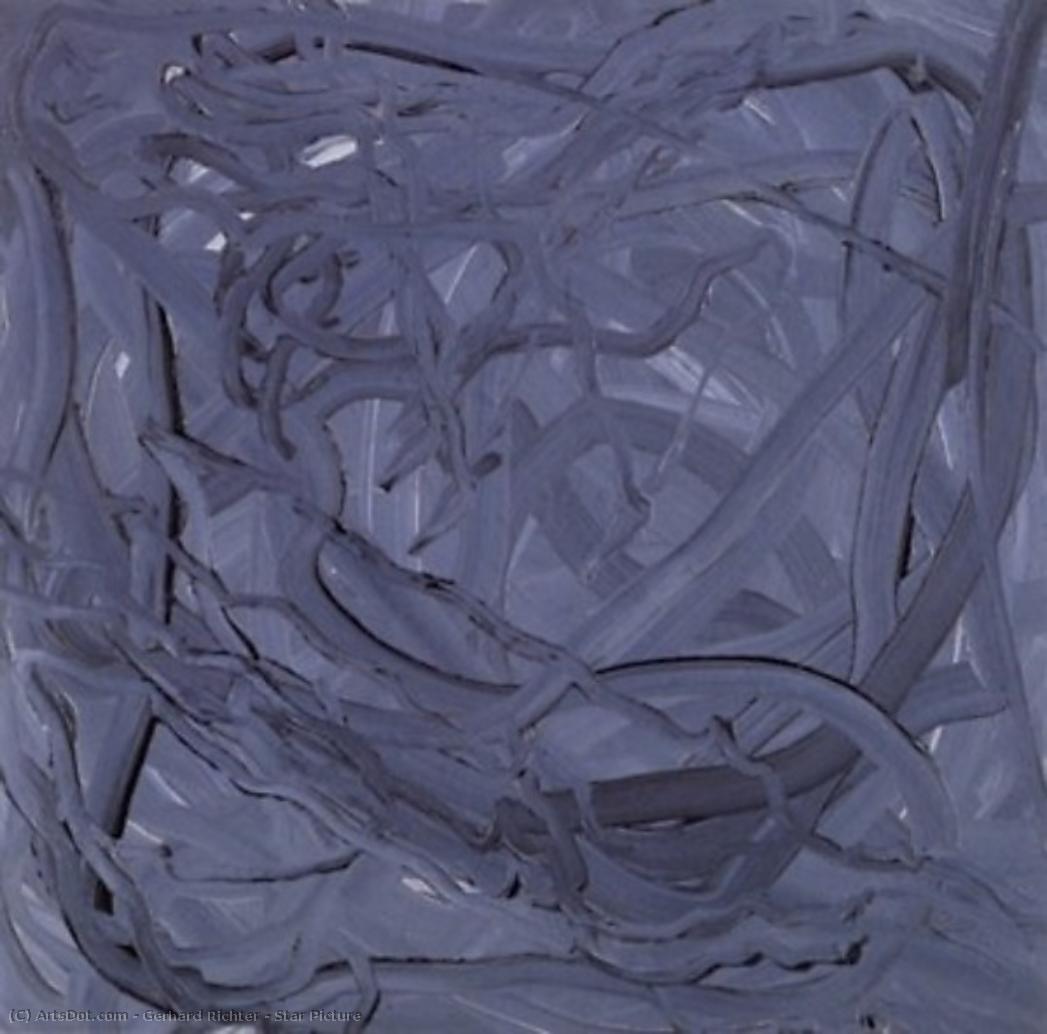
Gerhard Richter's ‘Star Picture,’ created in 1969, is not an invitation to gaze upon the cosmos with romantic wonder, but rather a compelling confrontation with its unknowable vastness. This abstract oil on canvas, measuring 70 x 70 cm, exists as a dense field of blues and greys, a chaotic interplay of lines and forms that resists easy interpretation. It’s a work born from a pivotal moment in history – the year humanity first set foot on the moon – yet it doesn't celebrate triumph or discovery. Instead, ‘Star Picture’ feels like an attempt to grapple with the unsettling implications of expanding our horizons, a visual echo of the anxieties and uncertainties that accompanied such monumental leaps forward.
The Technique of Uncertainty
Richter’s approach in ‘Star Picture’ is deeply rooted in his exploration of perception and representation. He wasn't striving for photorealistic depiction; rather, he employed a technique that deliberately obscures clarity. The painting appears to be built up through layers of paint, mimicking the texture of brushstrokes yet lacking their inherent expressiveness. This creates a tactile quality, an invitation to run your eyes across the surface, but simultaneously denies any comfortable sense of resolution. Diagonal lines dominate the composition, generating a feeling of movement and instability, as if the very fabric of space is in flux. The even lighting further contributes to this ambiguity; there are no dramatic highlights or shadows to guide the eye, only a pervasive, atmospheric haze. It’s a masterful demonstration of how abstraction can convey not emptiness, but an overwhelming sense of information – too much data for the mind to process.
Historical Echoes and Artistic Lineage
To understand ‘Star Picture,’ it's crucial to consider Richter’s biography and the artistic climate of post-war Germany. Born in 1932, he experienced firsthand the trauma of displacement and political upheaval. This history profoundly shaped his artistic vision, leading him to question established norms and explore the limitations of representation. While early influences like Picasso and Arp are discernible in his abstract compositions, Richter quickly forged his own path. The late 1960s saw him experimenting with ‘photo-paintings,’ works based on photographs that he then blurred and distorted. ‘Star Picture’ can be seen as an extension of this exploration – a photograph of the cosmos rendered not as a clear image, but as a fragmented memory or a half-forgotten dream. The ZERO group, with their focus on light and space, also provided a crucial context for Richter's work, though he maintained a critical distance from their utopian ideals.
An Emotional Landscape
‘Star Picture’ is not a comforting artwork. It evokes a sense of unease, even disorientation. The density of the composition, the lack of clear focal points, and the muted color palette all contribute to this feeling. Yet, within this chaos lies a strange beauty – a testament to Richter's ability to transform abstract forms into emotionally resonant experiences. The painting doesn’t offer answers; it poses questions about our place in the universe, the nature of perception, and the limits of human understanding. It is a work that demands contemplation, inviting viewers to project their own anxieties and aspirations onto its enigmatic surface. For those seeking an artwork that transcends mere decoration and instead sparks dialogue and introspection, ‘Star Picture’ offers a profound and enduring resonance.
Sanatçı Özgeçmişi
A Life Shaped by Division: The Early Years and Artistic Formation of Gerhard Richter
Gerhard Richter’s artistic journey began in Dresden, Germany, amidst the turbulent backdrop of postwar Europe and the looming shadow of Soviet influence. Born on February 9, 1932, his childhood was profoundly impacted by displacement – his family repeatedly relocated during the Nazi era and subsequently under communist rule—experiences that instilled within him a fundamental skepticism toward ideological dogma and fueled an enduring fascination with uncertainty. His father, a schoolteacher navigating the constraints of East German society, fostered a love for literature and music in the home, while his mother nurtured a keen eye for detail and observation. These formative influences would prove crucial to Richter’s artistic sensibility, shaping his approach to representation and informing his exploration of complex themes throughout his career. Early Artistic Training: Socialist Realism and Beyond Richter commenced formal training at Dresden Academy of Fine Arts in 1951, initially immersing himself in the dominant aesthetic of socialist realism—a style dictated by the East German state that prioritized idealized depictions of labor and social harmony. Despite this initial engagement with established artistic conventions, Richter harbored a burgeoning desire for creative freedom, recognizing the limitations imposed by ideological constraints. He actively sought ways to transcend these boundaries, experimenting with diverse techniques and styles—from expressive brushstrokes to meticulous detail—demonstrating an early aptitude for artistic innovation. Recognizing the need for broader exposure, he relocated to Düsseldorf in 1961, joining a vibrant community of artists grappling with questions of identity and confronting the legacy of history. This pivotal move propelled him into the heart of West German art culture, where experimentation and critique flourished. The Düsseldorf School: Photorealism and Conceptual Inquiry Düsseldorf became Richter’s crucible for artistic transformation. He embraced photorealism—a style characterized by painstakingly accurate reproductions of photographic images—as a means of interrogating the nature of perception and representation. Simultaneously, he engaged in conceptual inquiry, questioning the very definition of painting itself through unconventional approaches like color charts and squeegee prints. His collaboration with Sigmar Polke yielded the provocative term ‘Capitalist Realism,’ encapsulating their shared disillusionment with prevailing artistic norms and their appropriation of imagery from advertising and mass media—a deliberate challenge to accepted aesthetic standards. Richter’s oeuvre reflects a continuous dialogue between observation and abstraction, realism and chance—a testament to his unwavering commitment to artistic exploration and his refusal to adhere to stylistic conventions. Major Achievements and Artistic Legacy Throughout his prolific career spanning decades, Gerhard Richter achieved remarkable success as both an artist and a cultural figure. His paintings consistently commanded record prices at auction, cementing his position among the most influential artists of our time—a testament to his technical virtuosity and intellectual rigor. However, Richter’s artistic legacy extends far beyond commercial acclaim; it resides in his profound engagement with historical and political themes—his willingness to confront uncomfortable truths and challenge conventional narratives. His work serves as a catalyst for critical dialogue, prompting viewers to contemplate the complexities of modern existence and questioning their own assumptions about reality. Richter's influence can be seen in the artistic endeavors of countless artists who have drawn inspiration from his pioneering techniques and his unwavering dedication to creative exploration—a legacy that transcends stylistic boundaries and affirms the enduring power of art to provoke thought and inspire action. Richter remains a vital voice in contemporary art, continuing to captivate audiences with his challenging and emotionally resonant creations—a testament to his artistic genius and his indelible mark on the history of visual culture.- Notable Paintings: Abstract Painting 610-1, Gilbert
- Techniques Employed: Photorealism, Color Charts, Squeegee Prints
- Influential Collaborations: Sigmar Polke
- Conceptual Frameworks: Capitalist Realism

Gerhard Richter
1932 - , Almanya
Kısa Bilgiler
- Artistic Movement Or Style:
- Fotorealizm
- Soyut sanat
- Artists Or Movements Influenced By This Artist: ['Sigmar Polke']
- Artists Who Influenced This Artist:
- Jean Arp
- Pablo Picasso
- Date Of Birth: 9 Şubat 1932
- Full Name: Gerhard Richter
- Nationality: Alman
- Notable Artworks:
- Gilbert
- S. ile Çocuk
- Place Of Birth: Dresden, Almanya
İlgili Makaleler

Ephemeral Dimensions: The Impact of Illumination on Perceptual Shifts in Contemporary Abstract Painting
Explore the profound impact of illumination on contemporary abstract painting. Expert insights into perceptual psychology, key artists & collecting valuable art. OriginalUniqueArt.
Duygu Voltanıyla Sanatı Yeniden Tanımlayan 10 Empresyonist Başyapıt
İfadeciliğin zirvesi! Van Gogh, Munch ve daha fazlasıyla 10 başyapıtı keşfedin. Sanatın duygusal gücünü deneyimleyin ve evinizi OriginalUniqueArt'tan kaliteli sanat baskılarıyla dönüştürün. Keşfetmek için tıklayın!

German Expressionism's 10 Defining Masterpieces | Art for Your Home
Explore 10 defining German Expressionism masterpieces – from Munch's 'The Scream' to Kandinsky’s abstracts. Discover the artists, stories & bold colors behind this powerful art movement. Find museum-quality reproductions at OriginalUniqueArt.com.

Gerhard Richter: A Retrospective on Abstraction, Memory & the Photographic Source
Explore the profound world of Gerhard Richter's abstract paintings. Discover his techniques, influences, and lasting impact on contemporary art – a guide for discerning collectors.

Slate Blue Masterpieces: 10 Iconic Paintings & Timeless Home Decor Ideas
Immerse yourself in the captivating world of slate blue! Explore 10 iconic paintings by Monet, Van Gogh & Renoir. Discover their stories, techniques & find museum-quality art reproductions for your home at .