Önizleme yap
 Paylaş
 Paylaş
 Detayları Gör

 İndir
İndir
 Benzerlerini gör
 X-Işını
 Slayt Gösterisi
Elephant, Horse, Cattle
 Oil On Canvas
- WallArt
- Expressionism
 1914
1914- Early Medieval
 84.0 x 80.0 cm
 Tümünü Gör
Giclée / Sanat Baskısı
Hızlı üretim ve esnek bitiş seçenekleriyle müze kalitesinde giclée veya kanvas baskı. ( El yapımı tablo satın al Görsel satın al)




P118B $10

P118H $10

P118W $10

P438Z $10

P508JH $12

P508YH $12

P805H $10

P805Z $10

P919BZ $10

P919G $10

P919XJ $10

P959ZH $10

P968JZ $12

W106C $8

W218G $10

W218JH $8

W218Y $10

W307PJ $10

W316G $10

W316PJ $8

W316Y $10

W398PJ $8

W4111J $10

W500HY $15

W500JH $15

W692G $12

W849H $8

W940BG $15

W953PJ $8




Eserin orijinal oranlarıyla uyumlu, önceden belirlenmiş boyutlarımız arasından seçim yapın.

Belirli bir çerçeveye veya alana uyması için kendi ölçülerinizi girebilirsiniz. Seçtiğiniz boyut orijinal görüntünün oranlarıyla eşleşmiyorsa, sanat eserini kırpacağız veya görüntüyü aynalanmış ya da düz dolgulu bir kenarlıkla genişleteceğiz. Üretim başlamadan önce onayınız için bir dijital taslak gönderilecektir.
Lütfen ekrandaki önizlemenin gerçek kırpma veya genişletmeyi yansıtmadığını unutmayın. Nihai kompozisyonu yalnızca taslak doğru bir şekilde gösterecektir.
Özel boyutlar mevcut olsa da, orijinal oranları korumak için önceden tanımlanmış listeden bir boyut seçmenizi öneririz.
Dünya Çapında Teslimat (); standart 4/5 hafta yerine 2 haftada. (21 Ağustos)

Dünya Çapında Ücretsiz Ekspres Kargo

Yüksek Kaliteli Keten Tuval

Tam Kapsamlı Nakliye Sigortası

Gümrük Vergisi İade Garantisi

Gerçek Renk Uyumu Garantisi

60 Günlük İade Politikası (Sadece Kusurlu Ürünler İçin)

%100 Para İade Garantisi

Toplu Alım İndirimi
 Cam seçeneği yalnızca 110 cm altındaki boyutlar için mevcuttur.

Elephant, Horse, Cattle
Giclée / Sanat Baskısı
Reproduksiyon Boyutu
-


Toplam Tutar
$ 80
Eser Açıklaması
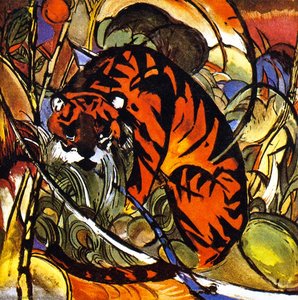
The Raw Essence of Being: Unveiling "Elephant, Horse, Cattle"
Franz Marc's “Elephant, Horse, Cattle,” painted in 1914, isn’t merely a depiction of animals; it’s a profound distillation of the artist’s deeply felt spiritual and emotional landscape. Created during a turbulent period – just before the outbreak of World War I – the painting vibrates with an intensity born from both apprehension and a yearning for connection to something larger than the self. Measuring 84 x 80 cm, this oil on canvas invites us into a world where form and color coalesce not to represent reality, but to embody its underlying spirit.
Marc, a key figure in the German Expressionist movement, rejected the objective representation favored by earlier artistic traditions. Instead, he sought to capture the subjective experience of seeing – the raw emotions, instincts, and primal energies that he believed resided within both the natural world and the human soul. This painting exemplifies his core philosophy: to translate the essence of life into a visual language understood through feeling rather than precise detail. The figures are not rendered with photographic accuracy; they’re imbued with an almost mythical quality, suggesting a timelessness beyond the confines of everyday experience.
A Symphony of Color and Form – Decoding Marc's Technique
The painting immediately captivates with its bold, unrestrained use of color. Marc employs a vibrant palette—deep blues, fiery reds, earthy browns, and luminous yellows—that feels both immediate and deeply resonant. These aren’t colors used to mimic nature; they are colors chosen for their emotional power. Notice how the dominant blue suggests a sense of vastness and perhaps even melancholy, while the reds and yellows inject an element of vitality and urgency. The forms themselves are simplified and abstracted, almost childlike in their directness. The animals—likely elephants or horses, though their precise identification is secondary to their symbolic weight—are rendered with broad brushstrokes, creating a sense of movement and dynamism. The background figure, partially obscured, adds another layer of intrigue, hinting at an observer contemplating the scene’s deeper meaning.
Marc's technique leans heavily on the principles of color theory, utilizing complementary colors to heighten visual impact and create a sense of tension and harmony simultaneously. The layering of paint is visible, contributing to the painting’s textured surface and adding to its overall feeling of immediacy. It’s a style that prioritizes emotional expression over meticulous detail, aligning perfectly with the core tenets of Expressionism.
Roots in Spirituality and the Animal Kingdom
Franz Marc's fascination with animals stemmed from a profound belief in their inherent spiritual significance. He saw them as embodiments of pure instinct, untainted by human complexities. This conviction is powerfully evident in his work, particularly in paintings like “Landscape with House and Two Cows” (also known as "Landscape with House, Dog and Cattle") and “Larch Sapling.” These works demonstrate a recurring motif: the depiction of animals within natural settings, often imbued with symbolic weight. In “Elephant, Horse, Cattle,” the grouping itself suggests a primal connection—a recognition of shared existence and perhaps even a yearning for unity.
His early theological explorations profoundly shaped his artistic vision. Marc sought to translate religious concepts into visual terms, believing that art could serve as a conduit for spiritual experience. This desire is reflected in the painting’s evocative atmosphere, which transcends mere representation and taps into something deeper—a sense of wonder, mystery, and perhaps even foreboding, given the historical context of its creation.
A Legacy Enduring – “Elephant, Horse, Cattle” in Context
"Elephant, Horse, Cattle" is a cornerstone of Marc’s oeuvre and a pivotal work within the Expressionist movement. It resides at The Museum City Gallery in Lenbachhous, Munich, Germany—a fitting location given Marc's Bavarian roots and the museum’s commitment to showcasing groundbreaking artistic innovation. The painting’s influence extends far beyond its immediate historical context, continuing to inspire artists today with its bold use of color, its exploration of emotional depth, and its profound engagement with the natural world. Reproductions by OriginalUniqueArt.com offer a remarkable opportunity to experience this masterpiece firsthand, bringing Marc's visionary spirit into your own space.
Sanatçı Özgeçmişi
Franz Marc (1880-1916): Pioneer of German Expressionism
Franz Moritz Wilhelm Marc, born on February 8, 1880, in Munich, Germany, was a painter whose brief but intensely focused career irrevocably altered the course of German Expressionism. His story is one of profound spiritual seeking translated into a vibrant visual language—a quest to understand the essence of life through the purity he found in the natural world, particularly within the animal kingdom. Initially influenced by his father, Wilhelm Marc, a landscape painter, young Franz’s artistic path wasn't immediately certain. He briefly contemplated theology, grappling with questions of faith and existence before ultimately dedicating himself to art at the Academy of Fine Arts in Munich. These early explorations into religious thought would remain deeply embedded within his work, shaping his belief that art could be a conduit for spiritual experience. His academic training provided him with technical foundations, but it was encounters with the works of Vincent van Gogh during visits to Paris that truly ignited his artistic vision. Van Gogh’s emotive use of color and raw expression resonated profoundly with Marc, liberating him from conventional techniques and setting him on a path toward a more subjective and emotionally charged style.Early Influences and Artistic Development
Marc's formative years were marked by a fascination with both Romantic literature and theology—a duality that would permeate his artistic sensibility throughout his life. His father’s landscape paintings instilled in him an appreciation for the grandeur of nature, while his mother’s Calvinist upbringing fostered a contemplative spirit. He studied drawing first with Gabriel Hackl and then painting with Wilhelm von Diez at Munich Academy, absorbing the stylistic conventions of academic naturalism alongside nascent explorations into Impressionistic color innovations. However, it was his encounter with Van Gogh's paintings during Parisian excursions that fundamentally reshaped his artistic perspective. As Marc himself eloquently expressed, “Van Gogh is for me the most authentic, the greatest, the most poignant painter I know.” He recognized in Van Gogh’s bold use of color and unflinching portrayal of emotion a liberation from formal constraints—a freedom to express inner spiritual truths without resorting to representational accuracy. This influence propelled him toward simplification and heightened emotional intensity, mirroring Symbolist ideals that championed the artist as martyr.The Birth of Der Blaue Reiter
Marc’s artistic journey took an extraordinary turn in 1907 with his relocation to Paris—a pivotal moment fueled by a desire for creative renewal following a period of personal turmoil. During this time, he immersed himself in the vibrant artistic milieu of the city and encountered artists who profoundly impacted his stylistic evolution. Notably, Robert Delaunay’s exploration of abstract forms and chromatic harmonies broadened Marc's horizons beyond traditional representation. This encounter spurred him toward experimentation with geometric abstraction—a departure from Impressionistic color palettes that signaled a decisive shift toward conveying spiritual concepts through simplified shapes and bold hues. Simultaneously, he cultivated friendships with fellow artists who shared his conviction that art could transcend the material realm and engage in dialogue with deeper existential questions. He joined August Macke and Wassily Kandinsky to establish *Der Blaue Reiter* (The Blue Rider) in 1911—a collective dedicated to forging a new artistic path rooted in Symbolist principles. This group’s inaugural exhibition showcased not only Marc's own work but also that of other avant-garde artists, cementing Der Blaue Reiter’s reputation as the epicenter of German Expressionism and initiating a dialogue about art’s capacity for spiritual expression.Animal Painting: A Spiritual Quest
Marc’s artistic preoccupation with animals began in earnest around 1907—a fascination driven by both anatomical curiosity and a profound belief that animals embodied an inherent purity and connection to nature absent from human society. He viewed animals as symbols of innocence, harmony, and spiritual transcendence—subjects he approached with reverence and meticulous attention to detail. Unlike Impressionists who sought to capture fleeting visual impressions, Marc aimed to distill the essence of his subjects into their fundamental forms—reducing figures to geometric shapes that conveyed emotional intensity without resorting to realistic depiction. Paintings like *The Tiger* (1912) exemplify this stylistic approach—a monumental composition characterized by assertive color choices and a deliberate simplification of form that encapsulates Marc’s artistic vision. He believed animals possessed an inner luminosity—a spiritual radiance—that mirrored the divine presence he perceived in the natural world. This conviction fueled his relentless pursuit of expressive abstraction, mirroring Symbolist ideals that championed the artist as martyr.Legacy and Recognition
Franz Marc tragically perished on March 4, 1916, during the Battle of Verdun—a devastating loss for the art world and a poignant reminder of the fragility of artistic creativity amidst the tumult of wartime conflict. Despite his untimely demise, Marc’s influence endured—inspiring generations of artists who embraced his stylistic innovations and championed his unwavering commitment to conveying spiritual truths through abstract forms and symbolic color. His paintings continue to captivate audiences today with their emotional depth and profound contemplation of existential themes—a testament to the enduring power of art to transcend the boundaries of time and place. Marc’s legacy extends beyond his artistic achievements; he remains a symbol of intellectual integrity, spiritual courage, and unwavering devotion to his craft—a figure whose work continues to resonate with viewers seeking solace and inspiration in the face of adversity. His contribution to German Expressionism solidified his position as one of the most important artists of the 20th century—a visionary who dared to explore the intersection between art, spirituality, and the sublime beauty of the natural world.
Franz Marc
1880 - 1916 , Almanya
Kısa Bilgiler
- Artistic Movement Or Style: Dışavurumculuk
- Artists Who Influenced This Artist:
- Vincent van Gogh
- Robert Delaunay
- Date Of Birth: 8 Şubat 1880
- Date Of Death: 4 Mart 1916
- Full Name: Franz Moritz Wilhelm Marc
- Nationality: Alman
- Notable Artworks:
- Tierschicksale
- Kızıl Geyik
- Gökyüzü Şelalesi
- Place Of Birth: Münih, Almanya
İlgili Makaleler

German Expressionism's 10 Defining Masterpieces | Art for Your Home
Explore 10 defining German Expressionism masterpieces – from Munch's 'The Scream' to Kandinsky’s abstracts. Discover the artists, stories & bold colors behind this powerful art movement. Find museum-quality reproductions at OriginalUniqueArt.com.

Franz Marc: Expressionism, Spirituality & the Animal Symbolism of a Modern Master
Explore the profound world of Franz Marc's Expressionist paintings. Discover his spiritual connection to animals, innovative use of color, and lasting impact on modern art history. Learn more at OriginalUniqueArt.
Sanatta Hayvanlar: İç Mekân Tasarımında Sembolizm ve Estetik Dönüşüm
Sanatta hayvanların sembolik anlamlarını keşfedin! Türk resim sanatından iç mekan tasarımına kadar kapsamlı rehberimizle evinizi dönüştürün. OriginalUniqueArt ile kaliteli yağlı boya tablolar ve özel portre siparişleri.
The Noble Steed: A Historical and Artistic Exploration of Horses in Fine Art
Explore the rich history of horses in fine art! From ancient depictions to Renaissance masterpieces & beyond, discover iconic artworks and artists. Learn about symbolism, techniques, and find museum-quality reproductions at OriginalUniqueArt.

The Noble Steed on Canvas: A Historical & Artistic Exploration of Horse Painting Across Cultures
Explore the rich history of horse painting! Discover masterpieces from Stubbs to Munnings & learn about symbolism, techniques & artists. Find museum-quality reproductions at OriginalUniqueArt.