Baskı Satışına Geç
 Devamını Oku







































 Herhangi bir kenarı 105 cm'den (yaklaşık 41 inç) büyük olan sanat eserleri veya reprodüksiyonlar için çerçeve, demonte edilmiş bir kit halinde gönderilecektir. Bu yöntem, güvenli teslimat sağlar ve taşıma sırasında oluşabilecek hasarları önler.


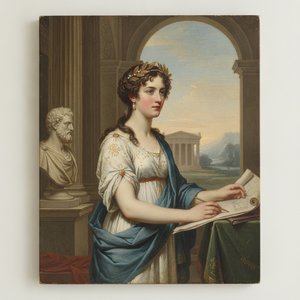
Melancholy by Constance Charpentier: A Portrait of Quietude
Constance Charpentier’s “Melancholy,” painted in 1801, is more than just a depiction of a seated woman; it's an exquisitely rendered meditation on solitude and the lingering grief of a generation. This oil-on-canvas masterpiece, currently residing within the hallowed halls of the Musée de Picardie in Amiens, France, offers a poignant glimpse into the artistic sensibilities of early 19th-century Europe – a period grappling with the aftermath of revolution and war.
The painting immediately draws the viewer’s eye to its central figure: a young woman lost in contemplative thought. Her posture is subtly slumped, her gaze fixed downwards, suggesting an inward journey of sorrow. The setting—a darkened landscape punctuated by indistinct trees—amplifies this sense of isolation and reinforces the theme of melancholy. Notice how Charpentier masterfully employs chiaroscuro, utilizing dramatic contrasts between light and shadow to sculpt the figure’s form and create a palpable atmosphere of quiet sadness. The muted palette – primarily creams, whites, and grays – further contributes to the painting's somber mood, while subtle variations within these tones hint at depth and texture.
Neoclassical Elegance: Style and Technique
“Melancholy” is a quintessential example of Neoclassicism, an artistic movement that sought inspiration from the art and ideals of ancient Greece and Rome. Charpentier’s work embodies this style through its emphasis on order, clarity, and balanced composition. The meticulous brushwork—evident in the delicate rendering of the fabric draped across the woman's body and the subtle modeling of her features—demonstrates a remarkable level of technical skill. The use of clean lines and defined edges is characteristic of Neoclassicism, lending the painting an air of formality and restraint.
Technically, Charpentier’s approach leans towards a restrained emotional palette, prioritizing form and structure over overt sentimentality. However, she skillfully captures the nuances of human emotion through her masterful use of light and shadow, creating a powerful sense of introspection within the subject's gaze. The painting’s shallow perspective further focuses attention on the figure, immersing the viewer in her internal world.
A Window into an Era: Historical Context
To fully appreciate “Melancholy,” it’s crucial to understand the historical context in which it was created. Following the tumultuous years of the French Revolution and Napoleonic Wars, France was a nation grappling with profound social and emotional upheaval. The loss of countless young men had left an indelible mark on society, particularly on women who often bore the brunt of responsibility and grief. Charpentier’s painting reflects this collective sorrow, offering a visual representation of the quiet despair that permeated French society at the time.
The Musée de Picardie, where “Melancholy” is housed, provides further context by showcasing other works from the same period, including pieces by Pierre Puvis de Chavannes and Frans Hals. These artists, like Charpentier, were deeply influenced by Neoclassicism and sought to capture the beauty and dignity of human experience through their art.
Symbolism and Emotional Resonance
Beyond its technical brilliance, “Melancholy” is rich in symbolism. The woman’s contemplative pose and downward gaze evoke a sense of introspection and sorrow, while the darkened landscape suggests a world shrouded in grief. The classical drapery—a hallmark of Neoclassicism—references ancient virtues and ideals, subtly hinting at a longing for a lost past or a more harmonious future. The painting's overall effect is profoundly moving, inviting viewers to contemplate the complexities of human emotion and the enduring power of melancholy.
Reproductions of “Melancholy” offer an accessible way to experience the beauty and emotional depth of this remarkable artwork. Whether displayed in a private residence or a public space, it serves as a timeless reminder of the capacity for art to capture and convey the most profound human experiences.
Soru ve Cevaplar
"Melancholy" eserini tam ekran slayt gösterisi olarak izleyebilir miyim?
Bir slayt gösterüsü mevcuttur: Constance Charpentier imzalı "Melancholy" eserinin Slayt Gösterisi sayfası.
"Melancholy" eserini daha detaylı inceleyebilir miyim?
Constance Charpentier imzalı "Melancholy" eserinin X-Ray görünümü, eserin X-Işını sayfasında yer almaktadır: on bir optik katman aracılığıyla görüntünün interaktif bir incelemesi.
Constance Charpentier imzalı "Melancholy" için önerilen baskı boyutu nedir?
Constance Charpentier imzalı "Melancholy" için Medium boyutunda bir reprodüksiyon önerilir. Boyut, oranlar korunarak ayarlanabilir.
 Önizle
 Gönder
 Paylaş
 Detaylar
 Rehber

 Dosyayı İndir
 Benzerleri
 X-Işını
 Slayt Gösterisi
 Q&A
Q&A İstatistikler