Baskı Satışına Geç
 Tümünü Gör







































 Herhangi bir kenarı 105 cm'den (yaklaşık 41 inç) büyük olan sanat eserleri veya reprodüksiyonlar için çerçeve, demonte edilmiş bir kit halinde gönderilecektir. Bu yöntem, güvenli teslimat sağlar ve taşıma sırasında oluşabilecek hasarları önler.


Antonio Bosio’s Wall-Painting Fragment: A Window Into Early Christian Rome
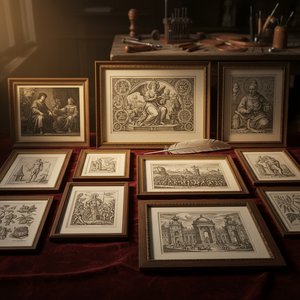
The image presented here—a meticulously reproduced black and white print of Antonio Bosio's wall painting fragment—offers more than just a visual depiction; it invites us into the intellectual fervor of 1632, when Renaissance ideals wrestled with burgeoning scientific curiosity. Bosio’s work, “Roma Sotterranea,” stands as a testament to his pioneering spirit – he was arguably the first urban spelunker, venturing deep beneath Rome's surface to document its hidden Christian heritage. This print captures a pivotal moment in art history: the attempt to illuminate the darkness of antiquity with the light of observation and scholarly analysis.- Composition & Perspective: The scene unfolds within an arched niche reminiscent of Roman doorways, skillfully employing limited perspective to convey spatial relationships between figures and architectural elements. Despite the constraints of printmaking techniques, Bosio’s vision manages to suggest depth and volume through overlapping forms and variations in line density.
- Technique & Material Evidence: The artwork's dominant characteristic is its masterful use of hatching and cross-hatching—a technique common in engraving—to achieve tonal values. This method faithfully reproduces the original wall painting’s surface texture, hinting at the rough stone formations and the intricate detailing of the cross design. It speaks to a dedication to documenting material evidence with precision.
- Symbolism & Emotional Resonance: The central figure—a saint or martyr—is positioned prominently within the arched niche, embodying themes of faith and sacrifice. Surrounding him are winged figures, likely angels, symbolizing divine protection and intervention. The overall atmosphere is solemn and reverent, reflecting the spiritual significance of the scene.
- Style & Historical Context: Bosio’s style aligns with early engraving techniques—characterized by meticulous line work and a focus on detailed representation—a stylistic choice that underscores the importance of scholarly documentation during the Renaissance. The print reflects a desire to capture the essence of Christian iconography as understood in the 17th century.
- Decorative Impact: Imagine this image adorning a hallway wall, bathed in soft light – its monochrome palette would create an understated elegance, complementing neutral tones and highlighting textural contrasts. The print’s graphic simplicity lends itself beautifully to interior design projects seeking timeless beauty and intellectual depth.
Soru ve Cevaplar
Antonio Bosio imzalı "Duvar Çizimi Parçası" eserinin renkleri canlı mı yoksa mat mı?
Antonio Bosio imzalı "Duvar Çizimi Parçası" eserinin renkleri Mat/Soluk doygunluğa sahiptir. Doygunluk, renklerin ne kadar canlı veya mat olduğunu ifade eder.
"Duvar Çizimi Parçası" hakkında bilgilere nereden ulaşabilirim?
Antonio Bosio imzalı "Duvar Çizimi Parçası" eserinin Bilgi Notu sayfası; eserin kimlik tablosu, sanatçının yaşam öyküsü içinde yerini gösteren on yıllık zaman çizelgesi, sanatçının diğer çalışmaları, ölçülmüş renk paleti ve dört farklı stilde kopyalamaya hazır atıfları içeren, iki sayfadan oluşan yazdırılabilir bir bilgi formu sunar.
Antonio Bosio imzalı "Duvar Çizimi Parçası" eserinde hangi teknik kullanıldı?
Antonio Bosio imzalı "Duvar Çizimi Parçası" eserinin tekniği Tuval Üzerine Akrilik Boya kullanılarak uygulanmıştır. Çoğaltımlar, bu tekniğin görünümünü yansıtmayı amaçlamaktadır.
Bu tablo hakkında daha fazla bilgi
 Gerçek Boyutta Önizle
 Paylaş
 Paylaş
 Detayları Gör
 Rehber

 İndir
İndir
 Benzer ürünler
 X-Işını
 Slayt Gösterisi
 Soru & Cevap
 İstatistikler