Romanticism
Alpine Landscape (Alexandre Calame)
Alpine Landscape, Alexandre Calame (1810–1864) tarafından yapıldı. Romanticism akımına aittir. Oil On Canvas ile yapılmıştır. Boyutları 45 × 31 cm'dir.
- Oil On Canvas
- 45 × 31 cm

 Gerçek Boyutta Önizle

 El Yapımı Yağlı Boya Tablo
 Paylaş
 Paylaş
 Bilgi Formu


 İndir
 Benzer ürünler
 X-Işını
 Slayt Gösterisi
 Soru & Cevap

 İstatistikler
Alpine Landscape hakkında kısa bilgi
- Başlık
- Alpine Landscape
- Sanatçı
- Alexandre Calame (1810–1864)
- Sanatçının doğum yeri
- Vevey, İsviçre
- Teknik
- Oil On Canvas
- Boyutlar
- 45 × 31 cm
- Akım
- Romanticism
- Dönem
- 19th Century
- Konu
- alpine landscape, mountain scenery, swiss alps view, river valley scene, atmospheric perspective, landscape painting
Alpine Landscape neyi betimliyor?
Identification of the Alpine Landscape
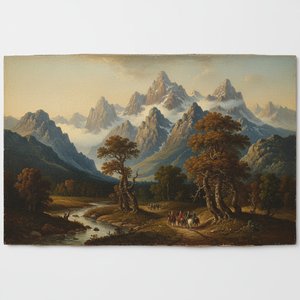
Alpine Landscape is an oil painting by the Swiss artist Alexandre Calame. The canvas captures a mountainous valley where a river winds through the terrain. A rocky outcrop anchors the left side of the scene, leading the eye toward distant, receding peaks. This work reflects the artist's lifelong preoccupation with the rugged topography of his homeland.
Alexandre Calame was born in 1810 in Vevey, Switzerland. He spent much of his life observing the textures of the Alps, from the weight of granite to the movement of mountain streams. The artist eventually passed away in 1864 in Menton, France. In this specific composition, the light remains diffused, as if filtered through an overcast sky or the soft glow of early morning.
The scene focuses on the scale of the natural world. Trees and shrubs ground the foreground, providing a sense of texture against the vastness of the background. The mountains rise in geometric triangles, their forms softening as they vanish into the atmospheric distance. A quiet stillness settles over the valley.
Composition and Visual Elements
A rocky outcrop anchors the left side of the frame, its jagged edges catching the light to pull the eye into the scene. From this stone threshold, the gaze follows a river as it winds through a mountainous valley. In the foreground, the earth is textured with the presence of shrubs and trees, grounding the viewer amidst the wild vegetation. These small, detailed forms provide a tactile entry point before the eye moves toward the vastness of the background.
The composition relies on a steady use of perspective to carve out a sense of immense depth. The mountains recede into the distance, their scale dwarfing the river and the greenery below. This arrangement emphasizes the sheer magnitude of the alpine terrain. The verticality of the peaks meets the horizontal flow of the water, creating a structured balance within the natural chaos. The light remains diffused, casting soft shadows across the mountain slopes and the valley floor. A quiet stillness settles over the stone and the stream.
Technique and Artistic Materials
Oil paint meets canvas in this landscape. The artist applied thin, translucent washes of pigment, layering them one after another in a sequence of glazes. This meticulous process builds a luminous depth, allowing light to settle within the layers. It is a slow accumulation of color. The surface holds the weight of the mountain and the softness of the air.
The brushwork captures the physical reality of the terrain. Roughness defines the stone of the rocky outcrop, while the texture of the foliage is rendered with precise, tactile strokes. Light enters the scene as a diffused glow, suggesting the quiet of an overcast day or the pale clarity of early morning. Shadows settle into the mountain crevices, creating a sense of immense scale through tonal modulation. The atmosphere feels heavy with moisture, as if the light itself is filtered through a mountain mist.
The Artistic Style of Calame
A sense of the sublime anchors this work, a hallmark of the Romanticism movement. Calame was a pivotal figure within the Düsseldorf School of Painting, bringing a disciplined eye to the untamed wilderness. He treats the mountains not as static stone, but as living, breathing entities. Through a mastery of atmospheric perspective, the distant peaks recede into a soft, hazy light, creating a profound sense of depth. This tonal modulation allows the viewer to feel the weight of the air between the rocky foreground and the far horizon.
The brushwork is expressive, capturing the rugged textures of the landscape. He uses these strokes to convey the emotional impact of nature, translating the scale of the valley into a felt experience. There is a palpable emotion in the way light hits the river and the cliffs, suggesting the solitude of the high Alps. His connection to these mountains is evident in the precise, almost tactile rendering of the terrain. The scene remains quiet, held in a delicate balance of light and shadow.
Related Works by Alexandre Calame
The artist’s hand often returned to the weight of the mountains and the movement of the air. In 1838, he captured the tension of a storm at Handeck, where the sky meets the jagged rock. This energy persists in his 1856 work, Storm in the Alps, a scene of chaotic weather and turbulent clouds. He also documented the specific topography of the Valley of Lauterbrunnen in 1856, rendering the deep clefts of the Swiss terrain. These works reflect a lifelong preoccupation with the raw power of the high passes.
Water remains a constant presence in his compositions, shifting from the violent to the still. He painted the Lake of the Four Cantons, near Brunnen, in 1853, finding a different rhythm in the alpine waters. His vision extended beyond the peaks to the warmth of the south, seen in Pozzuoli and the Bay of Naples, 1844. Even in more quiet studies, such as Landscape with Oaks, about 1859, the meticulous observation of nature remains central. The light continues to shift across the stone.
Alpine Landscape için yüksek çözünürlüklü görseller
Kamu malı: sanatçı 1864 yılında vefat etmiştir.
Alexandre Calame, Alpine Landscape.
Alexandre Calame (1810–1864), Alpine Landscape, oil on canvas. Kamu malı. Görsel: OriginalUniqueArt.com.
Alpine Landscape hakkında sorular ve cevaplar
"Alpine Landscape" hangi teknikle yapılmıştır?
"Alpine Landscape", Oil On Canvas kullanılarak icra edilmiştir.
Alexandre Calame imzalı "Alpine Landscape" eserinin gerçek boyutları nedir?
"Alpine Landscape" adlı eserin orijinal boyutları 45 x 31 cm ölçülerindedir. Orijinal boyutlar, bir reprodüksiyon boyutu seçerken yararlı bir referans niteliğindedir.
Alexandre Calame imzalı "Alpine Landscape" neyi betimliyor?
Alexandre Calame imzalı "Alpine Landscape" eserinde yer alan temalar alpine landscape, mountain scenery, swiss alps view, river valley scene, atmospheric perspective, landscape painting, nature’s grandeur” unsurlarını içermektedir. Bunlar birlikte, eserin konu içeriğini özetlemektedir.
"Alpine Landscape" eseri kamu malı mı?
Alexandre Calame imzalı "Alpine Landscape", kamu malıdır - telif hakkı süresi dolmuştur statüsündedir. Bu durum, eserin görüntüsünün nasıl çoğaltılabileceğini belirler.
"Alpine Landscape" eserinin sanatçısı kim?
"Alpine Landscape" eserinin sanatçısı Alexandre Calame'tir. Eser, Alexandre Calame adına kataloglanmıştır.
Alexandre Calame imzalı "Alpine Landscape" hangi sanat akımına dahil?
"Alpine Landscape", Romanticism akımına ait bir eserdir. Bu akım, eserin dahil olduğu sanatsal geleneği ifade eder.
"Alpine Landscape" adlı eser, Alexandre Calame kariyerinin hangi dönemine ait?
Alexandre Calame'in kariyerinde "Alpine Landscape", Mature Period dönemine denk gelmektedir. Bu evre, eserin sanatçının diğer çalışmalarıyla kıyaslanmasına olanak tanır.
Alexandre Calame imzalı "Alpine Landscape" adlı eser kamu malı mıdır ve neden?
Alexandre Calame imzalı "Alpine Landscape" adlı eser kamu malıdır - telif hakkı süresi dolmuştur statüsündedir. Telif hakları süresi sanatçının ölüm tarihinden itibaren hesaplanmaktadır ve Alexandre Calame, 1864 yılında vefat etmiştir.
"Alpine Landscape" adlı eser, Alexandre Calame'in diğer çalışmalarıyla hangi ortak noktaları paylaşıyor?
"Alpine Landscape", temaları arasında romantic nature's beauty, düsseldorf school influence, swiss landscape focus", alpine sublime ideal, detailed observation, calame's signature style, nature as spiritual space yer alan Alexandre Calame'in Romanticism dönemine ait bir eserdir.
Sanatçı hakkında, Alexandre Calame

1810–1864, İsviçre
Alexandre Calame
Alexandre Calame (1810 – 1864): Alp Görkemini Yakalamak 1810 yılında İsviçre'nin Arabie (modern Vevey) bölgesinde dünyaya gelen Alexandre Calame, Romantik dönemde büyük bir şöhret kazanan ve Düsseldorf Resim Okulu'nun en kilit figürlerinden biri olarak kabul edilen İsviçreli bir manzara ressamıdır. Sanat yolculuğu, oldukça zorlu koşullar altında başladı; babasının yaşadığı mali yıkım, Calame'in örgün eğitim almasına engel oldu ve onu ergenlik yıllarından itibaren bir banka memuru olarak çalışmaya zorladı. Ancak bu pragmatik zorunluluk, sanat tutkusunu söndürmek yerine onu daha da körükledi. Bankacı Diodati ile olan karşılaşması sayesinde, ünlü Düsseldorf manzara ressamı François Diday'in yanında paha biçilmez bir eğitim alma fırsatı yakaladı.
Alexandre Calame Hakkında Alexandre Calame tarafından yapılmış öne çıkan eserler
Alexandre Calame tarafından yapılan diğer eserler
 Torrent in the Alps1849
 Valley of Lauterbrunnen1856
 The Mythen1861
 Landscape1837
Alpine Landscape üzerine denemeler
 Apertures of Perspective: The Window as a Compositional Device in Landscape ArtExplore how masters use windows to frame landscapes and depth. Master the art of composition now.
 19th century Swiss paintersLouis Buvelot left Switzerland for Melbourne in 1864 to become the father of Australian landscape painting. How did his Swiss training chan…
 Majestic Peaks on Canvas: A Historical & Artistic Exploration of Mountains in Fine ArtExplore the history of mountain painting! Discover Romantic masterpieces & key artists like Dahl & Calame. Learn about the Sublime & Pictur…