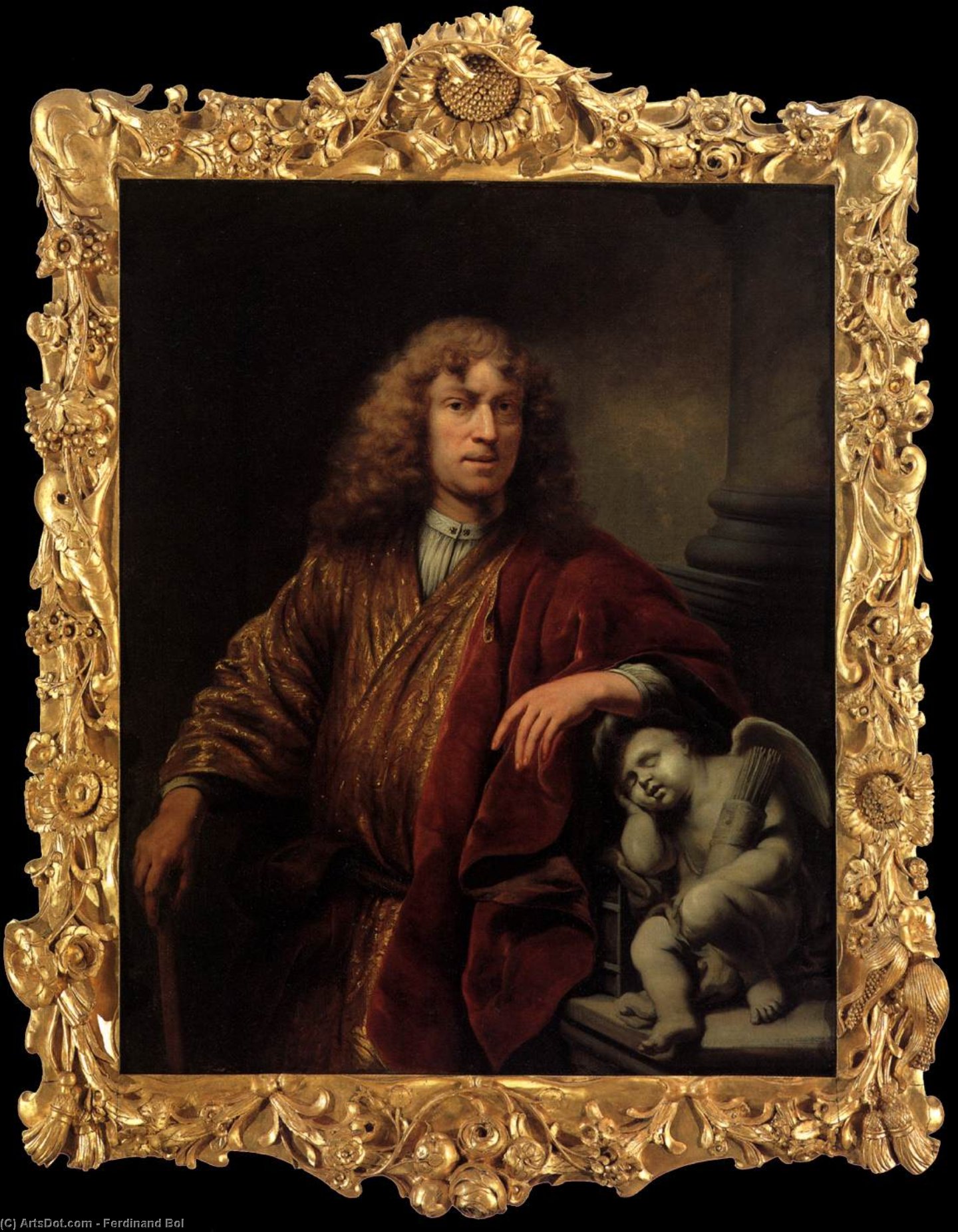
Porträtt av Ferdinand Bol

De 100 mest kända Ferdinand Bol-målningarna, varje ett unikt konstverk

Uppdaterad november 2026 · rangordnad efter vår popularitetspoäng (sökningar, besök och beställningar för varje verk) · 167 verk av Ferdinand Bol i vår katalog

Kortfattat

Portrait of Michiel Adriaansz de Ruyter (1667) är den målning av Ferdinand Bol som drar till sig flest blickar; originalet finns på Rijksmuseum, Amsterdam. Därefter dras blicken till Portret van Ferdinand Bol (1653) och Bacchus and Ariadne (1664). Bland de 167 verk av Ferdinand Bol i vår katalog är dessa 100 de mest kända, var och en ett unikt original presenterat med sitt år, sitt museum och anledningen till dess tidlösa betydelse.

1616 – 1680, Dordrecht Baroque Flest verk: Rijksmuseum

Topp 10 målningar av Ferdinand Bol, ur galleriets perspektiv

1
Portrait of Michiel Adriaansz de Ruyter (1667) av Ferdinand Bol

Portrait of Michiel Adriaansz de Ruyter

1667 · Oil On Canvas · Rijksmuseum, Amsterdam

The Portrait of Michiel Adriaansz de Ruyter is a significant work by the Dutch artist Ferdinand Bol. Painted in 1667, this oil-on-canvas portrait captures the likeness of the celebrated Dutch Navy officer Michiel de Ruyter. It was produced in memory of the Four Days Battle, a moment of profound importance in maritime history. The composition reflects the gravity of the era, presenting the commander with a sense of quiet authority.

2
Portret van Ferdinand Bol (1653) av Ferdinand Bol

Portret van Ferdinand Bol

1653 · Oil On Canvas · Rijksmuseum, Amsterdam

A single man leans over a stone ledge, his presence anchored in the heavy silence of a dark room. He wears a wide-brimmed hat that casts a soft shadow across his brow, while a golden-yellow doublet catches the light, revealing the intricate texture of patterned sleeves. A deep red cloak falls from his shoulders, adding a weight of color to the somber atmosphere. In his left hand, he holds the…

3
Bacchus and Ariadne (1664) av Ferdinand Bol

Bacchus and Ariadne

1664 · Oil On Canvas · Ermitaget, Sankt Petersburg

Ferdinand Bol's “Bacchus and Ariadne,” painted in 1664, is a captivating portrait that transcends mere representation to become a profound meditation on love, loss, and the sublime beauty of the natural world. Often overshadowed by the towering legacy of Rembrandt van Rijn, Bol’s work reveals a remarkable sensitivity to light, color, and psychological nuance – qualities that elevate this painting beyond its mythological subject matter and firmly establish it as…

4
Portret van Elisabeth Dell (1653) av Ferdinand Bol

Portret van Elisabeth Dell

1653 · Oil On Canvas · Rijksmuseum, Amsterdam

The light enters from the upper left, a soft and directional glow that carves the features of Elisabeth Dell out of the surrounding shadows. She sits in a moment of calm contemplation, her gaze drifting away from the viewer toward something unseen in the distance. There is a profound stillness in her posture as she leans against a dark, heavy ledge. Her skin possesses a porcelain-like quality, luminous against the…

5
Self-portrait (1647) av Ferdinand Bol

Self-portrait

1647 · Oil On Canvas · Toledo Museum of Art, Toledo

This painting, titled Self-portrait, was executed by the Dutch artist Ferdinand Bol in 1647. It offers a direct encounter with the artist himself, captured during a period of significant development in the Netherlands. Bol, who was born in Dordrecht in 1616, lived until 1680, leaving behind a body of work that reflects the evolving sensibilities of the seventeenth century.

6
Self-Portrait (1669) av Ferdinand Bol

Self-Portrait

1669 · Oil On Canvas · Rijksmuseum, Amsterdam

To stand before this self-portrait is to encounter not merely a likeness, but a carefully constructed statement of status, intellect, and enduring confidence. Rendered in the opulent style of the Baroque period, this work captures the sitter at a moment of profound self-possession. The composition immediately draws the eye into the central figure, whose very bearing speaks of wealth and established dignity. Notice how the artist has utilized dramatic lighting—the…

7
Portrait of an Unknown Woman (1644) av Ferdinand Bol

Portrait of an Unknown Woman

1644 · Oil On Canvas · Kenwood House, London

The woman sits in a quiet, suspended moment, her gaze drifting toward the left of the frame as if caught by a sudden thought or a distant sound. She is a figure of quiet dignity, draped in heavy, dark garments that seem to absorb the very air around her. A brilliant white millstone ruff encircles her neck, its crisp, radiating pleats catching a strong light that carves her features out…

8
Young Woman at a Window (1649) av Ferdinand Bol

Young Woman at a Window

1649 · Oil On Canvas · Ermitaget, Sankt Petersburg

A Study in Light and Introspection A young woman leans against a stone windowsill, her gaze directed downward in quiet contemplation. The composition utilizes a medium close-up to establish an intimate connection with the subject. Bathed in directional light from the upper left, her features are defined by soft shadows and a precise application of chiarosc de lum. This technique creates a palpable three-dimensional depth, pulling the figure forward from…

9
The Fearlessness of Fabricius in the Camp of Pyrrhus (1655) av Ferdinand Bol

The Fearlessness of Fabricius in the Camp of Pyrrhus

1655 · Oil On Canvas · Amsterdam Museum, Amsterdam

A massive elephant looms in the shadows, its rough skin a heavy contrast to the polished steel of a soldier's armor. This is the camp of King Pyrrhus, a place of tension where diplomacy meets the threat of brute force. The air feels thick with the scent of dust and the weight of an impending decision. In the center of this theatrical arrangement, the Roman consul Fabricius stands firm. He…

10
Salomo ontvangt geschenken (1662) av Ferdinand Bol

Salomo ontvangt geschenken

1662 · Oil On Canvas · Rijksmuseum, Amsterdam

In this grand, large-scale composition, we find ourselves drawn into a theatrical moment of historical significance. The scene depicts King Solomon receiving his tribute, a subject that allows for a profound exploration of power and ceremony. The arrangement is crowded and deliberate, guiding the eye through a bustling assembly of attendants and onlookers toward the central figure. There is a palpable sense of weight here, found in the heavy folds…

Ferdinand Bols berömda målningar, nummer 11 till 100

11Woman looking in a Mirror with a Maidservant (1630) av Ferdinand BolWoman looking in a Mirror with a Maidservant1630 · Ermitaget 12Young woman with a lira da gamba (1653) av Ferdinand BolYoung woman with a lira da gamba1653 · Kunsthistorisches Museum 13Portrait of Pieter Burgersdijk (1623-1691) (1664) av Ferdinand BolPortrait of Pieter Burgersdijk (1623-1691)1664 · Museum de Lakenhal 14A Lady Playing the Lute (1654) av Ferdinand BolA Lady Playing the Lute1654 · Nationalmuseum 15Consul Titus Manlius Torquatus Orders the Beheading of his Son (1664) av Ferdinand BolConsul Titus Manlius Torquatus Orders the Beheading of his Son1664 · Rijksmuseum 16Portrait of a Man (1670) av Ferdinand BolPortrait of a Man1670 · Los Angeles County Museum of Art 17Portrait of an Officer (1655) av Ferdinand BolPortrait of an Officer1655 · Ermitaget 18Elijah Fed by an Angel (1660) av Ferdinand BolElijah Fed by an Angel1660 19Portrait of a Boy, said to be the artist's son, aged 8 (1652) av Ferdinand BolPortrait of a Boy, said to be the artist's son, aged 81652 · National Gallery 20Portrait of Admiral Michael Adriansz de Ruijter (1668) av Ferdinand BolPortrait of Admiral Michael Adriansz de Ruijter1668 · Statens Museum for Kunst 21Portrait of a woman (1655) av Ferdinand BolPortrait of a woman1655 · Art Institute of Chicago 22Farao's Dochter Vindt Mozes in Het Biezen Mandje. (1669) av Ferdinand BolFarao's Dochter Vindt Mozes in Het Biezen Mandje.1669 · Rijksmuseum 23Portrait of Carel Fabritius (1644) av Ferdinand BolPortrait of Carel Fabritius1644 · Ermitaget 24Portrait of An Old Woman (1640) av Ferdinand BolPortrait of An Old Woman1640 · Nationalmuseet i Warszawa 25Portrait of a Woman (1656) av Ferdinand BolPortrait of a Woman1656 · Statens Museum for Kunst 26Portrait of a Man in a High Beret (1631) av Ferdinand BolPortrait of a Man in a High Beret1631 · Museum Gouda 27The good Samaritan figured (1631) av Ferdinand BolThe good Samaritan figured1631 28Self-Portrait (1647) av Ferdinand BolSelf-Portrait1647 29Self-Portrait (1647) av Ferdinand BolSelf-Portrait1647 30Portrait of a Lady (1644) av Ferdinand BolPortrait of a Lady1644 · National Gallery of Ireland 31David's Dying Charge to Solomon (1643) av Ferdinand BolDavid's Dying Charge to Solomon1643 · National Gallery of Ireland 32Man with a Fur-Trimmed Hat (1647) av Ferdinand BolMan with a Fur-Trimmed Hat1647 33Woman wearing a feather cap and veil (1648) av Ferdinand BolWoman wearing a feather cap and veil1648 · Bavarian State Painting Collections 34Angel appears to Zideon (1640) av Ferdinand BolAngel appears to Zideon1640 · Museum Catharijneconvent 35Woman at her Dressing Table (1643) av Ferdinand BolWoman at her Dressing Table1643 · Museum of Fine Arts, Houston 36couple in landscape (1645) av Ferdinand Bolcouple in landscape1645 · Dordrechts Museum 37Self portrait with baret (1646) av Ferdinand BolSelf portrait with baret1646 · Dordrechts Museum 38A Rabbi in a Fur Cloak (1638) av Ferdinand BolA Rabbi in a Fur Cloak1638 · Royal Collection 39Isaac blessing Esau (1642) av Ferdinand BolIsaac blessing Esau1642 40Rembrandt and his Wife Saskia (1638) av Ferdinand BolRembrandt and his Wife Saskia1638 · Royal Collection 41A Young Woman holding a Staircase Bannister (1644) av Ferdinand BolA Young Woman holding a Staircase Bannister1644 · Buscot Park 42Judah and Tamar (1644) av Ferdinand BolJudah and Tamar1644 · Museum of Fine Arts 43Young Man in Oriental Costume (1636) av Ferdinand BolYoung Man in Oriental Costume1636 · Museum of Fine Arts 44The holy Women at the Sepulchre (1644) av Ferdinand BolThe holy Women at the Sepulchre1644 · Statens Museum for Kunst 45Man with a Book (1644) av Ferdinand BolMan with a Book1644 46Rebecca and Eliezer at the Well (1645) av Ferdinand BolRebecca and Eliezer at the Well1645 47girl in a window (1641) av Ferdinand Bolgirl in a window1641 · Francisque Mandet Museum 48Hiob and the angel (1641) av Ferdinand BolHiob and the angel1641 49portrait of an old man (1639) av Ferdinand Bolportrait of an old man1639 50Double portrait of a boy and girl, full-length, in a landscape (1645) av Ferdinand BolDouble portrait of a boy and girl, full-length, in a landscape1645 51Portrait of an older Women (1642) av Ferdinand BolPortrait of an older Women1642 · Gemäldegalerie 52God's Messenger Appears to Joshua (1642) av Ferdinand BolGod's Messenger Appears to Joshua1642 53Portrait of Portrait of a Woman Dressed as a Huntress (1641) av Ferdinand BolPortrait of Portrait of a Woman Dressed as a Huntress1641 · Figge Art Museum 54Portrait of a Couple Leaning on the Balustrade of a Porch, Formerly Called Portrait of the Painter Ferdinand Bol and His Wife Lisbeth Dell (1654) av Ferdinand BolPortrait of a Couple Leaning on the Balustrade of a Porch, Formerly Called Portrait of the Painter Ferdinand Bol and His Wife Lisbeth Dell1654 · Musée de Tessé 55The War Council of the Goudse Schutterij under the leadership of Colonel Govert Suijs (1653) av Ferdinand BolThe War Council of the Goudse Schutterij under the leadership of Colonel Govert Suijs1653 · Museum Gouda 56The Pearl Necklace (1649) av Ferdinand BolThe Pearl Necklace1649 57Portrait of Elisabeth de Vlaming van Outshoorn (1600-1666) (1660) av Ferdinand BolPortrait of Elisabeth de Vlaming van Outshoorn (1600-1666)1660 · Museum Briner und Kern 58Portrait of Elbert Spiegel (1600-1674) (1660) av Ferdinand BolPortrait of Elbert Spiegel (1600-1674)1660 59Woman suckling an infant (1657) av Ferdinand BolWoman suckling an infant1657 · Nationalmuseet i Oslo 60Portrait of Anna Maria van Nutt (1658) av Ferdinand BolPortrait of Anna Maria van Nutt1658 · Museum Tongerlohuys 61Scene from Ancient History (The Incorruptibility of Gaius Fabricius) (1650) av Ferdinand BolScene from Ancient History (The Incorruptibility of Gaius Fabricius)1650 · Worcester Art Museum 62Portrait of an unknown man (1659) av Ferdinand BolPortrait of an unknown man1659 63Family portrait, possibly of the Trip children: Matthias Trip (?-1695), Jacob Trip (1615-1695) and Louis Trip (1653-1707) (1654) av Ferdinand BolFamily portrait, possibly of the Trip children: Matthias Trip (?-1695), Jacob Trip (1615-1695) and Louis Trip (1653-1707)1654 64Portrait of Marie Louise Gonzaga de Nevers (1650) av Ferdinand BolPortrait of Marie Louise Gonzaga de Nevers1650 65Pyrrus (1658) av Ferdinand BolPyrrus1658 66Alexander and Roxane (1659) av Ferdinand BolAlexander and Roxane1659 67Portrait of a Man and a Woman in a Landscape (1655) av Ferdinand BolPortrait of a Man and a Woman in a Landscape1655 68Woman sitting in Chair with Book (1659) av Ferdinand BolWoman sitting in Chair with Book1659 69Portrait of Sir John Hebdon (1659) av Ferdinand BolPortrait of Sir John Hebdon1659 · Museum of Fine Arts, Houston 70Portrait of a Man (1659) av Ferdinand BolPortrait of a Man1659 · Indianapolis konstmuseum 71Five officers of the Gouda city militia (1653) av Ferdinand BolFive officers of the Gouda city militia1653 · Museum Gouda 72Portrait of a Woman as Diana (1657) av Ferdinand BolPortrait of a Woman as Diana1657 · Centraal Museum 73Portrait of Ephraim Bueno (1650) av Ferdinand BolPortrait of Ephraim Bueno1650 · Kedleston Hall 74Esther and Mordecai (1654) av Ferdinand BolEsther and Mordecai1654 · Ermitaget 75Young Man in a feathered Cap (1647) av Ferdinand BolYoung Man in a feathered Cap1647 · Thyssen-Bornemisza-museet 76Double portrait of  Jan van der Voort (1626-1678) and his sister Catharina van der Voort (1622-1674), with a servant (1661) av Ferdinand BolDouble portrait of Jan van der Voort (1626-1678) and his sister Catharina van der Voort (1622-1674), with a servant1661 · Koninklijk Museum voor Schone Kunsten Antwerpen 77The Crowning of Mirtillo (1650) av Ferdinand BolThe Crowning of Mirtillo1650 · Fine Arts Museums of San Francisco 78Fabritius and Pyrrhus (1656) av Ferdinand BolFabritius and Pyrrhus1656 · Royal Palace Amsterdam 79An allegory of the admiralty (1661) av Ferdinand BolAn allegory of the admiralty1661 · Amsterdam Museum 80Elisha refuses the gifts of Naäman (1661) av Ferdinand BolElisha refuses the gifts of Naäman1661 · Amsterdam Museum 81Portrait of a man at a casement (1652) av Ferdinand BolPortrait of a man at a casement1652 · Museum der bildenden Künste 82Portrait of a lady at a casement (1652) av Ferdinand BolPortrait of a lady at a casement1652 83Half-length portrait of a young man (1651) av Ferdinand BolHalf-length portrait of a young man1651 · Gemäldegalerie 84Portrait of a Mathematician (1658) av Ferdinand BolPortrait of a Mathematician1658 85Venus and Adonis (1661) av Ferdinand BolVenus and Adonis1661 86Otto Van Der Waeyen in a Polish Costume (1656) av Ferdinand BolOtto Van Der Waeyen in a Polish Costume1656 · Museum Boijmans Van Beuningen 87Portrait of Michiel Adriaensz. de Ruyter (1667) av Ferdinand BolPortrait of Michiel Adriaensz. de Ruyter1667 · Het Scheepvaartmuseum 88Portrait of Michiel de Ruyter with a Servant (1667) av Ferdinand BolPortrait of Michiel de Ruyter with a Servant1667 89Moses descends from Mount Siniai with the Ten Commandments (1662) av Ferdinand BolMoses descends from Mount Siniai with the Ten Commandments1662 · Royal Palace Amsterdam 90Four Regents of the Leprozenhuis (1668) av Ferdinand BolFour Regents of the Leprozenhuis1668 · Amsterdam Museum 91Portrait of an unknown man (1662) av Ferdinand BolPortrait of an unknown man1662 92Portrait of an unknown woman (1662) av Ferdinand BolPortrait of an unknown woman1662 93Portrait of Lieutenant Admiral Cornelis Tromp (1629-1691) (1667) av Ferdinand BolPortrait of Lieutenant Admiral Cornelis Tromp (1629-1691)1667 · Het Scheepvaartmuseum 94Portrait of a man holding a hat (1662) av Ferdinand BolPortrait of a man holding a hat1662 · Musée Crozatier 95The Toper (1651) av Ferdinand BolThe Toper1651 · Wallace Collection 96Portrait of a Scholar (1659) av Ferdinand BolPortrait of a Scholar1659 · Indianapolis konstmuseum 97Mutter mit drei Kindern (Caritas) (1655) av Ferdinand BolMutter mit drei Kindern (Caritas)1655 · Bildergalerie Sanssouci 98Man in Golden Helmet (Mars) (1657) av Ferdinand BolMan in Golden Helmet (Mars)1657 · Nationalmuseet i Warszawa 99Angel Appearing to Elijah (1642) av Ferdinand BolAngel Appearing to Elijah1642 · The Leiden Collection 100Four Governors of the Amsterdam Leper Asylum (1649) av Ferdinand BolFour Governors of the Amsterdam Leper Asylum1649 · Rijksmuseum

Ferdinand Bols berömda målningar, period för period

Motiven som fångade Ferdinand Bols blick

De fyra motiv som återkommer oftast i dessa originalverk, var och ett med sitt främsta exempel.

Museerna som förvarar Ferdinand Bols originalverk

De 8 museer som innehar flest av målningarna på denna sida.

Museum Stad Verk av Ferdinand Bol Målningar från denna lista
Rijksmuseum, AmsterdamRijksmuseum Amsterdam 28 Portrait of Michiel Adriaansz de Ruyter, Portret van Ferdinand Bol, Portret van Elisabeth Dell
Ermitaget, Sankt PetersburgErmitaget Sankt Petersburg 8 Bacchus and Ariadne, Young Woman at a Window, Woman looking in a Mirror with a Maidservant
Amsterdam Museum, AmsterdamAmsterdam Museum Amsterdam 4 The Fearlessness of Fabricius in the Camp of Pyrrhus, An allegory of the admiralty, Elisha refuses the gifts of Naäman
Statens Museum for Kunst, KöpenhamnStatens Museum for Kunst Köpenhamn 3 Portrait of Admiral Michael Adriansz de Ruijter, Portrait of a Woman, The holy Women at the Sepulchre
Museum Gouda, GoudaMuseum Gouda Gouda 3 Portrait of a Man in a High Beret, The War Council of the Goudse Schutterij under the leadership of Colonel Govert Suijs, Five officers of the Gouda city militia
Nationalmuseet i Warszawa, WarszawaNationalmuseet i Warszawa Warszawa 5 Portrait of An Old Woman, Man in Golden Helmet (Mars)
Dordrechts Museum, DordrechtDordrechts Museum Dordrecht 3 couple in landscape, Self portrait with baret
Gemäldegalerie, BerlinGemäldegalerie Berlin 3 Portrait of an older Women, Half-length portrait of a young man

Ferdinand Bol genom decennierna: ett unikt original för varje era

Verk per decennium

Välj ett decennium för att se originalverket som definierar det.

Ferdinand Bols målningar: frågor till galleriet

Vilket är Ferdinand Bols mest kända verk?Visa svaret

Portrait of Michiel Adriaansz de Ruyter (1667), Rijksmuseum, Amsterdam. Portret van Ferdinand Bol (1653) och Bacchus and Ariadne (1664) följer efter.

Vid vilken ålder skapade Ferdinand Bol Portrait of Michiel Adriaansz de Ruyter?Visa svaret

51 år gammal: Portrait of Michiel Adriaansz de Ruyter är från 1667, och Ferdinand Bol föddes 1616.

Vilka tio målningar av Ferdinand Bol är de mest kända?Visa svaret

Portrait of Michiel Adriaansz de Ruyter, Portret van Ferdinand Bol, Bacchus and Ariadne, Portret van Elisabeth Dell, Self-portrait, Self-Portrait, Portrait of an Unknown Woman, Young Woman at a Window, The Fearlessness of Fabricius in the Camp of Pyrrhus och Salomo ontvangt geschenken. Rankingen ovan visar varje verks årtal och museum.

Hur många verk av Ferdinand Bol är kända?Visa svaret

Vår katalog innehåller 167 verk av Ferdinand Bol, daterade från 1630 till 1670.

Var kan de mest kända originalen av Ferdinand Bol ses?Visa svaret

Främst i Rijksmuseum (Amsterdam), Ermitaget (Sankt Petersburg) och Amsterdam Museum (Amsterdam). Museitabellen ovan listar alla.

Under vilken period skapade Ferdinand Bol sina mest kända målningar?Visa svaret

Under 1650s: 38 av de 100 verk som finns på denna sida skapades då, varav Portret van Ferdinand Bol.

Vilket av de kända verken av Ferdinand Bol är det tidigaste respektive det senaste?Visa svaret

På den här sidan är det tidigaste Woman looking in a Mirror with a Maidservant (1630) och det senaste Portrait of a Man (1670).

Vilka motiv föredrog Ferdinand Bol?Visa svaret

Man (50), Woman (35) och Dark background (13), fördelat på 100 verk på denna sida.

Vilka material använde Ferdinand Bol mest av när hen målade?Visa svaret

Oil On Canvas, för 84 av de 100 verk som finns på denna sida.

Vilken konstinriktning tillhör Ferdinand Bols verk?Visa svaret

Baroque, om man dömer efter originalen på denna sida.

Vilka original av Ferdinand Bol kan jag se på Rijksmuseum?Visa svaret

Portrait of Michiel Adriaansz de Ruyter, Portret van Ferdinand Bol och Portret van Elisabeth Dell: Rijksmuseum, Amsterdam har 8 av verken på denna sida.

Ferdinand Bol: ett porträtt av konstnären

Ferdinand Bol: A Forgotten Jewel of the Dutch Golden Age

Ferdinand Bol, a name perhaps less familiar than those of his illustrious contemporaries Rembrandt van Rijn and Johannes Vermeer, nevertheless occupies a significant, if often overlooked, position within the pantheon of 17th-century Dutch Masters. Born in Dordrecht in 1616, Bol’s artistic journey was deeply intertwined with that of Rembrandt, serving as a pupil in the master's Amsterdam studio during a formative period. This apprenticeship profoundly shaped his style, initially leading to works so convincingly reminiscent of Rembrandt that attribution could prove challenging even for seasoned experts. However, to simply categorize Bol as a mere imitator would be a disservice to his own unique artistic voice and considerable talent. His early life laid the groundwork for a career marked by both technical brilliance and an evolving stylistic independence. While details regarding his initial training remain somewhat scarce – possibilities include tutelage under Jacob Cuyp in Dordrecht or Abraham Bloemaert in Utrecht – it was undoubtedly his time with Rembrandt that proved pivotal, immersing him in the dramatic lighting, psychological depth, and masterful brushwork characteristic of the Baroque period.

Rembrandt’s Influence: The Early Years

Bol's artistic development can be traced through a fascinating trajectory—one beginning with faithful emulation and gradually blossoming into a distinctive personal style. In his early works, the influence of Rembrandt is undeniable; compositions often echo those of his teacher, employing similar chiaroscuro effects – that dramatic contrast between light and dark – and a penchant for portraying figures in moments of intense emotional or psychological drama. These initial paintings, predominantly portraits and genre scenes, were so strikingly reminiscent of Rembrandt that they frequently sparked debate amongst art critics and collectors. Bol’s early style was characterized by a somewhat heavy, almost brooding quality, reflecting the somber mood often found in Rembrandt's works. However, as Bol matured, he began to refine his technique, moving towards a greater emphasis on clarity, elegance, and refined detail. His palette lightened considerably, shifting from the dark, earthy tones favored by Rembrandt to brighter, more vibrant hues. This shift is particularly evident in his portraits, which gradually acquired a more polished, aristocratic bearing. He also developed a greater sense of spatial depth and a more sophisticated use of perspective, moving away from the flattened compositions typical of earlier Dutch painting.

From Rembrandt’s Shadow to Independent Vision

Bol's artistic development can be traced through a fascinating trajectory—one beginning with faithful emulation and gradually blossoming into a distinctive personal style. In his early works, the influence of Rembrandt is undeniable; compositions often echo those of his teacher, employing similar chiaroscuro effects and a penchant for portraying figures in moments of intense emotional or psychological drama. However, as Bol matured, he began to refine his technique, moving towards a greater emphasis on clarity, elegance, and refined detail. His palette lightened, and his figures acquired a more polished, aristocratic bearing. This shift is particularly evident in his portraits, which became increasingly sought after by Amsterdam’s wealthy elite. He quickly rose through the ranks of Amsterdam's artistic community, becoming a burgher in 1652 and marrying into a family with connections to both the Admiralty and the wine merchants’ guild – affiliations that undoubtedly contributed to securing prestigious commissions. Notably, he received orders for chimney pieces for the new Amsterdam Town Hall, designed by Jacob van Campen, a testament to his growing reputation and artistic standing. He even took on pupils of his own, most notably Godfrey Kneller, who would later achieve fame as an English portrait painter.

Historical Narratives and Portraiture: A Diverse Oeuvre

Bol’s oeuvre is remarkably diverse, encompassing historical subjects, portraits, *tronies* (character studies), and even some landscape elements. He demonstrated a particular aptitude for large-scale historical paintings, imbuing them with a sense of grandeur and dramatic tension. The Peace Negotiations between Claudius Civilis and Quintus Petillius Cerealis on the Demolished Bridge, now housed in a museum collection, stands as a prime example of his skill in depicting complex narratives with compelling visual impact. The painting showcases not only his mastery of composition and perspective but also his ability to convey the weight of historical events through expressive gestures and carefully rendered details. However, it was perhaps in the realm of portraiture that Bol truly excelled. He possessed an uncanny ability to capture the likenesses of his sitters while simultaneously revealing their inner character and social status. His portraits are characterized by a refined elegance and psychological insight, offering glimpses into the lives and personalities of Amsterdam’s prominent citizens. Works like Man in Golden Helmet (Mars), now residing in Warsaw's National Museum, exemplify this talent, presenting a figure imbued with both authority and vulnerability.

Legacy and Rediscovery

Despite his success during his lifetime, Ferdinand Bol’s reputation waned considerably after his death in 1680. His works were often misattributed to Rembrandt, obscuring his individual contributions to Dutch Golden Age painting. It wasn't until the 20th century that concerted efforts began to re-evaluate his oeuvre and establish him as a significant artist in his own right. Today, scholars and collectors are increasingly recognizing the unique qualities of Bol’s work—his masterful technique, his evolving stylistic independence, and his ability to capture both the outward appearance and inner lives of his subjects. While his output remains relatively small compared to some of his contemporaries, the surviving paintings offer a captivating window into the artistic and cultural landscape of 17th-century Amsterdam. His legacy continues to inspire admiration and intrigue, ensuring that this once-forgotten master will continue to be rediscovered and appreciated by generations to come. The Museum Van Loon in Amsterdam and the Rembrandt House Museum both provide opportunities to encounter his work within the context of the era that shaped him.