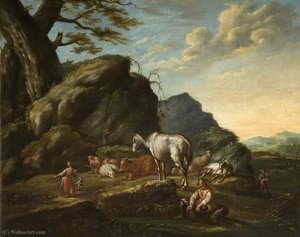
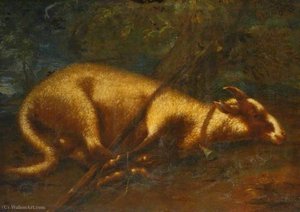
Goats and Flock of Sheep
Goats and Flock of Sheep is an oil painting by Philipp Peter Roos. The artist, who was also known by the moniker Rosa di Tivoli, produced this work about 1681. He was a German Baroque painter born in Sankt Goar, Germany.
Kortfattat
Av alla originalverk som Philipp Peter Roos lämnade efter sig är det mest kända Goats and Flock of Sheep (1681), i samlingen hos Bavarian State Painting Collections, München. Tätt efter följer Piece of Livestock (1681) och Landscape with Cattle and Shepherd (1681). Vår katalog innehåller 93 verk av Philipp Peter Roos; galleriet har bevarat de 92 som världen beundrar mest, var och en presenterad med sitt datum, sitt museum och sin historia.
Goats and Flock of Sheep is an oil painting by Philipp Peter Roos. The artist, who was also known by the moniker Rosa di Tivoli, produced this work about 1681. He was a German Baroque painter born in Sankt Goar, Germany.
Piece of Livestock is an oil painting by Philipp Peter Roos, executed in 1681. The work originates from the Baroque period, a time when the artist was establishing his presence within the Italianate landscape tradition.
Landscape with Cattle and Shepherd is a work by the German Baroque painter Philipp Peter Roos. Created about 1681, the painting reflects the artist's specialized focus on pastoral scenes and animal subjects. Roos was a significant figure in the development of Italianate landscapes, often characterized by his intimate study of livestock and the natural environment.
In Piece of Livestock, Philipp Peter Roos organizes a pastoral scene through a close-up, ground-level perspective that establishes an immediate intimacy with the subjects. The composition is dominated by a large, seated cow positioned slightly to the right of the center. To the left, a smaller lamb or calf provides a sense of scale, while a woman interacts with a dog in the space behind the primary subject. This arrangement…
Resting Flock with Shepherds is an oil painting by the German Baroque artist Philipp Peter Roos. Created about 1681, this work captures a quiet moment within a rugged landscape. The composition focuses on a group of livestock and a shepherd, rendered with a sense of immediate presence that draws the viewer into the scene.
Resting Flock with Shepherds is an oil painting by Philipp Peter Roos. The canvas captures a heavy stillness among livestock and their guardian. This work was created about 1681. It presents a scene of animals and men gathered in a quiet, layered space under a turbulent sky.
In this Baroque-style oil painting, the mythological drama of the Liberation of Io unfolds with a sudden, heavy intensity. Created by Philipp Peter Roos about 1681, the scene captures a moment of profound tension between the divine and the mortal. A massive, powerful bull dominates the foreground, its muscular form rendered with a weight that feels almost tangible. This central figure looms over the landscape, its presence commanding the space…
This oil on canvas painting, dated 1681, presents a monochromatic scene rendered in various shades of gray. In the foreground, a young woman is positioned amidst a group of livestock, including sheep or goats. The composition is a medium shot, placing the human subject and the animals in the immediate front and middle ground. The terrain is undulating, forming rolling hills that recede into a background of hazy mountains and…
Returning Flock with Shepherds is an oil painting by Philipp Peter Roos. Created about 1681, the work captures a quiet moment of pastoral movement. The artist, a German Baroque painter, was born in Sankt Goar. He would later become known by the moniker Rosa di Tivoli.
The scene unfolds in Shepherd with Cow, Sheep and Goats in Italian Mountain Landscape, a work that captures a quiet moment of pastoral life. This painting, created about 1680, brings together a shepherd and his diverse herd amidst a rugged, mountainous setting. The figures and animals exist within a landscape that feels both immediate and deeply rooted in the natural world.
De fyra motiv som återkommer oftast i dessa originalverk, var och ett med sitt främsta exempel.
De 8 museer som innehar flest av målningarna på denna sida.
| Museum | Stad | Verk av Philipp Peter Roos | Målningar från denna lista |
|---|---|---|---|
| München | 15 | Goats and Flock of Sheep, Piece of Livestock, Landscape with Cattle and Shepherd | |
| Köpenhamn | 5 | Cattle Piece, Landscape with a Bull, Sheep and Goats, A Shepherd with his Herd | |
| Buenos Aires | 4 | Landscape with shepherd and animals, Landscape with figures and animals, Shepherd and animals in a landscape | |
| Bratislava | 3 | Goat Herd with a Goatherd, Shepherd's Idyl in a Romantic Landscape with Ruins, Herd by an Ancient Well | |
| Prag | 3 | Ravine with a Stream, a Shepherd and His Herd, Horse and Goats Grazing, Shepherd with a Herd of Sheep and Goats | |
| Wien | 3 | Herd with Sleeping Shepherds, Rider Meeting, Landscape with Flock of Sheep | |
| Sankt Petersburg | 3 | Landscape with a Grotto, Landscape with a Waterfall, Landscape with a Herd | |
| Stockholm | 3 | Dead Hare, Landskap med hjord, A Goat Resting |
Välj ett decennium för att se originalverket som definierar det.
This large-scale oil painting, dated 1669, presents a crowded, maximalist composition of diverse animal species. The arrangement is packed, with various animals overlapping to create a sense of density and movement. The color palette relies on deep, earthy tones, including rich browns, blacks, and dark ochres. These dark shades are interrupted by specific highlights of white and cream, alongside splashes of red from a rooster and parrots. The lighting follows…
Goats and Flock of Sheep is an oil painting by Philipp Peter Roos. The artist, who was also known by the moniker Rosa di Tivoli, produced this work about 1681. He was a German Baroque painter born in Sankt Goar, Germany.
A heavy, dark-colored cow anchors the center of this scene, its presence felt in the weight of its silhouette. To the left, two goats rest upon the ground, one a pale contrast of white and light tan against the shadows. A man sits nearby, leaning back in a moment of stillness, his gaze directed toward the animals or perhaps the viewer. The air in the enclosure feels thick and dim,…
In this work, titled Shepherd's Idyl in a Romantic Landscape with Ruins, the artist Philipp Peter Roos presents a quiet moment of rural existence. Created about 1700, the painting captures a shepherd tending to his flock amidst a landscape of rolling hills and weathered stone structures. There is a sense of stillness in the way the figures and animals occupy the space, suggesting a life governed by the rhythms of…
Goats and Flock of Sheep (1681), Bavarian State Painting Collections, München. Piece of Livestock (1681) och Landscape with Cattle and Shepherd (1681) följer efter.
24 år gammal: Goats and Flock of Sheep är från 1681, och Philipp Peter Roos föddes 1657.
Goats and Flock of Sheep, Piece of Livestock, Landscape with Cattle and Shepherd, Piece of Livestock, Resting Flock with Shepherds, Resting Flock with Shepherds, Liberation of Io, Piece of Cattle, Returning Flock with Shepherds och Shepherd with Cow, Sheep and Goats in Italian Mountain Landscape. Rankingen ovan visar varje verks årtal och museum.
Vår katalog innehåller 93 verk av Philipp Peter Roos, daterade från 1669 till 1700.
Främst i Bavarian State Painting Collections (München), Statens Museum for Kunst (Köpenhamn) och National Museum of Fine Arts (Buenos Aires). Museitabellen ovan listar alla.
Under 1680s: 21 av de 92 verk som finns på denna sida skapades då, varav Goats and Flock of Sheep.
På den här sidan är det tidigaste Various animals gathered before Noah's Ark (1669) och det senaste Shepherd's Idyl in a Romantic Landscape with Ruins (1700).
Landscape (33), Animals (29) och Goats (19), fördelat på 92 verk på denna sida.
Oil On Canvas, för 18 av de 92 verk som finns på denna sida.
Baroque, om man dömer efter originalen på denna sida.
Goats and Flock of Sheep, Piece of Livestock och Landscape with Cattle and Shepherd: Bavarian State Painting Collections, München har 15 av verken på denna sida.
I den italienska barockens gyllene ljus är det få namn som frammanar landsbygdens pastorala lugn så starkt som Philipp Peter Roos. Historien känner honom under det stämningsfulla öknamnet Rosa di Tivoli, och denna tyskfödda mästare transformerade landskapsmåleriet genom en djup, nästan visceral koppling till den naturliga världen. Roos föddes 1655 i Rhenlandet – närmare bestämt nära Sankt Goar – och var ämnad för penseln från sina tidigaste år. Han var son till Johann Heinrich Roos, en respekterad landskapsmålare som gav honom de grundläggande lektionerna i tonal harmoni och kompositionell balans, element som senare skulle definiera konstnärens mogna stil. Denna tidiga lärlingsperiod handlade inte enbart om teknik; det var en fördjupning i ett sätt att se världen genom ljusets, skuggans och jordens tysta värdighet.
Roos livsresa förändrades dramatiskt år 1677, ett ögonblick som möjliggjordes av den generösa landgreven av Hessen-Kassel, Karl I. Genom att inse den unga målarens växande talang, gav landgreven de ekonomiska medel som krävdes för att Roos skulle kunna påbörja en livsavgörande resa till Rom. Denna vandring från de germanska traditionerna till hjärtat av den italienska barocken tillät Roos att absorbera den livfulla energin i den romerska konsten. Det var här han sökte mentorskap under den berömde Giacinto Brandi, vars inflytande hjälpte till att förfina Roos förmåga att sammanväva klassisk struktur med en mer spontan och atmosfärisk realism. Denna period i Rom var också djupt personlig; det var under dessa år som Roos förälskade sig i Isabella Brandi, hans mentors dotter. Deras förening skulle slutligen leda honom till att bosätta sig i Tivoli, ett steg som för alltid skulle knyta hans identitet till det landskap han älskade så högt.
Det som verkligen utmärker Rosa di Tivolis konstnärskap är den oöverträffade autenticiteten hos hans djurmotiv. Till skillnad från många av hans samtida, som använde djur som blott dekorativa eftertankar i ett landskap, behandlade Roos varje varelse – från den kraftfulla oxen till den smidiga geiten – med en porträttörs vördnad. Hans residens i Tivoli var berömt för att vara utformat kring ett koncept som liknade en levande ateljé; han höll en omfattande samling av både exotiska och tama djur, vilket effektivt förvandlade hans omgivningar till en kontinuerlig studie av rörelse, anatomi och temperament. Denna intima närhet gjorde det möjligt för honom att fånga det subtila rycket i ett öra eller den muskulära spänningen hos ett djur under press, vilket gav hans dukar en häpnadsväckande vitalitet.
Hans tekniska mästerskap är uppenbart i hur han navigerade den barockestetiska komplexiteten. Medan hans kompositioner ofta lånar de fridfulla och atmosfäriska kvaliteterna från den nederländska guldåldern, är de genomströmmade av den dramatiska intensitet som kännetecknar den italienska skolan. Hans verk uppvisar ofta:
Philipp Peter Roos historiska betydelse ligger i hans förmåga att överbrygga klyftan mellan de strukturerade landskapstraditionerna i Nordeuropa och det emotionella, ljusfyllda dramat i Italien. Han framträdde under en tid då den vetenskapliga undersökningen började ställa högre krav på precisa observationer av naturen, samtidigt som religiösa och mytologiska teman fortfarande dominerade det konstnärliga medvetandet. I hans målningar finner man både naturforskarens noggranna detaljrikedom och den romantiska själens poesi. Genom att dokumentera den romerska landsbygdens flora och fauna med sådan hängivenhet, skapade han ett visuellt arkiv som säger lika mycket om tidens anda som om själva motiven.
Trots att han gick bort år 1706 och lämnade efter sig ett arv som är etsat i själva jorden i Tivoli, lever hans inflytande vidare. Han förblir en central gestalt för alla som studerar utvecklingen av djurmåleri och det italienska landskapets estetik. Genom hans ögon ser vi inte bara en samling boskap; vi bevittnar en djup hyllning till livet i dess mest fundamentala och oförställda former. Hans arbete fortsätter att resonera som ett vittnesbörd om observationens kraft och den pastorala idyllens bestående skönhet.