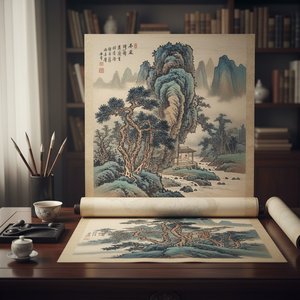
The Life and Identity of Jiang Zhu
To understand the weight of Jiang Zhu’s output, one must first grasp the precarious nature of his lineage. Born in 1626 in Nanchang, Jiangxi, within the Ming Empire, he was a member of the House of Zhu. As a descendant of a Ming imperial prince, his very existence was tied to a collapsing political order. He was born into a family of accomplished scholars and artists, a background that provided the technical foundation for his later pursuits. However, his identity was never static. He is frequently identified by the names Bada Shanren or Zhu Da, names that reflect a man constantly reshaping his persona to survive a changing regime.
His identity was defined by a tension between high-born status and the necessity of concealment. While his bloodline linked him to the imperial court, his practical reality was that of a painter, calligrapher, and poet. This combination of skills was not merely a professional choice but a survival mechanism for a man whose family history made him a target. He operated within the complex social structures of the Ming and Qing eras, using his brush to navigate a world where his true origins were both a source of profound talent and a dangerous secret.
A Period of Seclusion and Monastic Life
The transition from imperial descendant to fugitive was a necessity of survival. Following the collapse of the Ming dynasty and the rise of the Qing, the threat of execution forced a radical reinvention. He did not merely hide; he remade himself as a secluded Buddhist monk to escape the reach of the new authorities. This was a calculated erasure of his former identity. He retreated to a Buddhist monastery in the mountains, trading the life of a prince for the anonymity of the priesthood.
This period of monastic life lasted for more than 30 years. It was a long, deliberate withdrawal from the political chaos of the era. By seeking refuge in a temple, he learned the teachings of Buddhism, a move that provided both physical safety and a new psychological framework. This seclusion was not a passive waiting period. It was a fundamental shift in his existence that defined his later perspective. He lived under the shadow of the Manchu conquest, using the monastery as a shield against the perils of a changing empire.
Professional Career and Artistic Style
After leaving the priesthood, he returned to secular life in Nanchang to work as a professional artist, calligrapher, and poet. In 1684, he adopted the name Bada Shanren. His output during this period was defined by an individualistic and outlandish style that was uniquely his. He did not rely on the standard visual language of his contemporaries; instead, he produced wayward compositions that contained many layers of meaning. These works were often daring and powerful, rejecting the safe, conventional aesthetics of the era.
His reputation was complicated by his temperament. He was frequently condemned as a mad eccentric, a label that likely stemmed from the idiosyncratic nature of his visual vocabulary. His paintings were not merely decorative; they were assertive and often reflected a sense of internal tension. This refusal to conform to established norms is what gives his body of work its specific, jagged energy. He operated outside the expected boundaries of 17th-century Chinese art, prioritizing a personal, often obtuse, expression over clarity or traditional harmony.
Frågor och svar
Kan jag sortera Jiang Zhus konstverk efter färg?
Jiang Zhus verk kan utforskas efter färg på artistens Färgindex-sida.
Hur många konstverk av Jiang Zhu finns tillgängliga att bläddra bland?
Du kan bläddra bland 41 konstverk verk av Jiang Zhu på sidan Samtliga konstverk.
Vilka konstinriktningar tillhörde Jiang Zhu?
De konstinriktningar som Jiang Zhu verkade inom kan ses på artistens Alla konststilar-sida, där konstverken är grupperade efter inriktning.
Var kan jag hitta statistik gällande Jiang Zhus verk?
Sidan Besöksstatistik för Jiang Zhu presenterar statistik baserad på konstnärens verk som finns listade på denna webbplats.