Work
Abstract Art
Modern
194.0 x 130.0 cm
Handgjord oljereproduktion
Handmålad olja på duk i din valda storlek och ram, tillverkad efter beställning av våra konstnärer.
Välj bland våra förinställda storlekar som motsvarar konstverkets ursprungliga proportioner.
Du kan ange egna mått för att passa en specifik ram eller yta. Om den valda storleken inte matchar originalbildens proportioner kommer vi antingen att beskära konstverket eller utöka målningen med ytterligare handmålade element. En digital skiss skickas till dig för godkännande innan produktionen påbörjas.

Observera att förhandsvisningen på skärmen inte återspeglar den faktiska beskärningen eller utökningen. Endast skissen visar den slutgiltiga kompositionen korrekt.
Även om anpassade storlekar är möjliga, rekommenderar vi att du väljer en dimension från den fördefinierade listan för att bevara originalproportionerna.
Efter beställning kommer OriginalUniqueArt.com team att mejla kunden för instruktioner och tillhandahålla en skissförhandsvisning
Leverans över hela världen () på 3–4 veckor istället för standard 5 veckor. (24 juli). Inga kompromisser med kvaliteten.
Fri expressfrakt över hela världen
Högkvalitativ linnecanvas
Fullständig fraktförsäkring
Garantier för återbetalning av tullavgifter
Garantier för exakt färgåtergivning
60 dagars returrätt (endast vid fabrikationsfel)
100% pengarna tillbaka-garanti
Mängdrabatt erbjuds
Work
Teknik för reproduktion
Storlek på reproduktion
-
Slutgiltigt pris
-
Beskrivning av konstverket
The Essence of Form: A Journey Through Yoo Youngkuk’s Abstract Peaks
In the realm of Korean modernism, few names resonate with as much structural power and emotional depth as Yoo Youngkuk. His work serves as a profound bridge between the tangible majesty of the natural world and the ethereal purity of geometric abstraction. This particular masterpiece, a sweeping landscape of monumental proportions, invites the viewer into a dreamscape where the ruggedness of the earth meets the precision of the mind. At first glance, the eye is drawn to the striking, pyramidal silhouette of the mountain range, a shape that feels both ancient and avant-garde. Through a masterful command of color, Yoo transforms a mere geological feature into a rhythmic dance of light and shadow, capturing not just the sight of a mountain, but the very soul of its presence.
The technical brilliance of this piece lies in its vibrant, almost pulsating palette. The artist employs a sophisticated interplay of deep purples and fiery reds, creating a chromatic tension that breathes life into the canvas. These hues do not merely sit upon the surface; they interact with one's perception, creating an illusion of depth and movement. The way the crimson tones bleed into the violet shadows suggests the fleeting magic of a mountain sunset, where the atmosphere itself seems to thicken with color. This technique of layering bold, saturated pigments allows the artist to achieve a sense of three-dimensionality within a strictly two-dimensional, abstract framework, making the large-scale 194 x 130 cm canvas feel like a window into another dimension.
Beyond its visual splendor, the painting carries a profound historical and symbolic weight. As a pioneer of Korean abstraction, Yoo Youngkuk sought to distill the essence of his homeland's landscape into fundamental shapes. The mountains are not merely scenery; they are symbols of resilience, permanence, and the enduring spirit of nature amidst a changing world. For the discerning collector or interior designer, this artwork offers more than just aesthetic appeal; it provides a focal point of intellectual and emotional gravity. Whether placed in a contemporary gallery setting or as a commanding centerpiece in a sophisticated residential space, the piece commands attention, evoking a sense of wonder and a contemplative stillness that lingers long after the viewer has turned away.
Konstnärsbiografi
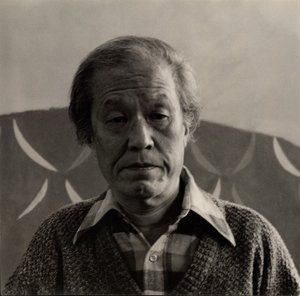
Yoo Youngkuk - Korea's First Abstract Artist
Yoo Youngkuk (劉永國; denoted as YYK) stands as a monumental figure in Korean art history, recognized universally as the pioneer of abstract painting and arguably the most influential artist of his generation. Born in 1916 in Uljin-gun, Gyeongsangbuk-do Province, South Korea—a region celebrated for its majestic mountains and serene coastal landscapes—Yoo’s artistic journey began amidst profound societal transformations, mirroring the broader narrative of Korean modernity. His formative years instilled within him a deep appreciation for nature's enduring beauty, an element that would permeate his oeuvre throughout his prolific career. This connection to the Korean landscape served as both inspiration and conceptual bedrock for his groundbreaking explorations into non-representational art forms. Early Influences & Formal Training: Seeds of Abstraction Yoo’s artistic education commenced at Bunka Gakuin University in Tokyo, Japan, where he immersed himself in Western avant-garde movements—particularly Russian Constructivism and Suprematism—influenced by artists like Kazimir Malevich. These encounters fundamentally reshaped his artistic sensibilities, propelling him toward a radical departure from traditional Korean painting conventions. Recognizing the transformative potential of abstraction, Yoo actively engaged with pioneering Japanese artists such as Murai Masanari and Hasegawa Saburo, fostering dialogues that solidified his commitment to exploring purely visual language devoid of illusionistic representation. This intellectual exchange proved pivotal in shaping his artistic vision and establishing him as a vanguard of Korean art’s modernist trajectory. Sinsasil-pa & The Birth of Korean Abstract Expressionism In 1948, Yoo joined forces with Kim Whanki and Lee Kyusang to establish Sinsasil-pa (新寫實派), Korea's inaugural abstract expressionist group—a watershed moment that irrevocably altered the course of Korean art. Driven by a desire to articulate the realities of postwar Korea through an aesthetic framework liberated from conventional stylistic constraints, the group championed a bold assertion of artistic autonomy and challenged prevailing artistic norms. Yoo’s participation in Sinsasil-pa marked not merely a collaborative endeavor but also a declaration of intent—a resolute commitment to forging a new visual idiom that resonated with the spirit of the era. His early works during this period exemplify the group's experimental ethos, characterized by dynamic interplay between color fields and emerging geometric forms. The Mountain Motif: Symbolism & Artistic Evolution Throughout his artistic career, Yoo Youngkuk consistently revisited the motif of the mountain—a recurring symbol reflecting Korea’s identity and resilience. Rather than depicting mountains in literal detail, Yoo abstracted their essence—their solidity, grandeur, and spiritual significance—into powerful compositions imbued with color and form. This deliberate simplification served as a conduit for conveying profound emotional depth and philosophical contemplation. As Yoo himself eloquently articulated, “The mountain is just another aspect of physics that have been endowed by nature. It could be an empty bowl of abstraction. It can also be under-interpreted to be a used pillow at an inn in the mountain side, facilitating friendly conversations all night long.” This profound observation encapsulates his artistic philosophy—a belief that art should transcend mere visual representation and engage viewers on a deeper level of emotional resonance. Legacy & Recognition: A Lasting Impression Yoo Youngkuk’s contributions to Korean modern art were widely acknowledged during his lifetime, culminating in a comprehensive survey by *Monthly Art* magazine which hailed him as the most outstanding artist among over a hundred contemporaries. His enduring influence extends beyond his paintings; he paved the way for subsequent generations of Korean artists to embrace abstraction and experiment with innovative artistic approaches. Yoo’s unwavering dedication to artistic innovation—coupled with his profound connection to Korean culture and landscape—continues to inspire artists today. His ability to distill the emotional core of nature into pure visual form stands as a testament to his unparalleled artistry and enduring legacy, securing his place among Korea's most revered artistic figures.Yoo Youngkuk
1916 - 2002 , Sydkorea
Kortfattad information
- Artistic Movement Or Style: Abstrakt konst
- Artists Or Movements Influenced By This Artist:
- Konstruktivism
- Suprematism
- Artists Who Influenced This Artist:
- Murai Masanari
- Hasegawa Saburo
- Date Of Birth: 1916
- Full Name: Yoo Youngkuk
- Nationality: Sydkorea
- Notable Artworks:
- Berg
- Verk
- Place Of Birth: Uljin, Sydkorea

Glasalternativet är endast tillgängligt i storlekar under 110 cm.