

 Visa i rummet
 Skicka
 Dela
Dela
 Detaljer
 Studentguide för konstverk

 Ladda ner
 Liknande objekt
 Röntgen
 Bildspel
 Besökstatistik
Elia
 Akryl på duk
- Väggkonst
- Bezalel School Style
 1916
1916 90.0 x 91.0 cm
 Israels museum
 Läs mer
Konstverket som visas på denna sida skyddas av upphovsrättslagen, vilket innebär att vi inte lagligt kan skapa eller sälja en identisk reproduktion. Detta skydd upprätthålls genom internationella avtal såsom den Bernkonventionen och genom nationella lagar, inklusive de som fastställs av Amerikansk upphovsrättslag – Titel 17. Alla rättigheter förbehållna. Återgivning av konstverk är förbjuden utan skriftligt tillstånd från WahooArt.
Denna metod följer fullt ut upphovsrättsliga regler eftersom den inte innebär kopiering eller duplicering av det skyddade konstverket. Istället är det en kreativ nytolkning – en ny målning som är influerad av originalet men inte identisk med det.
Giclée / Konsttryck
Giclée- eller canvasprint av museumskvalitet med snabb produktion och flexibla ytbehandlingsalternativ. ( Köp handmålat konstverk Byt till digital bildförsäljning)




P118B Skr10

P118H Skr10

P118W Skr10

P438Z Skr10

P508JH Skr12

P508YH Skr12

P805H Skr10

P805Z Skr10

P919BZ Skr10

P919G Skr10

P919XJ Skr10

P959ZH Skr10

P968JZ Skr12

W106C Skr8

W218G Skr10

W218JH Skr8

W218Y Skr10

W307PJ Skr10

W316G Skr10

W316PJ Skr8

W316Y Skr10

W398PJ Skr8

W4111J Skr10

W500HY Skr15

W500JH Skr15

W692G Skr12

W849H Skr8

W940BG Skr15

W953PJ Skr8




Välj bland våra förinställda storlekar som motsvarar konstverkets ursprungliga proportioner.

Ange den bredd och höjd du behöver, för att passa din ram eller din vägg. Ett tryck kan endast beskäras, aldrig göras större än bilden, vilket innebär att ett format med en annan formform leder till att en del av bilden går förlorad. Vi skickar en digital mockup för godkännande innan vi trycker något. Bilden som visas på denna sida visar inte den faktiska beskärningen — det är endast mockuppen som gör det.
Leverans över hela världen () på 2 veckor istället för standard 4/5 veckor. (21 oktober)

Fri expressfrakt över hela världen

Högkvalitativ linnecanvas

Fullständig fraktförsäkring

Garantier för återbetalning av tullavgifter

Garantier för exakt färgåtergivning

100 dagars returrätt vid fabrikationsfel

100% pengarna tillbaka-garanti

Mängdrabatt erbjuds
 Glasalternativet är endast tillgängligt i storlekar under 110 cm.

Elia
Giclée / Konsttryck
Reproduktionsstorlek
-


Totalpris
Skr 787
Elijah – Ett Symfoniskt Uttryck för Judaisk Tradition och Förnyelse
“Elijah’s Chair” är ett mäktigt exempel på Bezalel Skolans konstnärliga språk, född ur Jerusalems ambition att skapa en estetisk rörelse som skulle väcka nationell stolthet genom bibliska teman och symboler. Detta imponerande träskulptur från 1916 skapades av den israeliske konstnären Wolf Rawicki (Ze’ev Raban), en pionjär inom Bezalel Skolans stil och grundare av Israels konstvärld. Verkets komplexa detaljer och användning av ljus och teknik berättar en historia om religiös övertygelse, kulturell identitet och den fortsatta kopplingen till judisk historia genom århundradena.- Konstnärlig Stil: Bezalel Skolan präglas av klassiska hebreiska influenser och fokuserar på att förmedla en känsla av nationalitet genom användningen av bibliska bilder och emblem. Detta är särskilt tydligt i skulpturens dekorativa element, där cheruberer och komplexa geometriska mönster återger klassisk Bezalel-stil.
- Teknik: Skulptören använde sig av en kombination av träsnidning och inlayteknik för att skapa ett verk som är både tekniskt imponerande och estetiskt tilltalande. Det detaljerade träsnidandet och användningen av guld eller brass för dekorativa inslag visar på hög konstnärlig skicklighet och omsorg för materialvalet.
- Historisk Kontext: Skulpturen är direkt kopplad till den sionistiska rörelsen och dess ambition att återuppväcka judisk kultur och identitet efter århundraden av förvisning. ”Elijah’s Chair” symboliserar därför inte bara en religiös ritual utan också ett hopp om framtid och kontinuitet inom judisk historia.
- Symbolik: Skulpturen är tänkt att vara ett monument över judisk tradition och den fortsatta kopplingen till bibliska rötter. Sittelsen av gudfader vid denna stol representerar en viktig ritual inom judendomen och betonar vikten av kontinuitet och arv mellan generationer.
Frågor och svar
Hur intensiva är färgerna i "Elia" av Wolf Rawicki (Ravitzki)?
Färgintensiteten i "Elia" är Monokrom. Intensitet beskriver hur starka färgerna upplevs.
Vilken är den upplevda ljusstyrkan i "Elia" av Wolf Rawicki (Ravitzki)?
När det gäller upplevd ljusstyrka är "Elia" av Wolf Rawicki (Ravitzki) strålande.
Hur mycket ljus verkar färgerna i "Elia" reflektera?
"Elia" av Wolf Rawicki (Ravitzki) har en luminans på Ljusstark. Luminans beskriver hur mycket ljus färgerna tycks reflektera.
Om konstnären
The Pioneering Vision of Ze’ev Raban: From Rawicki to the Soul of Israeli Art
Ze’ev Raban, born Wolf Rawicki in Kaunas, Russia, in 1890, stands as a monumental figure in the genesis of Israeli art. His journey wasn't merely that of an artist finding his voice; it was the forging of a new aesthetic identity for a nation yearning to express itself. Rawicki’s early life, steeped in the cultural currents of Eastern Europe, laid the foundation for a career dedicated to synthesizing tradition and modernity, culminating in works that became iconic symbols of a burgeoning national consciousness. He wasn't simply *a* painter; he was an architect of visual culture, deeply involved in shaping the artistic landscape of the nascent State of Israel.
Early Formation & The Bezalel School
Rawicki’s formal training took him across Europe – Munich, Paris, and Brussels – exposing him to the prevailing styles of the early 20th century. He absorbed the lessons of Jugendstil, Symbolism, and Art Nouveau, but these influences were never adopted wholesale. A crucial turning point came with his arrival at Bezalel Academy in Jerusalem in 1906. Bezalel, founded by Boris Schatz, was more than an art school; it was a crucible for creating a distinctly “Hebrew style.” This wasn’t about replicating historical forms but rather excavating the spirit of Jewish culture and translating it into contemporary artistic expression. Raban quickly became a central figure in this endeavor, embracing the challenge of defining what that aesthetic might look like.
A Synthesis of Tradition & Modernity
Raban's work is characterized by a remarkable ability to blend diverse influences. He sought inspiration not only from European art movements but also from traditional Jewish crafts, Islamic motifs, and the archaeological discoveries unfolding in Palestine. This fusion manifested in his decorative arts – silver Hanukkah lamps, ceremonial objects, furniture—where intricate carvings and stylized forms evoked ancient patterns while remaining firmly rooted in a modern sensibility. He believed that true Hebrew art wasn’t about imitation but about *interpretation* – distilling the essence of Jewish heritage into new artistic languages. His designs weren't merely beautiful; they were imbued with symbolic meaning, reflecting a deep connection to history and faith.
Major Achievements & The Capitoline Wolf
While Raban excelled in numerous mediums, his impact extended beyond individual artworks. He was instrumental in establishing the aesthetic principles of early Israeli design, influencing everything from typography to public monuments. Perhaps his most enduring legacy is the “Capitoline Wolf,” a silver menorah created for the Hebrew University on Mount Scopus in 1926. This piece, inspired by the Roman wolf that suckled Romulus and Remus, became a powerful symbol of Jewish resilience and national aspiration. It wasn’t simply a religious object; it was a statement about reclaiming heritage and forging a new future. The menorah's design, incorporating stylized Hebrew letters and motifs, resonated deeply with the Zionist movement and solidified Raban’s position as a leading artistic voice.
Historical Significance & Lasting Influence
Ze’ev Raban died in 1970, leaving behind a body of work that continues to inspire. He wasn't just an artist; he was a cultural pioneer who helped define the visual identity of Israel. His commitment to synthesizing tradition and modernity, his dedication to creating a distinctly Hebrew aesthetic, and his ability to imbue objects with profound symbolic meaning cemented his place as one of the most important figures in Israeli art history. His influence can be seen in the work of subsequent generations of artists and designers, who continue to grapple with the challenges of balancing cultural heritage with contemporary expression. Raban’s legacy is a testament to the power of art to shape national identity and inspire a sense of belonging.
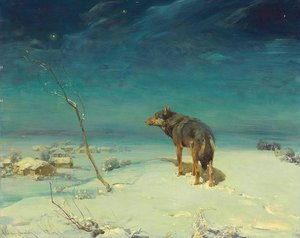
Wolf Rawicki (Ravitzki)
1890 - 1970 , Russia
Snabbfakta
- Full Name: Ze'ev Raban
- Nationality: Israeli
- Date Of Birth: 1890
- Date Of Death: 1970
- Place Of Birth: Kaunas, Russia
- Notable Artworks:
- Elijah
- Standing Hanukkah Lamp
- Capitoline Wolf
- Artistic Movement Or Style: Bezalel School Style
Relaterade artiklar
The Barbizon School: A Professional Guide to Naturalism and Landscape Mastery for Interior Designers
Explore the Barbizon School's mastery of naturalism. An expert guide for hotel designers and procurement managers on sourcing high-quality landscape reproductions to elevate hospitality and corporate interiors with authentic, large-scale fine art solutions.
Elizabeth Adela Forbes: A Pioneering Impressionist of the Newlyn School
Explore the life & art of Elizabeth Adela Forbes, a pioneering Impressionist of the Newlyn School. Discover her captivating paintings, unique style, and lasting legacy with OriginalUniqueArt.

The Hague School: Realism, Atmosphere & the Dawn of Dutch Impressionism
Explore the Hague School's pivotal role in Dutch art history. Discover realism, atmospheric landscapes & its influence on Impressionism. Learn about key artists like Mauve & Maris with OriginalUniqueArt.

The Sublime Landscape: Exploring the Hudson River School Movement
Explore the captivating world of the Hudson River School! Discover the history, artists, and defining characteristics of this iconic American art movement. Learn about Romanticism's influence & find inspiration for your collection.

Hudson River School: Topp 10 mästerverk för ditt hem – Konst & Historia | OriginalUniqueArt.com
Upptäck de 10 mest ikoniska mästerverken från Hudson River School! Lär känna Thomas Cole, Frederic Church och andra amerikanska landskapsmålare. Köp högkvalitativa konsttryck & inred med storslagen naturkonst på OriginalUniqueArt.com.
