 Byt till tryck
 Visa mer







































 För konstverk eller reproduktioner som är större än 105 cm (cirka 41 tum) på någon sida, levereras ramen som ett isärplockat kit. Denna metod säkerställer en trygg leverans och förhindrar skador under transport.


Chez Mouquin: A Snapshot of Parisian Bohemia
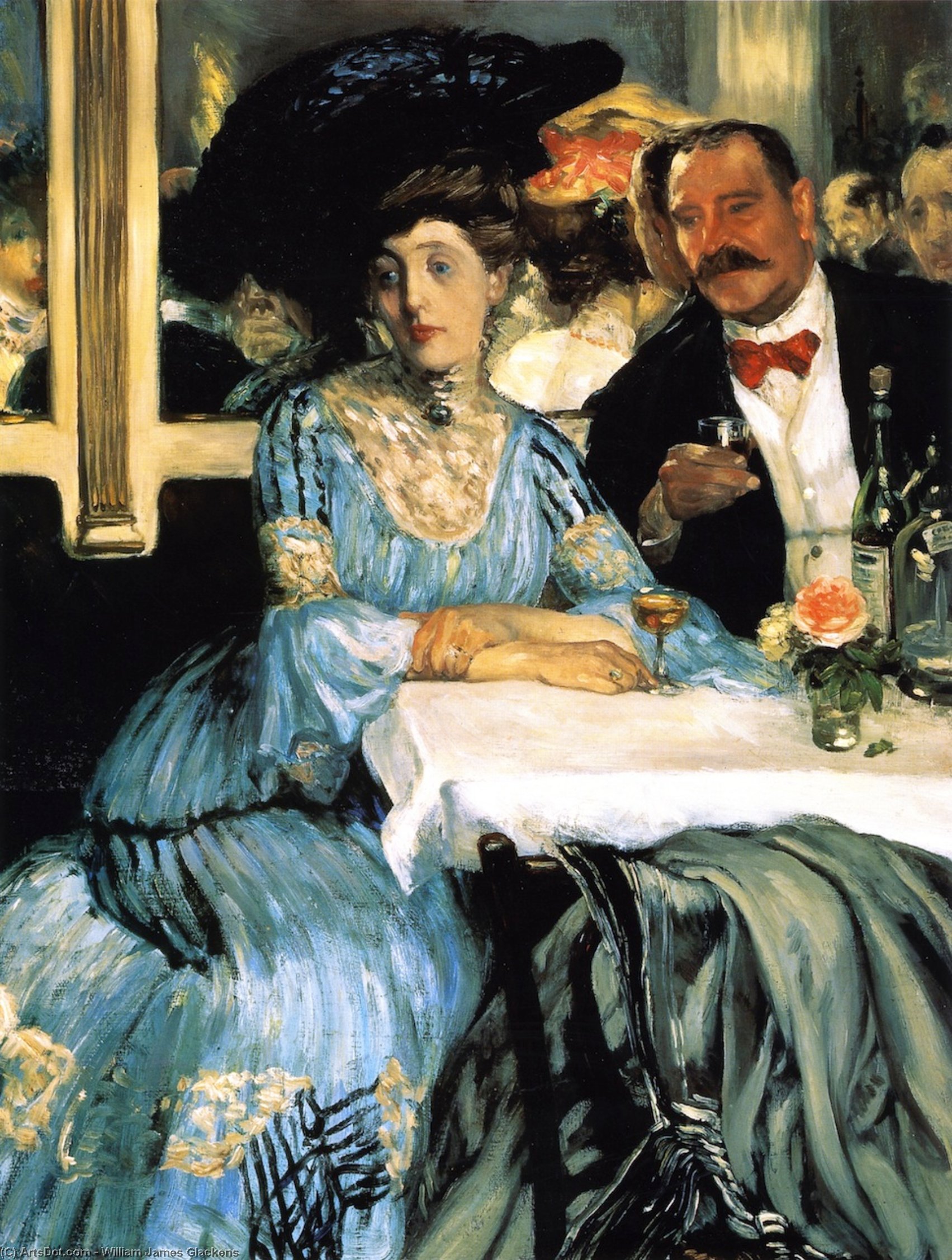
William James Glackens’ “Chez Mouquin,” completed in 1905, stands as a quintessential emblem of the Ashcan School—a movement that irrevocably altered the course of American art. Rejecting the idealized landscapes and mythological narratives favored by their predecessors, Glackens and his fellow artists sought to portray the gritty realities of urban life with unflinching honesty.
The painting depicts a scene within Mouquin’s Restaurant, a popular Parisian establishment frequented by artists and intellectuals during the Belle Époque. At its center is Jeanne Mouquin, the proprietor's wife, engaged in conversation with James B. Moore, a wealthy playboy known for his patronage of the arts. Glackens himself subtly captures the atmosphere of the dining room, reflecting the faces of fellow attendees—Charles Fitzgerald, an art critic and Edith Glackens, his wife—creating a tableau vivant that encapsulates the spirit of artistic camaraderie.
Glackens’ masterful technique exemplifies Ashcan Realism. Employing muted tones—primarily browns, ochres, and blacks—he skillfully captures the dim lighting of the restaurant, enhancing the sense of intimacy and immediacy. The brushstrokes are loose and expressive, conveying movement and capturing the subtle nuances of facial expressions. Glackens' deliberate use of chiaroscuro – dramatic contrasts between light and dark – draws attention to key figures and contributes to the painting’s overall mood.
A Reflection of Artistic Vision
“Chez Mouquin” isn’t merely a depiction of a social gathering; it’s a profound statement about Glackens' artistic philosophy. Like many Ashcan artists, he eschewed grand narratives in favor of capturing everyday moments—the conversations, gestures, and expressions that define human experience. This approach aligns with the broader Ashcan ethos: to portray American life as it truly is – flawed, vibrant, and brimming with potential.
Glackens’ influence extends beyond his stylistic choices. He championed a rejection of academic conventions, prioritizing observation and emotional resonance over meticulous detail. His work anticipates the modernist impulse toward simplification and abstraction, foreshadowing developments that would reshape art in subsequent decades.
Historical Context: The Belle Époque
The painting’s setting—Paris during the Belle Époque (roughly 1871-1914)—provides crucial context for understanding its significance. This era witnessed unprecedented social and cultural transformation, fueled by industrialization, urbanization, and burgeoning artistic experimentation. Artists like Glackens sought to document these changes, capturing the dynamism of a society undergoing rapid modernization.
Mouquin’s Restaurant itself was a hub of intellectual discourse and artistic activity—a place where writers, painters, and musicians convened to discuss ideas and inspire one another. Glackens' portrayal captures this atmosphere perfectly, reflecting the optimism and ambition that characterized the Belle Époque.
Symbolism & Emotional Impact
"Chez Mouquin" speaks volumes about the human condition—the desire for connection, the pursuit of beauty amidst chaos, and the celebration of shared experience. The muted palette contributes to a contemplative mood, inviting viewers to linger on the faces of the figures depicted.
Glackens’ ability to convey emotion through subtle gestures and expressions underscores his commitment to realism as a means of capturing psychological truth. “Chez Mouquin” remains a powerful reminder that art can illuminate the complexities of human life and inspire us to appreciate the beauty found in ordinary moments—a legacy cemented by its prominent place within the Art Institute of Chicago’s collection.
Frågor och svar
Vilken är den övergripande stämningen i "Chez Mouquin" av William James Glackens?
"Chez Mouquin" har en Elegant atmosfär.
Var kan jag ladda ner "Chez Mouquin" av William James Glackens?
Bilden av "Chez Mouquin" av William James Glackens kan laddas ner från verkets sida för Ladda ner digital bild: en högupplöst digital bildnedladdning.
Vilken konstnär tillskrivs "Chez Mouquin"?
"Chez Mouquin" tillskrivs William James Glackens.
 Förhandsvisa
 Skicka
 Dela
Dela
 Visa detaljer
 Guide
Guide

 Ladda ner
 Liknande objekt
 Röntgen
 Bildspel
 Q&A
Q&A Statistik