

 Förhandsvisa
 Skicka
 Dela
Dela
 Visa detaljer
 Guide
Guide

 Ladda ner
 Liknande objekt
 Röntgen
 Bildspel
 Statistik
Still-Life
 Oil On Canvas
- WallArt
- Baroque
 1653
1653- Early Modern
 105.0 x 88.0 cm
 Ermitaget
 Visa mer
Giclée / Konsttryck
Giclée- eller canvasprint av museumskvalitet med snabb produktion och flexibla ytbehandlingsalternativ. ( Beställ handmålad reproduktion Byt till digital bild)




P118B Skr10

P118H Skr10

P118W Skr10

P438Z Skr10

P508JH Skr12

P508YH Skr12

P805H Skr10

P805Z Skr10

P919BZ Skr10

P919G Skr10

P919XJ Skr10

P959ZH Skr10

P968JZ Skr12

W106C Skr8

W218G Skr10

W218JH Skr8

W218Y Skr10

W307PJ Skr10

W316G Skr10

W316PJ Skr8

W316Y Skr10

W398PJ Skr8

W4111J Skr10

W500HY Skr15

W500JH Skr15

W692G Skr12

W849H Skr8

W940BG Skr15

W953PJ Skr8




Välj bland våra förinställda storlekar som motsvarar konstverkets ursprungliga proportioner.

Ange den bredd och höjd du behöver för att passa din ram eller vägg. Ett tryck kan endast beskäras, aldrig göras större än originalbilden, vilket innebär att ett format med en annan proportion leder till att en del av bilden går förlorad. Vi skickar en digital mockup för godkännande innan vi påbörjar tryckningen. Bilden som visas på denna sida visar inte den faktiska beskärningen — det är endast mockuppen som gör det.
Leverans över hela världen () på 2 veckor istället för standard 4/5 veckor. (26 oktober)

Fri expressfrakt över hela världen

Högkvalitativ linnecanvas

Fullständig fraktförsäkring

Garantier för återbetalning av tullavgifter

Garantier för exakt färgåtergivning

100 dagars returrätt (endast vid fel)

100% pengarna tillbaka-garanti

Mängdrabatt erbjuds
 Glasalternativet är endast tillgängligt i storlekar under 110 cm.

Still-Life
Giclée / Konsttryck
Storlek på reproduktion
-


Slutgiltigt pris
Skr 794
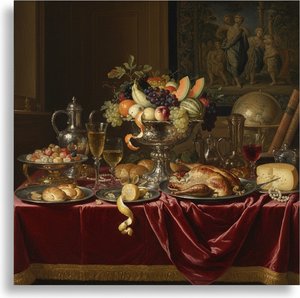
A Symphony of Light and Luxury
In the quiet, shadowed corners of the Dutch Golden Age, few masters could command the stage with as much dramatic flair as Willem Kalf. His 1653 masterpiece, Still Life with Lobster, Drinking Horn and Glasses, is not merely a painting of objects; it is a carefully orchestrated performance of light, texture, and prestige. As one gazes upon this canvas, they are immediately transported into an era of unprecedented maritime prosperity, where the spoils of global trade were celebrated through the meticulous brushstrokes of the pronkstilleven—the grand, opulent still life. The composition serves as a window into a world of sensory indulgence, where every glint of silver and every dewdrop on a peach tells a story of wealth, discovery, and the fleeting nature of earthly delights.
The artwork captures a moment of suspended animation, presenting an arrangement that feels both bountiful and profoundly intimate. A vibrant lobster, its shell a testament to Kalf’s ability to render organic complexity, rests amidst the soft, velvety skins of peaches and pears. These natural elements are juxtaposed against the hard, reflective surfaces of man-made treasures: a gleaming silver goblet, a sturdy drinking horn, and delicate glassware that catches the light with ethereal precision. This interplay between the perishable fruit and the enduring precious metals creates a tension that is central to the Baroque experience, inviting the viewer to linger on the exquisite details of each meticulously rendered form.
The Mastery of Chiaroscuro and Texture
Technically, Kalf’s work represents the pinnacle of seventeenth-century Dutch realism. He employs chiaroscuro—the dramatic use of intense light and deep shadow—to sculpt his subjects out of the darkness. This technique does more than provide depth; it breathes life into the inanimate. The way light spills across a silver vessel or pierces through a glass, casting long, evocative shadows across a richly patterned tablecloth, creates a palpable sense of three-dimensionality. For the discerning collector or interior designer, this mastery of contrast offers a profound visual weight that can anchor a room, providing a focal point that changes character as the ambient light of a space shifts throughout the day.
Beyond the play of light, Kalf’s true genius lies in his tactile virtuosity. He possesses an uncanny ability to translate the language of touch into oil on canvas. One can almost feel the cool, smooth surface of the bronze candlestick, the rougher texture of the drinking horn, and the soft, yielding flesh of the ripening fruit. This commitment to hyper-realistic detail ensures that a high-quality reproduction of this piece retains its soul, offering an immersive experience that celebrates the beauty of material existence. It is this level of craftsmanship that makes Kalf’s work eternally relevant for those seeking to infuse their environments with a sense of historical grandeur and sophisticated elegance.
Symbolism and the Soul of the Baroque
To look closely at Kalf’s arrangement is to read a silent poem about the human condition. In the seventeenth century, nothing was purely decorative; every element carried a weight of meaning. The lobster, often associated with luxury and abundance, serves as a symbol of the era's economic triumphs. Meanwhile, the drinking horn alludes to conviviality and social standing, reminding the viewer of the communal joys of the Dutch mercantile class. Yet, beneath this layer of opulence lies a subtle memento mori—a gentle reminder of mortality. The very ripeness of the fruit suggests an approaching decay, a poignant contrast to the enduring brilliance of the silver and gold.
This duality—the celebration of life’s richness alongside a contemplation of its transience—is what gives the painting its profound emotional resonance. It evokes a sense of quiet melancholy wrapped in a cloak of splendor. For those looking to decorate with art that possesses depth and narrative, Kalf’s work offers an unparalleled opportunity. A reproduction of this still life does not just adorn a wall; it invites conversation, stimulates the intellect, and brings a touch of timeless, scholarly prestige to any curated collection or thoughtfully designed interior.
Frågor och svar
Vilken är den emotionella tonen i "Still-Life" av Willem Kalf?
"Still-Life" av Willem Kalf förmedlar en Dramatic emotionell ton.
Vilken konstnärlig inriktning tillhör "Still-Life" av Willem Kalf?
"Still-Life" av Willem Kalf tillhör Baroque-rörelsen. Denna rörelse ger det stilistiska sammanhanget för verket.
Vilken teknik och vilket årtal gäller för "Still-Life" av Willem Kalf?
"Still-Life" skapades år 1653 i Oil On Canvas.
Konstnärsbiografi
Ett liv i överdådighet: Willem Kalfs värld
Willem Kalf, ett namn synonymt med den nederländska stormaktstidens praktfulla stilleben, föddes i Rotterdam 1619 i en familj med goda ekonomiska förutsättningar. Hans far, Jan Jansz Calff, innehade viktiga positioner inom stadens förvaltning, vilket gav unge Willem en uppväxt präglad av både trygghet och en tidig exponering för den växande merkantila värld som senare skulle påverka hans konst så djupt. Även om detaljerna kring Kalfs tidiga utbildning förblir något dunkla, är det känt att han under 1630-talet genomgick en period av konstnärlig utveckling i Paris, där han blev en del av den livliga gemenskapen av flamländska konstnärer i Saint-Germain-des-Prés. Denna formativa erfarenhet ledde honom initialt mot mindre rustika interiörer och stilleben – anspråkslösa början som senare skulle blomstra ut i de storslagna pronkstilleven för vilka han hyllas än idag. Förlusten av båda föräldrarna vid 1638 års slut tvingade honom tillbaka till Nederländerna, vilket lade grunden för hans mogna konstnärliga period.Från ödmjuka början till mästerlig uppvisning
Kalfs tidiga verk från Paris avslöjar en konstnär som håller på att finna sin röst. Dessa målningar avbildade ofta enkla arrangemang – grönsaker och vardagliga köksredskap som hinkar och pannor – placerade mot dunkla bakgrunder där figurer snarare antyddes än fullt ut formulerades. Denna stil ekade de måleriska traditioner som var rådande i Flandern under det tidiga 1600-talet, särskilt hos konstnärer som David Teniers den yngre. Men Kalfs ambition växte snart bortom dessa anspråkslösa kompositioner. Vid sin återkomst till Nederländerna påbörjade han en anmärkningsvärd utveckling mot vad som skulle bli hans signaturstil: pronkstilleven, eller det "praktfulla stillebenet". Detta var inte bara avbildningar av föremål; de var noggrant konstruerade uppvisningar av rikedom och sofistikering, där lyxartiklar som silverskålar, fint porslin, exotiska frukter och skimrande glas framträdde med enastående elegans.Illusionens konst och symbolisk resonans
Det som verkligen utmärkte Kalfs pronkstilleven var hans oöverträffade mästerskap i ljus och textur. Han besatt en extraordinär förmåga att återge silvrets reflekterande egenskaper, glasets transparens och frukternas sammetslena ytor med en nästan svindlande realism. Hans kompositioner var inga slumpmässiga arrangemang; de var minutiöst planerade orkestreringar designade för att fånga samspelet mellan ljus och skugga, vilket skapade en känsning av djup och dramatik. Även om den grundläggande strukturen i hans målningar – arrangemanget av föremålen – förblev relativt konsekvent, var varje verk ett bevis på Kalfs skicklighet i att variera texturer och fånga nyanserade ljuseffekter. Men bortom den tekniska briljansen fanns en subtil symbolisk dimension. De överdådiga föremål han avbildade var inte bara vackra; de anspelade på teman som förgänglighet, rikedom och världsliga njutningars flyktiga natur – en blinkning till vanitas-traditionen som var så framträdande i det nederländska måleriet.Arv och inflytande
Willem Kalfs betydelse sträckte sig långt bortom hans egen produktiva gärning. Hans semi-monokroma stilleben utövade ett påtagligt inflytande på fransk konst, särskilt inom kretsen kring bröderna Le Nain, som beundrade hans sofistikerade användning av ljus och skugga. Även om enskilda verk kanske inte är lika allmänt kända som vissa av hans samtida, är Kalfs bidrag till genren obestridligt. Han var med och definierade pronkstilleven genom att fånga själen i det nederländska 1600-talssamhället – en era präglad av en oöverträffad ekonomisk blomstring och en växande köpmannaklass som var ivrig att visa upp sin rikedom och förfining. Idag pryder hans målningar prestigefyllda museisamlingar över hela världen, däribland Museum Boijmans Van Beuningen i Rotterdam, National Gallery of Art i Washington D.C. och Getty Museum, vilket säkerställer att hans arv som en mästare av nederländskt stilleben fortsätter att inge vördnad och beundran. Hans noggranna öga för detaljer och mästerliga användning av ljus förblir tidlösa kännetecken för konstnärlig excellens.Utforska vidare
- Wikipedia: https://en.wikipedia.org/wiki/Willem_Kalf
- National Gallery of Art: https://www.nga.gov/artists/1430-willem-kalf
- Getty Museum: https://www.getty.edu/art/collection/person/103JR3

Willem Kalf
1619 - 1693 , Nederländerna
Kortfakta
- Artistic Movement Or Style: Holländska guldåldern, Stilleben
- Artists Or Movements Influenced By This Artist:
- Fransk konst
- Bröderna Le Nain
- Artists Who Influenced This Artist:
- Simon Luttichuys
- Pieter Claesz
- Willem Claeszoon Heda
- Date Of Birth: 1619
- Date Of Death: 1693
- Full Name: Willem Kalf
- Nationality: Holländsk
- Notable Artworks:
- Stilleben med en nautilusskål
- Le vieux puits
- Silverkanna & porslinsskål
- Place Of Birth: Rotterdam, Nederländerna
Relaterade artiklar

Golden Light & Dutch Skies: The Timeless Magic of Dutch Golden Age Landscapes
Discover the breathtaking beauty of Dutch Golden Age landscapes. Explore the mastery of light, chiaroscuro, and 17th-century realism through an expert art history lens, celebrating the enduring legacy of the Dutch Masters for discerning collectors and art lovers.
Abraham Hendricksz van Beyeren: Pioneering Dutch Still Life & the Banquet Tradition
Explore the captivating world of Dutch Golden Age still life with Abraham van Beyeren. Discover his innovative techniques, symbolic banquet scenes & lasting influence on art history. Learn about collecting these masterpieces.

Illuminating Innovation: Exploring the Dutch Golden Age of Painting
Explore the Dutch Golden Age of painting with OriginalUniqueArt. Discover Rembrandt, Vermeer & other Masters. Learn about key characteristics, iconic artworks, and lasting influence. Expert insights for collectors & enthusiasts.

Nederländsk Guldålder: Topp 10 mästerverk som definierade epoken – konst & heminredning
Utforska de 10 ikoniska mästerverken från den nederländska guldåldern! Lär känna Rembrandt, Vermeer och Hals – deras teknik & berättelser. Hitta konsttryck och inspiration för din heminredning på OriginalUniqueArt.com. Upptäck hela samlingen online!

Golden Age Reflections: Dutch Baroque Painting & Cultural Innovation
Explore the Dutch Golden Age of painting! Discover key artists like Vermeer & ter Borch, their innovative techniques, and the rich cultural context behind these Baroque masterpieces. Learn about collecting & appreciating this iconic art period.

