

 Förhandsvisa
 Skicka
 Dela
Dela
 Visa detaljer

 Ladda ner
 Liknande objekt
 Röntgen
 Bildspel
 Statistik
Coney Island
 1940
1940 26.0 x 35.0 cm
 Visa mer
Köp en högupplöst, förbättrad digital bild med betydligt högre kvalitet än förhandsvisningen online.
Varje fil är noggrant förberedd av våra interna specialister med hjälp av avancerade verktyg och professionell manuell retuschering. Vi säkerställer att varje bild har exceptionell skärpa, exakt färgåtergivning och fina detaljer.
Den slutgiltiga filen levereras via e-post inom 72 timmar, optimerad för omedelbar användning i professionella sammanhang, redaktionellt bruk och tryckmiljöer. Detta är samma kvalitet som med förtroende används av ledande designstudior, förlag och gallerier.
Digital bild
Ladda ner en högupplöst fil för personlig visning, utskrift och kreativa projekt. ( Byt till tryck Beställ handmålad reproduktion)
Ingår i varje beställning av digital bild
Professionell digital leverans, garanterad
När du väljer OriginalUniqueArt.com får du inte bara en bild – du får ett professionellt förädlat digitalt konstverk, skapat med precision och med en garanterad tillfredsställelse. Här är allt som ingår i din beställning, automatiskt:

Snabb leverans via e-post
Din högupplösta digitala bild skickas till dig via e-post inom 72 timmar efter beställning – redo för omedelbar användning.

AI-förbättrad digital bild
Ditt konstverk optimeras professionellt med hjälp av avancerade AI-verktyg och manuell redigering, vilket garanterar maximal detaljrikedom, skärpa och färgnoggrannhet.

Gratis livstidsåterutskick
Har du råkat radera eller tappa bort din fil? Ingen oro – vi skickar den kostnadsfritt till dig när som helst.

Inga importavgifter – någonsin
Njut av ditt konstverk omedelbart utan tull, importavgifter eller leveranskostnader – digitala nedladdningar är alltid skattefria.

Garanterad färgåtergivning
Vi säkerställer att din digitala bild återger de ursprungliga färgerna så exakt som möjligt med hjälp av professionella verktyg och färghantering.

100 dagars nöjdhetsgaranti
Om du inte är nöjd med din digitala bild kommer vi att revidera den eller återbetala 100% inom 100 dagar – utan frågor.

100% pengarna-tillbaka-garanti
Inte nöjd? Få full återbetalning inom 100 dagar efter att du mottagit din digitala fil – utan frågor.

Rabatt vid storköp
Köp 3 bilder, spara 10% – Köp 5, spara 15% – Köp 10+, spara 20%. Perfekt för kreativa projekt, gallerier och byråer.
Konstnärsbiografi
The Shadow of the City: The Life and Lens of Weegee
In the frantic, neon-lit pulse of mid-century New York, one name emerged from the darkness to document the city's most visceral moments: Weegee. Born Arthur Melville Fellig in 1899, the man behind the pseudonym was far more than a mere observer; he was a phantom of the streets, a self-made pioneer who transformed the grim realities of urban decay into a profound form of visual journalism. His journey did not begin in the hallowed halls of an art academy, but rather in the grit and hardship of Brooklyn. After serving as a soldier in World War I—an experience that likely stripped away any lingering illusions of romanticism—Fellig turned his gaze toward the burgeoning chaos of Manhattan. He was a man who understood that the true heart of the metropolis beat most loudly in its darkest alleys, its crime scenes, and its moments of sudden, unvarnished tragedy.
Weegee’s rise to prominence was characterized by an unparalleled audacity. Eschewing the traditional path of seeking employment through official channels, he famously created his own vocation. For years, he operated without credentials, haunting Manhattan Police Headquarters and waiting for the police teletype to broadcast the next unfolding drama. This relentless pursuit allowed him to arrive at scenes of accidents, fires, and crimes often mere minutes after they occurred, capturing a raw immediacy that no other photographer could replicate. His work was not an attempt to beautify the struggle of the Great Depression or the tension of the post-war era; instead, it was a confrontation. Through his lens, the viewer was forced to witness the unflinching reality of poverty, injury, and death, presented without the comfort of artistic embellishment.
Technique and the Aesthetics of Flash
The visual language of Weegee was defined by a stark, high-contrast aesthetic that has since become iconic in the history of street photography. Utilizing a Rolleiflex camera equipped with a powerful flashbulb, he mastered the art of illuminating the shadows. This technique created a dramatic, almost theatrical lighting effect, where subjects were thrust into sharp relief against an impenetrable black background. This "flash-heavy" style did more than just provide visibility in the dead of night; it heightened the psychological tension of his compositions, isolating individuals and objects within a void of urban uncertainty. There was no room for retouching or manipulation in his process; he sought a brutal honesty that relied entirely on the spontaneous interplay of light and darkness.
His compositions, while appearing spontaneous, were deeply impactful due to their ability to frame the human condition. Whether capturing a captured burglar, the chaotic energy of Coney Island, or the sudden stillness of a street accident, Weegee possessed an innate sense of timing and framing. His black and white prints carried a weight that color could never achieve, emphasizing textures of wet pavement, weathered skin, and the cold steel of police sirens. This mastery of light allowed him to turn the mundane and the macabre into something hauntingly beautiful, bridging the gap between news photography and fine art.
Legacy and Historical Significance
The historical significance of Weegee lies in his role as a chronicler of an era that was rapidly disappearing. He captured the transition of New York from the desperate years of the Depression through the transformative period of World War II, providing a visual record of social realism that remains unparalleled. Beyond his solo photographic endeavors, his influence extended into the realm of cinema, where he collaborated with legendary directors like Stanley Kubrick, bringing his gritty, documentary-style eye to the silver screen.
Today, Weegee is remembered not just as a photojournalist, but as an artist who found meaning in the margins of society. His work serves as a testament to the power of the unmediated gaze, reminding us that there is profound truth to be found in the shadows. His legacy continues to inspire generations of street photographers who seek to capture the pulse of the world exactly as it is: raw, unfiltered, and undeniably human.
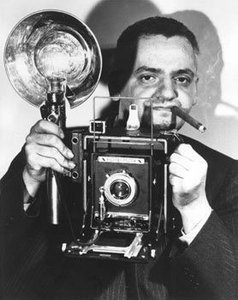
weegee (arthur fellig)
1899 - 1968
Snabbfakta
- Artistic Movement Or Style: Street Photography
- Date Of Birth: 1899
- Full Name: Arthur Fellig
- Nationality: American
- Notable Artworks:
- Brooklyn School Children See Gambler Murdered in Street
- Street Accident
- Victory Celebration
- Place Of Birth: New York City, USA