Byt till tryck
 Visa mer







































 För konstverk eller reproduktioner som är större än 105 cm (cirka 41 tum) på någon sida, levereras ramen som ett isärplockat kit. Denna metod säkerställer en trygg leverans och förhindrar skador under transport.


The Genesis of Abstraction: Unveiling ‘White Oval’ by Wassily Kandinsky
Wassily Kandinsky, a name synonymous with the birth of modern art, wasn't merely a painter; he was a visionary architect of feeling, translating inner experiences into vibrant visual languages. His journey from law student to revolutionary artist is as compelling as his artwork itself, and few pieces encapsulate this transformation more powerfully than ‘White Oval,’ created in 1919. This deceptively simple composition—a central white oval surrounded by a constellation of circles, lines, and splashes of color—represents a pivotal moment in Kandinsky’s exploration of abstraction, a deliberate rejection of representational art in favor of pure emotional expression. Born in Moscow in 1866, Kandinsky's early life was steeped in the traditions of Russian culture – his family history included connections to Mongolia and China – yet he felt an undeniable pull towards the burgeoning artistic movements of Europe. Witnessing Monet’s “Haystacks” ignited a profound shift within him, moving beyond mere depiction to capture the *essence* of color and its ability to evoke powerful sensations. ‘White Oval’ isn't just a painting; it’s a distillation of this evolving philosophy, a testament to Kandinsky’s belief that art could transcend the limitations of the visible world and tap directly into the realm of the soul.A Symphony of Color and Form
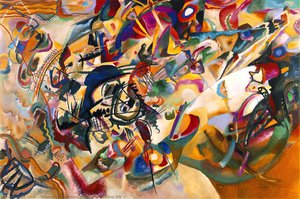
The beauty of ‘White Oval’ lies not in its complexity, but in its carefully orchestrated simplicity. Measuring 80 x 93 cm, the canvas is dominated by a large, luminous white oval – a shape that immediately draws the eye, acting as an anchor within the swirling composition. Around this central element dance a multitude of smaller circles, varying in size and intensity, interspersed with dynamic lines. The palette itself is remarkably restrained yet profoundly expressive: vibrant reds, deep blues, sunny yellows, verdant greens, and fiery oranges coalesce to create an energetic atmosphere. Kandinsky’s use of color wasn't arbitrary; he meticulously studied the psychological effects of hues, believing that each shade possessed its own inherent emotional power. Red, for instance, represented passion and energy, while blue evoked feelings of tranquility and introspection. The painting is executed in oil on canvas, a medium that allowed Kandinsky to build up layers of color and texture, creating a rich, tactile surface. The brushstrokes are visible, adding a sense of immediacy and spontaneity to the work—a deliberate departure from the smooth, polished surfaces favored by many of his contemporaries.The Spiritual Dimension: Influences and Intentions
Kandinsky’s artistic journey was deeply intertwined with spiritual ideas, particularly those influenced by Theosophy. He sought to create art that could awaken inner feelings and connect viewers to a higher consciousness. His seminal work, *Concerning the Spiritual in Art*, articulated this belief, arguing that color and form possessed an inherent spiritual significance. ‘White Oval’ embodies this philosophy perfectly; it's not simply a visual arrangement but a carefully constructed symbolic landscape designed to stimulate emotional response. The white oval itself can be interpreted as representing the “soul,” a blank canvas upon which the artist projects his inner world. The surrounding shapes and colors then act as symbols, each contributing to the overall composition of the painting’s spiritual narrative. Kandinsky's exploration of abstraction was not merely an aesthetic choice but a deeply personal quest for artistic truth—a desire to express what words could not capture.Kandinsky’s Legacy: A Bridge Between Art and Emotion
‘White Oval’ stands as a cornerstone in the development of abstract art, profoundly influencing generations of artists who followed. It's a key example of Kandinsky’s early work during his time with the Expressionist movement, which emphasized subjective experience and emotional intensity. His exploration of color theory and its connection to human emotion paved the way for later movements like Fauvism and Surrealism. The painting’s influence extends beyond the art world; it has been cited as a source of inspiration for designers, architects, and even musicians. Reproductions of ‘White Oval,’ such as those offered by OriginalUniqueArt.com, provide an accessible gateway to this groundbreaking artwork, allowing viewers to experience Kandinsky's vision firsthand. To delve deeper into the life and work of Wassily Kandinsky, explore resources like OriginalUniqueArt.com, which offers detailed information about his artistic development and other notable pieces such as “Small dream in red” or “Red Oval.” His legacy continues to resonate today, reminding us that art can be a powerful tool for self-expression and spiritual exploration.Frågor och svar
Vilken luminans har "White oval" av Wassily Wassilyevich Kandinsky?
"White oval" av Wassily Wassilyevich Kandinsky har en luminans på Ljus balans. Luminans beskriver hur mycket ljus färgerna tycks reflektera.
Vilket tryckformat rekommenderas för "White oval" av Wassily Wassilyevich Kandinsky?
För "White oval" är den rekommenderade tryckinställningen storleken Mellanformat med Liggande format orientering.
Vilken underliggande nyans genomsyrar "White oval" av Wassily Wassilyevich Kandinsky?
En Ockra till sepia nyans går igenom "White oval" av Wassily Wassilyevich Kandinsky.
 Förhandsvisa
 Skicka
 Dela
Dela
 Visa detaljer
 Guide
Guide

 Ladda ner
 Liknande objekt
 Röntgen
 Bildspel
 Q&A
Q&A Statistik