Impressionism · 1890
Spring (Thomas Dewing, 1890)
Thomas Dewing (1851–1938) skapade Spring. Den är från 1890. Det tillhör Impressionism-rörelsen. Den är utförd i Oil On Canvas. Verket finns bevarat på Smithsonian American Art Museum i Washington, D.C., USA. Måtten är 52 × 88 cm.
- 1890
- Oil On Canvas
- 52 × 88 cm
- Smithsonian American Art Museum, Washington, D.C.

 Förhandsvisa

 Handmålad oljemålning
 Skicka
 Dela
 Faktablad för elever


 Ladda ner
 Liknande objekt
 Röntgen
 Bildspel
 Frågor och svar

 Statistik
Spring i korthet
- Titel
- Spring
- Konstnär
- Thomas Dewing (1851–1938)
- Konstnär född i
- Boston, USA
- Datum
- 1890
- Material
- Oil On Canvas
- Mått
- 52 × 88 cm
- Utställningsplats
- Smithsonian American Art Museum, Washington, D.C., USA
- Rörelse
- Impressionism
- Tidsperiod
- 19th Century
- Motiv
- pastoral scene, outdoor leisure, women in art, springtime, nature landscape, soft light
Vad föreställer Spring?
Identification of Spring by Thomas Dewing
Spring is an oil on canvas painting by the American artist Thomas Dewing. The work was executed in 1890. This specific piece measures 52 x 88 cm in size. It is currently held in the collection of the Hirshhorn Museum and Sculpture Garden located in the United States.
The artist, Thomas Dewing, was born in Boston, United States. His practice involved the use of oil paints to render figures within outdoor settings. This particular composition depicts a group of women situated in a field characterized by grass and trees. The scene includes figures in various positions, some seated on the ground and others standing, amidst a landscape that contains two birds.
The Composition and Visual Elements
The scene is organized within a lush field where a group of women is positioned amidst tall grass and surrounding trees. The arrangement of the figures creates a sense of depth across the landscape. Some women are standing upright while others are seated directly on the ground. These subjects are engaged in various activities, such as playing games or simply occupying the outdoor space. Two birds are visible within the composition, placed among the natural elements.
The spatial organization is divided into a foreground, a middle ground, and a background. In the foreground and middle ground, the figures interact within the greenery, while the background recedes toward distant, less distinct elements. The horizon line is emphasized by the horizontal expanse of the field. The lighting appears diffused, consistent with an overcast sky, which casts a soft light over the figures and the vegetation. This arrangement creates an atmosphere of movement and social interaction within the natural setting.
Technique and Artistic Style
The work is an oil painting on canvas executed in a loose, impressionistic style. The application of paint is visible throughout the surface, creating a textured, impasto-like quality particularly in the rendering of the grass and the sky. This technique emphasizes the physical presence of the medium. The composition is structured through a clear division of the foreground, middle ground, and background, establishing a sense of spatial depth. Predominantly horizontal lines define the landscape, emphasizing the expanse of the field and the flatness of the terrain.
Organic shapes constitute the primary forms within the scene, including the hills, the fields, and the human figures. The brushwork is spontaneous, utilizing broken color to capture the specific atmosphere of an overcast day. Lighting appears diffused across the landscape. The artist employs a muted color palette and soft, feathery brushstrokes to define the subjects and their surroundings. This approach prioritizes the immediate visual impression of the environment over precise, sharp detail.
Related Works by the Artist
The artist's body of work includes several notable compositions that explore similar themes of female figures in specific settings. The White Dress is identified as a key work within his oeuvre. Other significant pieces include Woman in Black: Portrait of Maria Oakey Dewing, which is an oil on panel, and Lady in Gold, painted in 1912. These works often feature the refined, aristocratic female figures that characterize his tonalist style.
Other compositions from his career include The Recitation, dated 1891, and Summer, also known as Moonrise, which was painted in 1893. These paintings contribute to a collection that includes various works held in museums and private collections across the United States, such as those found in the Freer Gallery of Art at the Smithsonian Institution.
Vilket museum har Spring?
Smithsonian American Art Museum
Washington, D.C., USA
En krönika över den amerikanska identiteten Smithsonian American Art Museum, beläget i Washington, D.C., utgör nationens allra första samling av amerikansk konst. Som en integrerad del av Smithsonian Institution rymmer museet en av de största och mest inkluderande samlingarna av konst skapad i USA. Dessa verk utgör en obruten skildring av den amerikanska erfarenheten och fångar folkets strävanden, karaktär och fantasi, från kolonialtiden fram till idag.


Högupplösta bilder av Spring

Allmän egendom: konstnären avled 1938.
Andra storlekar, beskärningar och källhänvisningar →Thomas Dewing, Spring (1890), Smithsonian American Art Museum. Allmän egendom
Frågor om Spring besvarade
Vilket museum har originalet till "Spring"?
Originalet av "Spring" finns att se på Smithsonian American Art Museum, Washington, D.C., USA.
När skapades "Spring" av Thomas Dewing?
"Spring" dateras till 1890. Datumet placerar verket inom Thomas Dewings karriär och dess epok.
Vilken teknik användes för "Spring" av Thomas Dewing?
"Spring" är utförd i Oil On Canvas.
Vilka är de faktiska måtten på "Spring" av Thomas Dewing?
"Spring" mäter 52 x 88 cm i sin originalform. Originalmåtten är en bra referens när du väljer storlek på en reproduktion.
Vad föreställer "Spring"?
Teman som återfinns i "Spring" av Thomas Dewing inkluderar pastoral scene, outdoor leisure, women in art, springtime, nature landscape, soft light, american art, impressionistic. Tillsammans sammanfattar de verkets motiv.
Är bilden av "Spring" av Thomas Dewing fri att återge?
När det gäller upphovsrätt är "Spring" allmän egendom – upphovsrätten har löpt ut.
Vilken konstnär tillskrivs "Spring"?
Konstnären bakom "Spring" är Thomas Dewing. Verket är katalogiserat under Thomas Dewings namn.
Vilken stil tillhör "Spring"?
Konststilen som förknippas med "Spring" av Thomas Dewing är Impressionism. Denna klassificering placerar verket bland relaterade konstnärer och konstverk.
Var i Thomas Dewings karriär placerar sig "Spring"?
Inom Thomas Dewings karriär tillhör "Spring" perioden Mature Period. Denna fas underlättar jämförelser med konstnärens övriga verk.
Om konstnären, Thomas Dewing

1851–1938, USA
Thomas Dewing
**Tidig liv och utbildning** Thomas Wilmer Dewing, en amerikansk målare född den 4 maj 1851 i Boston, Massachusetts, inledde sin konstnärliga resa med en lärlingsplats inom litografi. Denna tidiga erfarenhet lade grunden för hans precision och detaljrikedom, men det var studierna vid Académie Julian i Paris från 1887 som verkligen formade hans stil. Där fick han undervisning av respekterade konstnärer Gustave Boulanger och Jules Lefebvre, vilket introducerade honom till den akademiska traditionen och de subtila nyanserna inom porträttkonsten. Paris var en smältdegel för nya idéer och influenser, och Dewing absorberade stadens atmosfär och utvecklade sin unika vision.
Andra verk av Thomas Dewing
 Lady in Gold1912
 The Recitation1891
 The Sorcerer's Slave (The Young Sorcerer), (painting)1877
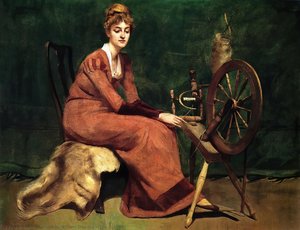 The Spinner1880

Essäer om Spring
 Masterpieces of the Wilderness: The Top 25 Thomas Cole ArtworksExplore the sublime Hudson River School through Thomas Cole's top 25 masterpieces. Discover the full collection online at OriginalUniqueArt…
 The Logic of the Landscape: Understanding Compositional Structure and DepthMaster landscape composition through the works of Patinir and Cézanne. Explore the logic of depth and perspective now.
 Virgin Islands artworks of the 1890s1890s US Virgin Islands artworks feature Camille Pissarro's landscapes and rare local pieces. View these masterpieces on OriginalUniqueArt.…