De Stijl · 1923
Composition (Theo van Doesburg, 1923)
Theo van Doesburg (1883–1931) skapade Composition. Den är från 1923. Det tillhör De Stijl-rörelsen. Den är utförd i Oil On Canvas. Måtten är 41 × 33 cm.
- 1923
- Oil On Canvas
- 41 × 33 cm

 Förhandsvisa

 Handmålad oljemålning
 Skicka
 Dela
 Guide


 Ladda ner
 Liknande objekt
 Röntgen
 Bildspel
 Frågor och svar

 Statistik
Composition: det viktigaste
- Titel
- Composition
- Konstnär
- Theo van Doesburg (1883–1931)
- Konstnär född i
- Utrecht, Nederländerna
- Datum
- 1923
- Material
- Oil On Canvas
- Mått
- 41 × 33 cm
- Rörelse
- De Stijl
- Tidsperiod
- Modern
- Motiv
- red, blue, yellow, black, white, rectangles
Vad föreställer Composition?
Identification of Composition by Theo van Doesburg
The canvas known as Composition emerges from the mind of Theo van Doesburg, a work that captures a specific moment in 1923. This piece exists as a precise arrangement of form and color, born from a period of intense creative focus. The artist, Theo van Doesburg, brings a sense of equilibrium to the surface, translating abstract thought into a tangible presence. It is a work that demands attention through its structural clarity and its commitment to the principles of the De Stijl movement.
The history of this object is tied to a specific circle of thinkers and patrons. Antony Kok commissioned the work, setting it on its path through the hands of those who shaped the modern era. From there, the painting finds its way into the hands of Bart de Ligt (1883–1938), who becomes its first owner. This transition marks the beginning of a long lineage of stewardship, as the work moves from the artist's studio into a private collection where its presence remains constant.
Every line and color choice within Composition reflects the artist's pursuit of a universal visual language. As we observe the work, we see the direct result of a vision that seeks to strip away the unnecessary to find a fundamental truth. The painting remains a vital part of the history of abstraction, holding the weight of its 1923 origins in every carefully placed rectangle and primary hue.
Visual Composition and Geometric Elements
The canvas unfolds as a precise grid of rectangles, where vertical and horizontal lines intersect to dictate the movement of the eye. There is a profound sense of equilibrium achieved through this arrangement, as non-representational forms find their place within a structured, rhythmic order. The eye moves across the surface, guided by the intersections of these straight lines, finding balance in the way the shapes occupy the space. It is a study in pure geometry, where the subject matter is stripped of any external reference, leaving only the essence of form and relation.
Color acts as the primary force within this structured environment. The palette relies on the fundamental strength of red, yellow, and blue, which anchor the composition. These primary hues interact with a supporting cast of black, white, and grey, creating a tension between the boldest tones and the more neutral shades. The colors appear solid and flat, avoiding any blending or shading, which emphasizes the stark, clean nature of the geometric arrangement. Each rectangle holds its own weight, contributing to a visual language that seeks a universal harmony through simplicity.
Provenance and History of the Object
The history of this work begins in the creative atmosphere of Paris, where it finds its way from the artist's studio into the hands of Bart de Ligt. This acquisition likely occurs in late 1923, marking the start of a long and steady lineage. De Ligt, a man deeply connected to the avant-garde circles of the time, holds the piece within his personal collection until his passing in 1938.
From that moment, the painting enters a quiet, private chapter. It remains within the same family, passing through the hands of descendants for nearly a century. This continuity preserves the work's integrity, keeping it sheltered within a single domestic line since 1923. The colors and forms remain as they were when they first left the artist's side, held in a state of careful preservation through the decades.
Documented Interpretations and Artistic Debates
The canvas captures a moment of profound transition, acting as a key work within the artist's entire oeuvre. It reveals a growing complexity within his purist style, where the rigid logic of geometry begins to dance with a more nuanced sense of equilibrium. One senses the tension between the absolute and the evolving, as the lines and colors find a new, sophisticated rhythm. This evolution suggests a mind moving beyond simple shapes toward a more intricate visual language.
A deep connection between the realm of architecture and the act of painting pulses through the work. The composition feels less like a mere arrangement of pigment and more like a blueprint for a structured reality. This link is no accident; the artist himself articulated the concept behind its creation in the magazine Architectura on 17th July 1923. The painting exists as a bridge, where the spatial logic of built environments meets the spiritual pursuit of pure abstraction.
Related Works by the Same Artist
The evolution of this geometric language unfolds through several other pieces that trace the artist's shifting focus. One can look back to Composition XX from 1920 to see the early movements of these shapes. Nearby in the timeline, the 1923 work Study for a Composition offers a glimpse into the creative process behind these structured arrangements. These works exist as part of a continuous search for balance and order within the frame.
As the years progress, the compositions grow more complex and dynamic. The 1925 Counter composition XIV introduces a different energy to the grid. Later, the Simultaneous Counter-Composition from 1929–1930 pushes the boundaries of the aesthetic even further. Each piece captures a specific moment in a lifelong pursuit of a new visual language, moving from the rigid to the more fluid and experimental.
Composition i hög upplösning
Allmän egendom: konstnären avled 1931.
Theo van Doesburg, Composition (1923). Allmän egendom
En digital expert kontrollerar färgerna mot originalmålningen och retuscherar filen så att den är trogen konstnärens penseldrag.
Köp högupplöst bildFrågor om Composition
När skapades "Composition" av Theo van Doesburg?
"Composition" av Theo van Doesburg skapades år 1923.
Vilken teknik användes för "Composition" av Theo van Doesburg?
"Composition" av Theo van Doesburg är utförd i Oil On Canvas. Reproduktionerna strävar efter att återge teknikens särpräglade utseende.
Vilka är måtten på originalet av "Composition" av Theo van Doesburg?
De registrerade måtten för "Composition" av Theo van Doesburg är 41 x 33 cm. Reproduktioner kan beställas i andra storlekar med bibehållna proportioner.
Vad föreställer "Composition" av Theo van Doesburg?
Teman som återfinns i "Composition" av Theo van Doesburg inkluderar red, blue, yellow, black, white, rectangles, lines. Tillsammans sammanfattar de verkets motiv.
Är "Composition" av Theo van Doesburg fri från upphovsrätt?
"Composition" av Theo van Doesburg är allmän egendom – upphovsrätten har löpt ut. Denna status avgör hur bilden av verket får återges.
Vem har skapat "Composition"?
"Composition" skapades av Theo van Doesburg. Informationen på denna sida beskriver Theo van Doesburgs originalverk.
Vilken konststil tillhör "Composition" av Theo van Doesburg?
"Composition" av Theo van Doesburg tillhör De Stijl-rörelsen. Denna rörelse ger det stilistiska sammanhanget för verket.
Vilken period av Theo van Doesburgs karriär tillhör "Composition"?
"Composition" representerar Theo van Doesburgs Mature Period.
Hur gammal var Theo van Doesburg när hen skapade "Composition"?
När "Composition" skapades år 1923, var Theo van Doesburg – född 1883 – 40 år gammal.
Om konstnären, Theo van Doesburg

1883–1931, Nederländerna
Theo van Doesburg
Theo van Doesburg: The Architect of Abstraction Theo van Doesburg, född Christian Emil Marie Küpper i Utrecht 1883, var en konstnär vars inflytande sträckte sig långt bortom bara målarfärg och penseldrag. Han var en revolutionär kraft som omformade grundvalarna för modern konst, en visionär vars resa började mitt i de kvarvarande eko av Impressionism och Post-Impressionism – initialt återspeglande stilar som påminner om Vincent van Goghs intensitet både i ämnesval och känslomässig djup. Denna tidiga fas fungerade dock som ett avgörande förberedande steg, en nödvändig brygga till den radikala transformation som skulle definiera hans bestående arv. Ett avgörande ögonblick inträffade 1913 med hans möte med Wassily Kandinskys *Rückblicke*.
Andra verk av Theo van Doesburg
 Counter composition XV1925
 Rhythm of a Russian Dance
 Troelstra1910
 Study for Composition VIII (The Cow)1918
Essäer om Composition
 The Geometry of Balance: Decoding Equilibrium and Rhythm in Mondrian’s Neo-PlasticismMaster the logic of Mondrian's Neo-Plasticism through expert analysis of balance and rhythm. Decode the geometry of modern art today.
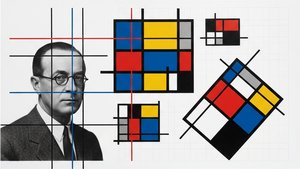 Theo van Doesburg: Pioneering De Stijl & the Evolution of Neo-PlasticismExplore the revolutionary De Stijl movement & Neo-Plasticism with our expert guide. Discover Piet Mondrian, Theo van Doesburg, and the last…
 Dutch artworks of the 1910sDutch modernism in the 1910s features the iconic works of Piet Mondrian, Kees van Dongen, and Isaac Israëls. Find museum-quality art on Ori…