
() ·
En målning skapad för dig, för hand
Handgjord oljereproduktion
Handmålad olja på duk i din valda storlek och ram, tillverkad efter beställning av våra konstnärer. ( Byt till tryck Byt till digital bild)
Konstnärens biografi
Sidney Edward Paget (1860-1908): Victorian illustrator famed for his iconic Sherlock Holmes illustrations in The Strand Magazine. Explore his detailed drawings & influence on the detective's visual identity.
 Visa mer
från ·
Kapitel 1
Vilken storlek bör det ha?
Glid för att ändra storlek; bilden till vänster visar ramen i dess verkliga bredd. Originalets proportioner bibehålls.
Välj bland våra förinställda storlekar som motsvarar konstverkets ursprungliga proportioner.

Ange den bredd och höjd du behöver för att passa din ram eller din vägg. Eftersom detta är handmålat kan konstnären, vid ett annat format, måla lite mer runt bilden eller beskära den något – det är du som väljer. Vi skickar en digital mockup för godkännande innan målningen påbörjas. Bilden som visas på denna sida representerar inte det slutgiltiga resultatet — det är endast mockuppen som visar det.
Kapitel 2
Hur vill du att den ska levereras?
Välj kanter för den uppspända duken
Välj din ram

Vit kant Skr1

Suddig kantfinish Skr1

Fortsatt motiv Skr1

P118B Skr10

P118H Skr10

P118W Skr10

P438Z Skr10

P508JH Skr12

P508YH Skr12

P805H Skr10

P805Z Skr10

P919BZ Skr10

P919G Skr10

P919XJ Skr10

P959ZH Skr10

P968JZ Skr12

W106C Skr8

W218G Skr10

W218JH Skr8

W218Y Skr10

W307PJ Skr10

W316G Skr10

W316PJ Skr8

W316Y Skr10

W398PJ Skr8

W4111J Skr10

W500HY Skr15

W500JH Skr15

W692G Skr12

W849H Skr8

W940BG Skr15

W953PJ Skr8

H24-GOLD Skr30

H24-SILVER Skr30

H36-GOLD Skr45

H36-SILVER Skr45
Inramad
Profil: . Total storlek inklusive ram: .
Kapitel 3
Vem målar det, och bör något ändras?
Efter beställning kommer OriginalUniqueArt.com team att skicka ett e-postmeddelande till kunden för instruktioner och tillhandahålla en förhandsvisning av utkastet
Leverans över hela världen () på 3–4 veckor istället för standard 5 veckor. (7 november). Inga kompromisser med kvaliteten.
Kapitel 4
De sista detaljerna
En skylt, precis som på ett museum?
Detaljer för graverad bronsplatta
This elegant plaque features the artist's name and the title of the artwork, finely engraved for a timeless presentation.
It is made from bronze with a refined, elegant finish. The text is precisely laser-engraved for a sharp and permanent result. Measuring 9x2 cm, the plaque is compact yet easy to read. It's built to be durable and scratch-resistant, offering a professional, museum-quality look. Mounting is simple thanks to the included adhesive backing.
Detaljer för transparent akrylplatta
The plaque includes essential engraved details such as the artist's name, the title of the artwork, the date it was created, the type of media used-like oil on canvas or watercolor-a brief description of the piece, and a QR code that links to the complete artwork information.
It is crafted from clear acrylic, offering a sleek, modern appearance. The text is UV-engraved in black to ensure strong visual contrast. With a size of 10x15 cm, it ensures optimal readability. It comes equipped with two metal hooks for secure wall mounting. The plaque is designed to be weather-resistant, making it suitable for various environments, and it includes interactive features that work seamlessly with smartphone scanning.
Detaljer för svart akrylplatta
This elegant plaque includes engraved information such as the artist's name, the title of the artwork, the date it was created, the type of media used (like oil on canvas or watercolor), a short description of the artwork, and a QR code for quick access to more information.
The plaque itself is made from refined black acrylic with a premium finish. The text is laser-engraved in white for high contrast and readability. Its size is 10x15 cm, designed to be easy to read. It comes with two metal hooks for professional mounting. The design is sleek and fits any interior style. It is also weather-resistant and durable, with built-in digital integration for mobile compatibility.
Ett skyddande fernissa?
När behöver du den?
Kapitel 5
Din målning, precis som du beställt den

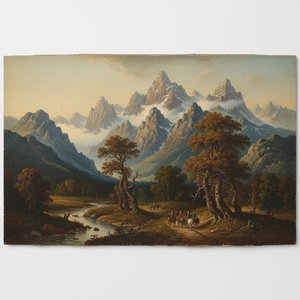
Mountainous Landscape
Reproduktionsmetod
Storlek på reproduktion
-

Elitkonstnär av högsta klass
Mer detaljrikedom, finess och extra produktionstid
-

Inramning av reproduktion
-
-
För konstverk eller reproduktioner som är större än 105 cm (cirka 41 tum) på någon sida, levereras ramen som ett isärplockat kit. Denna metod säkerställer en trygg leverans och förhindrar skador under transport.
Professionell montering krävs – detta är inte en produkt för självmontering.
Kitet måste monteras och duken spännas av en erfaren professionell inramare med hjälp av trälim (ingår ej), en spänntång för duk och klämmor för att hålla sargen rak medan limmet torkar. Felaktig montering eller ojämn spänning av duken kan orsaka permanenta skador på konstverket och täcks
 För konstverk eller reproduktioner som är större än 105 cm (cirka 41 tum) på någon sida, levereras ramen som ett isärplockat kit. Denna metod säkerställer en trygg leverans och förhindrar skador under transport.
Alla massiva träribbor ingår, exakt tillkapade efter mått.
Monteras med de medföljande skruvarna, samt trälim för hörnfogarna, vilket inte ingår och måste anskaffas av din ramverkare.
Professionella verktyg krävs och ingår ej: en dukspännare och klämmor för att hålla listerna raka medan limmet torkar.
Viktigt:
Hörnjunctionerna kräver trälim, listerna måste hållas på plats med tvingar tills limmet har torkat helt, och för att spänna duken på den monterade ramen krävs en spänntång för duk. Inget av detta ingår i kitet. Vänligen kontakta en erfaren professionell rammakare innan du beställer denna storlek.

Namnskylt
-
-

Skyddande fernissa
Glansig fernissa (förstärker färgerna, skyddar mot ljus och fukt)
-

Anpassa mitt konstverk
Exempel på vad som kan ändras: Byt ut ansiktet mot ett foto från kunden; Lägg till ett husdjur (t.ex. byt ut en katt mot en hund); Inkludera ett dolt meddelande i bakgrunden; Ändra bakgrundens landskap eller detaljer.
-

Expressleverans
Leverans över hela världen () inom 3–4 veckor istället för standardiserade 5 veckor. (7 november). Inga kompromisser med kvaliteten.
-
Expressleverans
Leverans över hela världen () inom 5 veckor. (14 november).
Ingår
Slutgiltigt pris
Skr 2997
Glasalternativet är endast tillgängligt i storlekar under 110 cm.
Ingår i varje beställning
- Fri expressfrakt över hela världen
- Högkvalitativ linnecanvas
- Fullständig fraktförsäkring
- Garantier för återbetalning av tullavgifter
- Garantier för exakt färgåtergivning
- 100 dagars returrätt (endast vid fel)
- 100% pengarna tillbaka-garanti
- Mängdrabatt erbjuds


 Förhandsvisa
 Skicka
 Dela
Dela
 Visa detaljer
 Guide
Guide

 Ladda ner
 Liknande objekt
 Röntgen
 Bildspel
 Frågor och svar
 Statistik
I siffror
- 29ramar att välja mellan
- standardstorlekar, i sina egna proportioner
- 5veckor att måla och leverera
Om originalet

- 51.0 x 76.0 cm


Sidney Edward Paget
1860 - 1908
Snabbfakta om Sidney Edward Paget
- Full Name: Sidney Edward Paget
- Nationality: British
- Date Of Birth: 1860
- Date Of Death: 1908
- Place Of Birth: London, England
- Notable Artworks: ['Sherlock Holmes Illustrations']
- Artistic Movement Or Style: Victorian Illustration
- Artists Who Influenced This Artist: ['Alfred Morris Butler']
- Artists Or Movements Influenced By This Artist: ['Arthur Conan Doyle']
Konstnärsbiografi
The Architect of Shadows: The Life and Legacy of Sidney Edward Paget
In the fog-shrouded streets of Victorian London, where mystery and deduction met in the gaslit corners of Baker Street, one man’s pen provided the visual heartbeat for a legend. Sidney Edward Paget was not merely an illustrator; he was the visual architect of the world's most famous consulting detective. While Arthur Conan Doyle provided the brilliant mind of Sherlock Holmes through prose, it was Paget who breathed physical form into the character, gifting him the sharp, observant gaze and the iconic silhouette that would haunt the collective imagination for generations. His work transcended simple decoration, acting as a vital bridge between the written word and the reader's sensory experience, crafting an atmosphere of tension and meticulous detail that defined the golden age of detective fiction.
Born on the 4th of October, 1860, to a family of modest means in Clerkenwell, Paget’s journey into the heart of the British art scene began with formal rigor. The son of a vestry clerk and a music professor, he possessed an innate sensitivity to both structure and emotion. His enrollment in the Royal Academy Schools in 1879 marked the beginning of a transformative era. It was within these hallowed halls that Paget forged connections that would later bleed into his most famous narratives. Most notably, he befriended Alfred Morris Butler, an architecture student whose very presence would become etched into the annals of literary history. As Paget sought to ground his illustrations in reality, Butler served as a primary model for the character of Dr. John Watson, ensuring that the companion to Holmes possessed a tangible, human weight that resonated with authenticity.
A Symbiosis of Ink and Imagination
The true explosion of Paget’s fame arrived in 1889, a year that saw the debut of A Study in Scarlet. When commissioned by Doyle to illustrate the burgeoning Holmes canon for The Strand Magazine, Paget embarked on a creative partnership that would yield eighteen profound illustrations. His approach was nothing short of revolutionary for the period. Eschewing the grand, theatrical gestures common in contemporary periodical art, Paget embraced a philosophy of understated observation. He understood that the essence of a detective story lies in the minute, often overlooked detail—the smudge of ash, the particular tilt of a hat, or the subtle tension in a sitter's hand. Through his masterful use of charcoal and pencil, he created compositions that prioritized the logic of deduction, mirroring the very mental processes of his protagonists.
His technical prowess allowed him to navigate the complex textures of Victorian life, from the opulent drawing rooms of the elite to the grimy, claustrophobic alleys of the East End. This versatility ensured that his work felt deeply embedded in the social fabric of the era. Beyond the Holmesian triumphs, Paget’s talent was recognized by the prestigious Royal Academy, where he exhibited numerous portraits and paintings between 1879 and 1905. His ability to capture psychological depth through subtle facial expressions allowed him to portray characters not as mere archetypes, but as living, breathing entities caught in the throes of mystery and peril.
The Enduring Silhouette
Though his life was tragically short, ending in 1908 at the age of forty-seven, the impact of Sidney Edward Paget remains indelible. He belonged to a remarkable lineage of illustrators; his brothers, Henry M. Paget and Walter Paget, were also significant contributors to the visual landscape of their time. Yet, it is the middle brother, Sidney, who achieved a unique form of immortality. His illustrations did more than just accompany text; they established the visual vocabulary for an entire genre. When we imagine Holmes leaning forward in thought or Watson observing with wary curiosity, we are seeing through the lens that Paget polished.
The historical significance of his work lies in its ability to have shaped the very identity of a cultural icon. Without Paget’s meticulous attention to the nuances of costume, light, and shadow, the visual legacy of Sherlock Holmes might have lacked the grounded, gritty realism that makes the character so enduring. He remains a master of the atmospheric, a storyteller who used the tip of a pencil to weave shadows into the very fabric of London's history, ensuring that even long after the gaslights dimmed, the image of the Great Detective would remain forever clear.
Relaterade artiklar
Majestic Peaks on Canvas: A Historical & Artistic Exploration of Mountains in Fine Art
Explore the history of mountain painting! Discover Romantic masterpieces & key artists like Dahl & Calame. Learn about the Sublime & Picturesque aesthetics and find your perfect artwork at OriginalUniqueArt.

Capturing the Wild: A Visual Journey Through Nature's Most Breathtaking Masterpieces
Embark on a visual journey through nature's most breathtaking masterpieces. From dramatic mountain vistas to serene pastoral scenes, explore the timeless beauty of classical landscapes and discover how to bring the majesty of the wild into your home with museum-quality art.

Summit of the Soul: Exploring the Sublime Majesty of Mountain Landscapes in Art History
Explore the sublime power of mountain landscapes through the eyes of Romantic masters. Discover art history's most majestic peaks today.

Majestic Peaks: The Timeless Allure of Mountain Landscape Artworks and the Sublime Spirit of the Alps
Discover the profound beauty of mountain landscape art. From Romanticism to Expressionism, explore masterpieces that capture the sublime. OriginalUniqueArt offers museum-quality, hand-painted oil reproductions and bespoke commissions for the discerning global collector.