

 Visa i rummet
 Skicka
 Dela
Dela
 Detaljer
 Studentguide för konstverk

 Ladda ner
 Liknande objekt
 Röntgen
 Bildspel
 Besökstatistik
Red Light
 Acrylic On Canvas
- WallArt
- Minimal Abstraction
 1971
1971- Modern
 1830.0 x 2744.0 cm
 British Council
 Läs mer
Konstverket som visas på denna sida skyddas av upphovsrättslagen, vilket innebär att vi inte lagligt kan skapa eller sälja en identisk reproduktion. Detta skydd upprätthålls genom internationella avtal såsom den Bernkonventionen och genom nationella lagar, inklusive de som fastställs av Amerikansk upphovsrättslag – Titel 17. Alla rättigheter förbehållna. Återgivning av konstverk är förbjuden utan skriftligt tillstånd från WahooArt.
Denna metod följer fullt ut upphovsrättsliga regler eftersom den inte innebär kopiering eller duplicering av det skyddade konstverket. Istället är det en kreativ nytolkning – en ny målning som är influerad av originalet men inte identisk med det.
Giclée / Konsttryck
Giclée- eller canvasprint av museumskvalitet med snabb produktion och flexibla ytbehandlingsalternativ. ( Köp handmålat konstverk Byt till digital bildförsäljning)




P118B Skr10

P118H Skr10

P118W Skr10

P438Z Skr10

P508JH Skr12

P508YH Skr12

P805H Skr10

P805Z Skr10

P919BZ Skr10

P919G Skr10

P919XJ Skr10

P959ZH Skr10

P968JZ Skr12

W106C Skr8

W218G Skr10

W218JH Skr8

W218Y Skr10

W307PJ Skr10

W316G Skr10

W316PJ Skr8

W316Y Skr10

W398PJ Skr8

W4111J Skr10

W500HY Skr15

W500JH Skr15

W692G Skr12

W849H Skr8

W940BG Skr15

W953PJ Skr8




Välj bland våra förinställda storlekar som motsvarar konstverkets ursprungliga proportioner.

Ange den bredd och höjd du behöver, för att passa din ram eller din vägg. Ett tryck kan endast beskäras, aldrig göras större än bilden, vilket innebär att ett format med en annan formform leder till att en del av bilden går förlorad. Vi skickar en digital mockup för godkännande innan vi trycker något. Bilden som visas på denna sida visar inte den faktiska beskärningen — det är endast mockuppen som gör det.
Leverans över hela världen () på 2 veckor istället för standard 4/5 veckor. (20 oktober)

Fri expressfrakt över hela världen

Högkvalitativ linnecanvas

Fullständig fraktförsäkring

Garantier för återbetalning av tullavgifter

Garantier för exakt färgåtergivning

100 dagars returrätt vid fabrikationsfel

100% pengarna tillbaka-garanti

Mängdrabatt erbjuds
 Glasalternativet är endast tillgängligt i storlekar under 110 cm.

Red Light
Giclée / Konsttryck
Reproduktionsstorlek
-


Totalpris
Skr 787
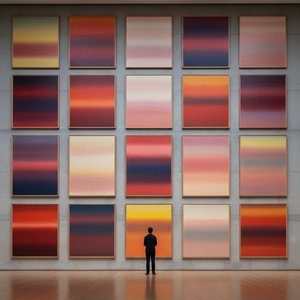
Sean Scully’s ‘Red Light’: A Symphony of Color and Structure
Sean Scully's "Red Light," completed in 1971, is more than just a painting; it’s an immersive experience, a carefully constructed dialogue between the artist’s influences and his own burgeoning vision. Executed during a pivotal moment in his career, this work embodies the ambition of its creator – to create “a compression of a surface,” a space where color and form collide with a deliberate intensity. The painting's genesis lies in a fascination with both the monumental simplicity of Rothko’s ‘Red Studio’ and the raw energy of Pollock, tempered by the rigorous geometry of Mondrian. Scully sought to harness this dynamic tension, resulting in a piece that is simultaneously chaotic and controlled, inviting the viewer into a mesmerizing labyrinth of color and texture.
Technique and Composition: A Grid of Illusion
- Systematic Construction: Scully’s meticulous approach is immediately apparent. The painting's creation involved a painstaking process of layering acrylic paint onto a grid-based canvas, achieved through the strategic use of masking tape – a technique he would later refine. This systematic method, reminiscent of architectural blueprints, lends the work a remarkable stability and precision.
- Layered Planes: Multiple layers of color were applied, building up depth and complexity. Heavy rollers ensured consistent coverage, creating a dense, almost tactile surface. The use of varying shades – from the vibrant canary yellow to the deep umber – generates a powerful sense of luminosity.
- Geometric Harmony: Despite the apparent chaos, the underlying structure is undeniably geometric. The repeating squares and lines create a visual rhythm that guides the eye across the canvas, contributing to the illusion of expansive space.
Symbolism and Influence: Red Threads and Electric Heaters
The title itself, “Red Light,” immediately evokes potent symbolism – referencing both the literal wavelength of light and the enduring legend of the ‘red thread’ connecting lovers across eternity. Scully consciously plays with this duality, using red as a dominant hue to create a sense of warmth and intensity. The horizontal red bands at the top, resembling the filaments of an electric heater, subtly reinforce this idea of energy and illumination. The influence of Matisse's 'Red Studio' is palpable in the exploration of color relationships, while Pollock’s emphasis on freedom and gesture provides a counterpoint to Mondrian’s structured approach.
Historical Context and Artistic Legacy
"Red Light" represents a crucial step in Scully’s artistic development. Created during a period of significant experimentation within the art world, it reflects the broader trends of abstraction and the exploration of color as a primary expressive force. The painting's architectural qualities – its soaring verticality and grid-like structure – foreshadowed Scully’s later move to New York and his embrace of Greenbergian principles. Scully’s early work is considered foundational to his distinctive style, characterized by bold simplicity and an unwavering commitment to the power of color.
Dimensions & Details
- Size: 1830 x 2744 cm
- Date: 1971
Frågor och svar
Hur intensiva är färgerna i "Red Light" av Sean Scully?
Färgerna i "Red Light" av Sean Scully har en Vivid intensitet.
Vilka är måtten på originalet av "Red Light"?
De registrerade måtten för "Red Light" av Sean Scully är 1830 x 2744 cm. Reproduktioner kan beställas i andra storlekar med bibehållna proportioner.
Är "Red Light" av Sean Scully en målning, en teckning eller ett tryck?
"Red Light" är ett verk av typen WallArt.
Om konstnären
A Life Forged in Abstraction: The Journey of Sean Scully
Born in Dublin, Ireland, in 1945, Sean Scully’s artistic path began not amidst the rolling green hills of his homeland, but in the bustling streets of South London, where his family relocated when he was four years old. This early displacement, a common thread for many artists, perhaps instilled within him a lifelong search for grounding and belonging—a quest that would manifest powerfully in his art. From a young age, Scully harbored an unwavering desire to create, beginning evening classes at the Central School of Art in London while still working various jobs to support himself. This dedication led to full-time studies at Croydon College of Art and ultimately, a Bachelor of Arts degree from Newcastle University in 1972. However, it was a pivotal fellowship to Harvard University that same year which truly altered his trajectory, introducing him to the United States and opening his eyes to new techniques like tape and spray paint—tools that would subtly but significantly influence his evolving style.From Minimalism’s Rigor to Emotional Resonance
Scully's artistic development is a compelling narrative of departure and synthesis. Initially drawn to the austere clarity of American Minimalism, he soon found himself yearning for something more—a way to infuse abstract form with emotional depth. His move to New York City in 1975 marked a turning point, not just geographically but artistically. While embracing his adopted home and becoming an American citizen in 1983, Scully began to weave together the threads of Minimalism with the rich traditions of European painting, particularly the work of Henri Matisse and Piet Mondrian. He also found inspiration in the architectural forms of classical Greece. This fusion resulted in the large-scale abstract paintings for which he is now celebrated—works characterized by bold vertical and horizontal bands, tessellating blocks, and geometric shapes rendered in subtly gradated colors. These compositions often evoke a sense of architecture itself – doors, windows, walls – creating spaces that feel both universal and deeply personal. Despite their monumental scale, Scully’s paintings possess an unexpected delicacy, achieved through his masterful layering and manipulation of paint, imbuing the surface with a tactile materiality that invites close contemplation. His apprenticeship as a typesetter also played a role in his early work, providing a foundation for precision and structure. A trip to Morocco in 1969 sparked a fascination with multi-colored stripes woven into wool tents and robes, which later became a recurring motif, adding another layer of cultural resonance to his visual language.Themes of Structure, Emotion, and Societal Shifts
Scully’s art is not merely about formal arrangements of color and shape; it delves into profound themes of structure versus emotion, intimacy versus monumentality. He strives to balance these seemingly opposing forces, creating works that are simultaneously visually striking and deeply personal. The influence of Samuel Beckett's *Waiting for Godot*, encountered during his time at Newcastle University, is palpable in the sense of quiet contemplation and underlying tension present in much of his work. As his career progressed, Scully began to reflect on broader societal changes, incorporating patterns reminiscent of checkerboards into some paintings—a visual metaphor for Ireland’s evolving identity and its transition towards a more complex, “chequered” society as he described it. This willingness to engage with the world beyond the canvas adds another dimension to his artistic practice, transforming abstract forms into vehicles for cultural commentary.Recognition and Enduring Legacy
Sean Scully’s contributions to contemporary art have been widely recognized throughout his career. He was twice nominated for the prestigious Turner Prize, in 1989 and 1993, solidifying his position as a leading figure in the British art scene. His work is now held in numerous major museum collections worldwide, including the Metropolitan Museum of Art, the Museum of Modern Art, the Guggenheim Museum in New York City, the National Gallery of Art, and the Smithsonian American Art Museum in Washington D.C., attesting to his enduring influence. In 2006, he generously donated eight paintings to the Hugh Lane Gallery in Dublin, leading to the creation of a dedicated room showcasing his work—a gesture that underscores his deep connection to his Irish roots. Beyond his painting practice, Scully has also shared his knowledge and expertise as a professor at various institutions, including the Academy of Fine Arts in Munich. His artistic journey represents a significant shift within contemporary art, bridging the gap between abstract and figurative painting and helping to usher in an era of emotional abstraction. By seamlessly blending intellectual rigor with profound emotional depth, Sean Scully has created a unique visual language that continues to inspire artists and captivate audiences around the globe. His legacy lies not just in what he paints, but in how he makes us feel.
Sean Scully
1945 - , Ireland
Snabbfakta
- Full Name: Sean Scully
- Nationality: Irish-American
- Date Of Birth: 1945
- Place Of Birth: Dublin, Ireland
- Notable Artworks:
- Colored Stacked Frames
- Red Light
- Stack Blues
- Artistic Movement Or Style: Emotional abstraction
- Artists Who Influenced This Artist:
- Henri Matisse
- Piet Mondrian
- Artists Or Movements Influenced By This Artist: ['Contemporary painters']
Relaterade artiklar

Geometrisk Abstraktion: Topp 10 Mästverk som Formade Konsten | OriginalUniqueArt.com
Utforska de 10 mästerverk som definierade geometrisk abstraktion! Lär känna Mondrian, Kandinsky & Malevich. Hitta inspiration och museumskvalitativa konsttryck för ditt hem på OriginalUniqueArt.com. Upptäck hela samlingen online!

Kandinskys 25 Mästerverk: En Färgstark Resa i Abstrakt Konst | OriginalUniqueArt
Utforska Wassily Kandinskys 25 mest ikoniska verk – från expressionism till abstrakt konst. Lär känna historien bakom mästerverken och hitta inspiration för din heminredning med OriginalUniqueArt.com. Upptäck hela samlingen online!

Beyond Form & Color: Geometric Abstraction's Evolution in 20th/21st Century Art
Explore the evolution of geometric abstraction from Cubism to contemporary art. Discover key artists like Malevich & Mondrian, investment insights, and expert collecting advice at OriginalUniqueArt.
Mark Rothkos 25 Mästerverk: Djupdykning i Färg och Existens | OriginalUniqueArt
Utforska Mark Rothkos 25 mest ikoniska målningar – en djupdykning i abstrakt expressionism och färgfältets psykologi. Upptäck historien bakom varje mästerverk och hitta inspiration till ditt hem med OriginalUniqueArt.coms exklusiva konsttryck.

Neo-Abstract Art: The High-Impact Evolution of Modern Visual Energy and Geometric Sophistication
Discover the power of Neo-Abstract art. Explore how bold geometric forms and high-impact visual energy are redefining modern design. Learn to curate sophisticated, high-energy spaces with the latest trends in contemporary abstraction and structural color.