

 Visa i rummet
 Skicka
 Dela
Dela
 Detaljer
 Studentguide för konstverk

 Ladda ner
 Liknande objekt
 Röntgen
 Bildspel
 Besökstatistik
Heaps of Ashes V


 Läs mer
Handgjord oljereproduktion
Handmålad olja på duk i din valda storlek och ram, tillverkad efter beställning av våra konstnärer. ( Byt till tryckta exemplar Byt till digital bildförsäljning)




































Välj bland våra förinställda storlekar som motsvarar konstverkets ursprungliga proportioner.

Du kan ange egna mått för att passa en specifik ram eller yta. Om den valda storleken inte matchar originalbildens proportioner kommer vi antingen att beskära konstverket eller utöka målningen med ytterligare handmålade element. En digital skiss skickas till dig för godkännande innan produktionen påbörjas.
Observera att förhandsvisningen på skärmen inte återspeglar den faktiska beskärningen eller utökningen. Endast skissen visar den slutgiltiga kompositionen korrekt.
Även om anpassade storlekar är möjliga, rekommenderar vi att du väljer en dimension från den fördefinierade listan för att bevara originalproportionerna.
Efter beställning kommer OriginalUniqueArt.com team att mejla kunden för instruktioner och tillhandahålla en skissförhandsvisning
Leverans över hela världen () på 3–4 veckor istället för standard 5 veckor. (25 september). Inga kompromisser med kvaliteten.

Fri expressfrakt över hela världen

Högkvalitativ linnecanvas

Fullständig fraktförsäkring

Garantier för återbetalning av tullavgifter

Garantier för exakt färgåtergivning

100 dagars returrätt vid fabrikationsfel

100% pengarna tillbaka-garanti

Mängdrabatt erbjuds
 Glasalternativet är endast tillgängligt i storlekar under 110 cm.

Heaps of Ashes V
Tryckteknik
Reproduktionsstorlek
-


Totalpris
$ 300
Om konstnären
The Architecture of Absence: The Life and Legacy of Reiner Ruthenbeck
Emerging from the transformative artistic landscape of post-war Germany, Reiner Ruthenbeck (1937–2016) carved a singular path through the realms of sculpture and conceptual art. His journey began not with the chisel or the mold, but through the lens of a camera. In his early years, Ruthenbeck acted as a vital witness to the avant-garde, using photography to document the ephemeral performances of the Fluxus movement and the Zero Group. This formative period allowed him to inhabit the very pulse of experimental art, capturing the fleeting energy of movements that sought to redefine the boundaries of creativity. It was this deep immersion in the spirit of performance that would later inform his profound understanding of space, presence, and the weight of what is left unsaid.
The trajectory of Ruthenbeck’s career underwent a seismic shift when he moved to study painting under the legendary Joseph Beuys at the Düsseldorf Kunstakademie. While the mentorship of Beuys provided him with a philosophical foundation rooted in existential inquiry, Ruthenbeck eventually found himself moving away from the canvas. By 1968, he had abandoned painting as a primary medium, turning instead toward a diverse and tactile vocabulary of sculptural materials. He began to explore the physical properties of the world around him, seeking to reveal the hidden tensions within matter itself. His work became a dialogue between the organic and the industrial, where the soft vulnerability of felt or paper could meet the rigid permanence of steel mesh or glass.
Materiality and the Poetics of the Void
Ruthenbeck’s sculptural practice was characterized by an unwavering commitment to simplicity and a mastery of reductive forms. He did not seek to decorate space, but rather to interrogate it. Drawing significant inspiration from Arte Povera and Minimalism, he utilized materials such as rubber, wood, metal, and ash to create works that functioned as meditations on emptiness and silence. His approach was never about grand, sweeping gestures; instead, it was a meticulous consideration of how mass, geometry, and scale influence our perception of the void. Through the juxtaposition of contrasting elements, he could make the invisible felt, turning the "nothingness" of a space into a tangible, heavy presence.
One of his most evocative contributions to the history of contemporary sculpture can be found in his series “Kegel und Haufen” (Cones and Piles). A profound example is his work “Heaps of Ashes V,” which features a sheet metal structure partially submerged within a pile of ash, rising in a honeycomb pattern. This piece serves as a powerful intersection of formal experimentation and historical memory. The very scent of the slag and ash evokes the industrial soul of the Ruhr Area, the German region where Ruthenbeck was born and raised. In this way, his work transcends mere abstraction, anchoring itself in the socio-industrial history of Germany—a landscape defined by coal mining, metallurgy, and the transformative power of industry.
A Lasting Impression on Contemporary Thought
Throughout his decades-long career, Ruthenbeck’s influence resonated far beyond the borders of Germany. His exhibitions in major institutions, such as Haus Konstruktiv Leipzig and Kunsthalle Düsseldorf, solidified his reputation as a master of conceptual depth. He achieved a rare feat in the art world: creating works that are simultaneously intellectually rigorous and emotionally resonant. To stand before a Ruthenbeck sculpture is to enter a state of contemplative stillness, where the viewer is invited to confront the fundamental nature of existence and the beauty found within the ephemeral.
The historical significance of Reiner Ruthenbeck lies in his ability to bridge the gap between the radical performance art of the 1960s and the disciplined minimalism of later decades. His legacy is defined by several key artistic pillars:
- The Documentation of Fluxus: His early photographic work preserved the ephemeral moments of some of the most important avant-garde movements in history.
- Material Dialogue: His unique ability to draw together contrasting natural and industrial materials to highlight their inherent physical properties.
- The Concept of Absence: His profound exploration of the void, using sculpture to give shape to silence and emptiness.
- Regional Connection: The integration of the industrial identity of the Ruhr Area into the conceptual framework of his art.
Ultimately, Ruthenbeck’s oeuvre remains a testament to the power of reduction. By stripping away the unnecessary, he allowed the essence of material and space to speak, leaving behind a body of work that continues to haunt and inspire the contemporary art landscape.

reiner ruthenbeck
1937 - 2016 , Germany
Snabbfakta
- Artistic Movement Or Style: Minimalist sculpture
- Artists Or Movements Influenced By This Artist: ['Arte Povera']
- Artists Who Influenced This Artist: ['Joseph Beuys']
- Date Of Birth: 1937
- Full Name: Reiner Ruthenbeck
- Nationality: German
- Notable Artworks: ['Heaps of Ashes V']
- Place Of Birth: Velbert, Germany
Relaterade artiklar
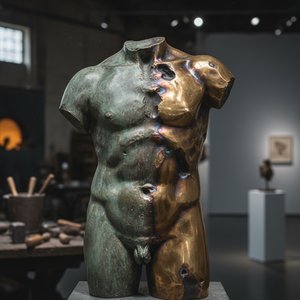
Bronsens bestående arv: Historia, tekniker och samtida tolkningar
Utforska bronskonstens fascinerande historia och teknik. Lär dig om gjutning, patinering, samlande och samtida tolkningar. Expertguide för konstälskare och investerare.

Bronsålderns Mästerverk: 10 Skulpturer Som Förändrade Konsthistorien | OriginalUniqueArt
Upptäck 10 legendariska brons skulpturer som revolutionerade konsthistorien! Lär känna Rodin, Michelangelo och andra mästare. Köp museumkvalitativa repliker & hitta inspiration för din inredning på OriginalUniqueArt.com.

The Enduring Form: Exploring Themes & Techniques in Sculpture Across Historical Periods
Explore the rich history of sculpture from ancient masterpieces to contemporary innovations. Discover key techniques, influential artists & investment potential for discerning art collectors.

10 Bronsskulpturer Som Förändrade Konsthistorien – Upptäck Mästerverken
Utforska 10 legendariska bronsmästerverk som revolutionerade konsten! Lär känna Michelangelo, Rodin och andra ikoniska skulptörer. Hitta inspiration & museumskvalitativa konsttryck på OriginalUniqueArt.com – för en tidlös inredning.

The Enduring Form: Sculpture Across History, Technique & Emotional Resonance
Explore the rich history of sculpture with OriginalUniqueArt. Discover key techniques, influential artists & investment potential for discerning collectors. Expert insights into valuing and collecting timeless masterpieces.